by an anonymous member of the Church of England
Rural ministry in the Church of England is a world apart from the busy city churches of provincial towns and the lively modern leaning evangelical congregations found in conurbations. If you’ve never worshipped in a small rural parish, imagine belonging to a small residents’ association where everyone is terribly polite whilst expressing very strong opinions, everything smells slightly damp and dusty, and the person in charge has indefinite job security, absolute authority, and may lack any of the practical or spiritual skills normally associated with being a vicar.
Picture one typical rural benefice. The priest-in-charge arrived three years ago from a nearby parish, where, it now transpires, her ministry had evolved spectacularly badly. The lay interview panel were not made aware of her past failures. Had they been, they would have been alert to the danger, I am sure, of appointing her to a benefice so similar to the one in which she had failed so publicly. That posting ended with both the incumbent and the parishioners begging the bishop for her to be moved elsewhere, which was done under cover of COVID. The more cynical felt she might have been drawn to parish ministry because of the provision of a house and an ‘easier’ life.
Parishioners in this benefice thought they had chosen a new vicar to engage with parishioners, cherish their elderly, and shepherd their community with gentle wisdom, much as the previous incumbent had done most successfully. Unfortunately, what they got (promoted by the area bishop behind the scenes), was an entirely unsuitable incumbent. She is devoid of social skills or empathy and is painfully shy. This manifests itself as unfriendliness and a passive aggressive approach to interaction with lay people, alongside a particular hatred for some individuals, whom she perceives as a threat. She seems lazy and unwilling to carry out her duties, whether administrative, pastoral or spiritual. She finds it hard to project herself in the services so that worship is generally irredeemably dreary.
Realising the problems, five out of seven churches’ wardens asked their Archdeacon to intercede and to devise ways in which they could help the incumbent. The wardens described to the Archdeacon the incumbent’s various failings: the poor quality of the services, the fact that the previous vicar had managed to take a huge number of services and she managed less than half that number, her continuous grumbling about the number of funerals which occur (not unsurprisingly in a rural community popular with retirees), her lack of interest in meeting her parishioners and her complete failure to provide any pastoral care. When challenged on this point she complained ‘what about pastoral care for me?!’
The Archdeacon confessed that he did recognise the resurgence of difficulties as in her previous post. He spent the remainder of the meeting explaining that he did not actually employ the priest and he was not, therefore, her line manager. He therefore could not help, beyond talking to her. The Archdeacon conceded that the priest was probably out of her depth but reassured the wardens that she was unlikely to last more than a year or two and would retire. This, he seemed to think, was a solution.
Soon the incumbent became aware of the increasing noise of criticism and her behaviour became aggressive and vindictive, directed against various lay members of the churches, whom she cast as ‘troublemakers’. She cancelled all further benefice meetings for churchwardens, a ‘divide and conquer’ policy, thus depriving them and their congregations of a voice.
The cold war then instigated by the priest in charge with one of the smaller parishes in the benefice is remarkable. Members of the lay community thus sought help from the area bishop.
The priest removed any responsibility for funerals, weddings and baptisms from that parish’s churchwardens. She asked in writing that one particular warden communicate with her only through a third party, a retired clergyman. Services taken by the priest in this parish are miserable and her attitude to the congregation is unfriendly and cold. There is no ‘hello’ or ‘goodbye’ to the wardens, or ‘thank you’, no friendly engagement with the congregation and the services are lacklustre. She brings with her to every service a ‘chaperone’, who is robed and skulks around the altar with no discernible purpose, except presumably, to protect the incumbent against attack! Frankly, the congregation dreads these encounters, and it has shrunken from ten to six people. A congregation of this size cannot afford to lose anyone.
The service rota for these Christmas weeks sadly included no services for this particular victimised parish – nothing between mid-November and mid-January. Villagers are left disappointed and bewildered that their church will be ‘dark’ over Christmas.
The incumbent also requires a chaperone (a retired clergyman) to attend PCC meetings, which, the latter noted, were most friendly, cheerful and constructive events!
There has been some good news. This benefice is much blessed with a supply of popular retired clergy who are willing and able to join the life of the seven parishes and lend a hand with services. But unfortunately, the present incumbent feels threatened by these thoroughly professional and experienced clergy, perhaps thinking that they will expose her shortcomings. The retired clergy have no such intentions and simply want to help spiritually and practically in villages which are now their forever homes. To this end the incumbent has banned them from taking services in the troublesome parish and has removed them from the service rota. They have been warned not to attend any church-related events in that village or even social occasions unrelated to the church. Those retired clergy feel they must comply, through a mistaken belief (I think) that the priest could remove Permission to Officiate, were they to break these rules. Surely not?
These are small acts of administrative vengeance wielded with a bureaucratic sledgehammer to destructive effect. Combine this with a diocesan hierarchy reluctant to confront conflict or take responsibility, and the result is inevitable: a priest who behaves like a minor autocrat, and parishes left waving for help. One might think this would concern the diocesan authorities.
Rural life, with its particular rhythms, expectations, and social glue, is often misunderstood by diocesan officials and possibly they are not interested and simply regard rural parishes as sources of money, for which they ask continually. These seven parishes struggle to pay their parish shares because of dwindling numbers.
Rural ministry throughout England is in dire straits. A dwindling number of clergy (and a dwindling number of congregants) means that parishes are bolted together into larger and larger, and more unwieldy, benefices. The benefice described here has seven parishes but twelve and fourteen are not unknown. The job of incumbent is thus almost impossible. But some priests do a grand job, nonetheless. They get congregations onside so that they will share the burdens and support their priest in practical ways. Such priests get to know every family and build social contacts that go both ways and provide help and support for all parties when needed. Congregants are often elderly and successful clergy understand that funerals are pastoral events, not inconvenient blockages in the clerical diary. Support of bereaved families is also essential and ongoing, but if a priest builds connections in each village this will happen naturally with the help and support of residents.
To make matters worse, bishops and archdeacons seem overstretched, spiritually lacking, and keen to avoid dealing with parish disputes. So poor leadership goes unchallenged, on the wobbly premise that church law states that diocese do not ‘employ’ their parish priests and so nothing can be done.
Unfortunately, this priest in charge has decided, having alienated all those who might help her, to isolate herself within a tight group of four friends, who will ‘defend her’ against all criticism and opposition. Sadly, two of these are themselves churchwardens and are thus not representing the views of the two congregations which they lead.
The parishes endure because they know the church is bigger than one priest.
They endure because Christmas comes whether clergy approve or not.
They endure because there will always be someone willing to stand up, light a candle, and declare that the story of Christ’s birth is not affected by diocesan ham-fistedness and incompetence.
And most of all, they endure because humour is the final defence of the Anglican soul. When faced with ecclesiastical incompetence, they do not riot. They do not revolt.
They make tea. They swap stories. They pray that one day they will find a priest they trust. And so these little parishes soldier on, powered mostly by cake, stubbornness and resilience.
In a strange way, this incumbent has achieved something extraordinary. By neglecting her work and her parishes, by waging bureaucratic and administrative war on her wardens, by exercising authority with a supreme lack of grace, she has inadvertently reminded us that the church is not run from the bishop’s palace, the deanery, and nor from the vicarage.
It is run—quietly, stubbornly, lovingly—from the pews. And the parish(es) will always outlast the priest.
It is difficult to see what, if anything, of the problems in rural ministry, the difficulties of multi-parish benefices and the vetting of ordinands will be effectively dealt with. Some more practical, real solutions would be useful with a manual on how to apply them. Rural churches are in dire straits. The Church of England needs to grasp the nettle.
anonymous,
A beautifully written piece. Profound and moving yet with an investigative tough edge. Thanks for making my day a little warmer with the “ run quietly stubbornly lovingly “ from the pews.
Quiet rural churches with attendances of 1 to 10 can have an impact! I returned to the Church age 35 after a 20 year break. Small rural churches in the Highlands and Islands played a large role. There was a lot of kindness, warmth and humanity, plus people able to articulate the evidence for belief with precision. Almost every denomination in the region was involved. There is often a self-regulating in rural communities, a bit like the subtle complexities of the human immune system. The excellent article above possibly misses something. The-‘handshake, nod and wink’-charmer can powerfully patrol the place and deceive lots of people in large charismatic-evangelical disco churches. Tithe and toe the line, or else get branded as a troublemaker, can be the order of the day in corporate churches. Would Mike Pilavachi have survived for so long as a leader in the Highlands and Islands? The smaller rural fellowships rest on the basics of bread, wine and water. There is a focus on the sacraments which is healthy.
Scottish Episcopal Church featured in Radio 4 ‘File-on-4 this week’: ‘An unholy row over bishop accused of bullying’. It might be positive to have a Scottish Episcopal Church writer do an SC feature. It’s hard to imagine anywhere more rural than Orkney which features in the excellent broadcast.
This account may well be 100% fair and accurate. I don’t know because I don’t know the Benefice or the people involved. What I do know, from many years of going into contexts as a consultant, troubleshooting and working with people trying to make sense of problematic situations, is it is extremely rare for any such situation to be entirely one sided in its causal factors. So please forgive me if I recognise many of the issues the writer presents, but read the account as a whole with a healthy hermeneutic of suspicion, desiring greater nuance in the analysis.
‘…on the testimony of two or three witnesses a matter shall be confirmed…’
The bible encourages common sense, and if multiple people are up in arms there probably is a problem with an incumbent. Failure to apply everyday standards of natural justice, such as the secular world generally embraces, has done dreadful damage to the Anglican Church.
With some dioceses might it take up to X200-300 witnesses before effective action eventually gets taken????????
And what if, as in the case above, two or three (or more) witnesses can be found to give evidence in favour of the incumbent? There are toxic parishes where people gang up to bully the incumbent. We have no idea what the actual issues are in the benefice described.
I agree with Frequent Flyer that the fault is rarely all on one side.
What if bullying, abuse or harassment charges can be clearly proven by a trail of evidence from multiple credible witnesses? ‘Knock for knock’ suits insurance companies when it comes to lower level car crash claims with only lower grade vehicle scratches. But can ‘knock for knock’ in a parish context be used by a diocese to cover up serious professional misconduct? I see what looks to me like bogus or sham witnesses emerging, when some senior clergy need protected. Note how sham witnesses will sing-“He/She’s a jolly good chap”-but frequently evade highly specific allegations of bullying-abuse-harassment cover up.
The large team benefice in which I am a lay minster has 4 rural parishes, although some might say that they are really quasi-suburbia! They bring a different focus, not so much old-fashioned rural but rather bounded identifiable communities, rather than our huge spawling parish with its growing housing estates leading to a benefice approaching over 45000. They teach us the value of belonging as long as they eschew narrow parochialism.
Next time I visit a rural church while on a walk in the area around the town where I worship, I shall sit and pray for the congregation and the incumbent, that if necessary, they will meet together in a spirit of reconciliation and forgiveness. In the interim, would it be constructive to meet as “2 or 3” and see what Jesus says about judging each other’s behaviour and character and focus on the fact that He died for our sins? He wasn’t hung up on having a Priest around, or an Archdeacon or a Bishop for that matter. I’m done with the Church hierarchy, having experienced similar passive aggressive bullying last year but nothing can separate me from the Gospel.
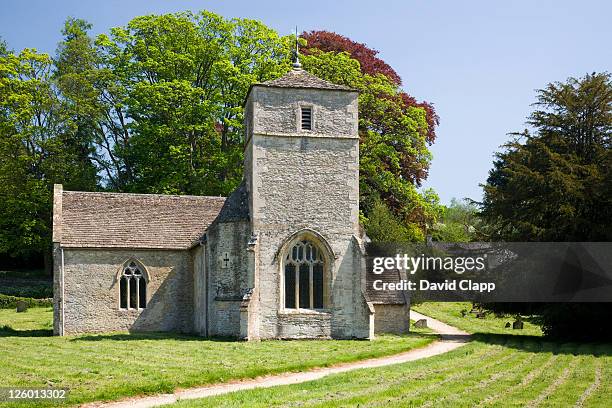
In case anyone is wondering, the church in the photograph is that of SS Michael & Martin, Eastleach Martin, in easternmost Gloucestershire. It is about 10 or so minutes’ drive from Stephen Parsons’ former benefice at Lechlade.
There is another church in the same village, St Andrew, Eastleach Turville. In view of the content of this article it is perhaps apt that Eastleach Martin is a redundant church, albeit one still consecrated and vested in the Churches Conservation Trust. There are, or at least were prior to the pandemic, one or two services at Eastleach Martin each year, plus the occasional wedding.
John Betjeman once did one of his Shell documentaries in Eastleach: https://www.youtube.com/watch?v=3E-XaDB5kLc&t=2s
Though, of course, Eastleach now falls within the same benefice as Lechlade.
Thanks for the link! Lovely piece of black and white film with an interesting commentary.
Dear anonymous, my heart goes out to you and my prayers for you all will continue. I could have written your piece, substituting 4 parishes for your 7. Amongst the heartbreak and sheer wonderment at the behaviour of the church hierarchy, and distress and distrust of our procedures for choosing candidates for ordination, it has been a very ‘interesting’ time watching the grooming of a few people by the incumbent, including 2 churchwardens. It continually surprises me how the result of grooming seems to remove people’s awareness and understanding of what else is happening right under their noses in a benefice/parish. “Jesus wept” is the verse I go back to most often. Lord please keep our eyes open and give us understanding and love as well as your vision and your healing.
Reading-‘Orthodoxy’-by G K Chesteron once again. Chapter 7-‘The Eternal Revolution’-refers to the association between the Church and democracy. Clericalism wrecks Anglicanism, and a disempowered laity tend to leave, or to expend time-money on projects beyond the organised Church. Rural parishes are often able to sit out the departure of a duff incumbent. Parishioners often share their disgust with each other, and count down the time for a worse than useless priest to leave.