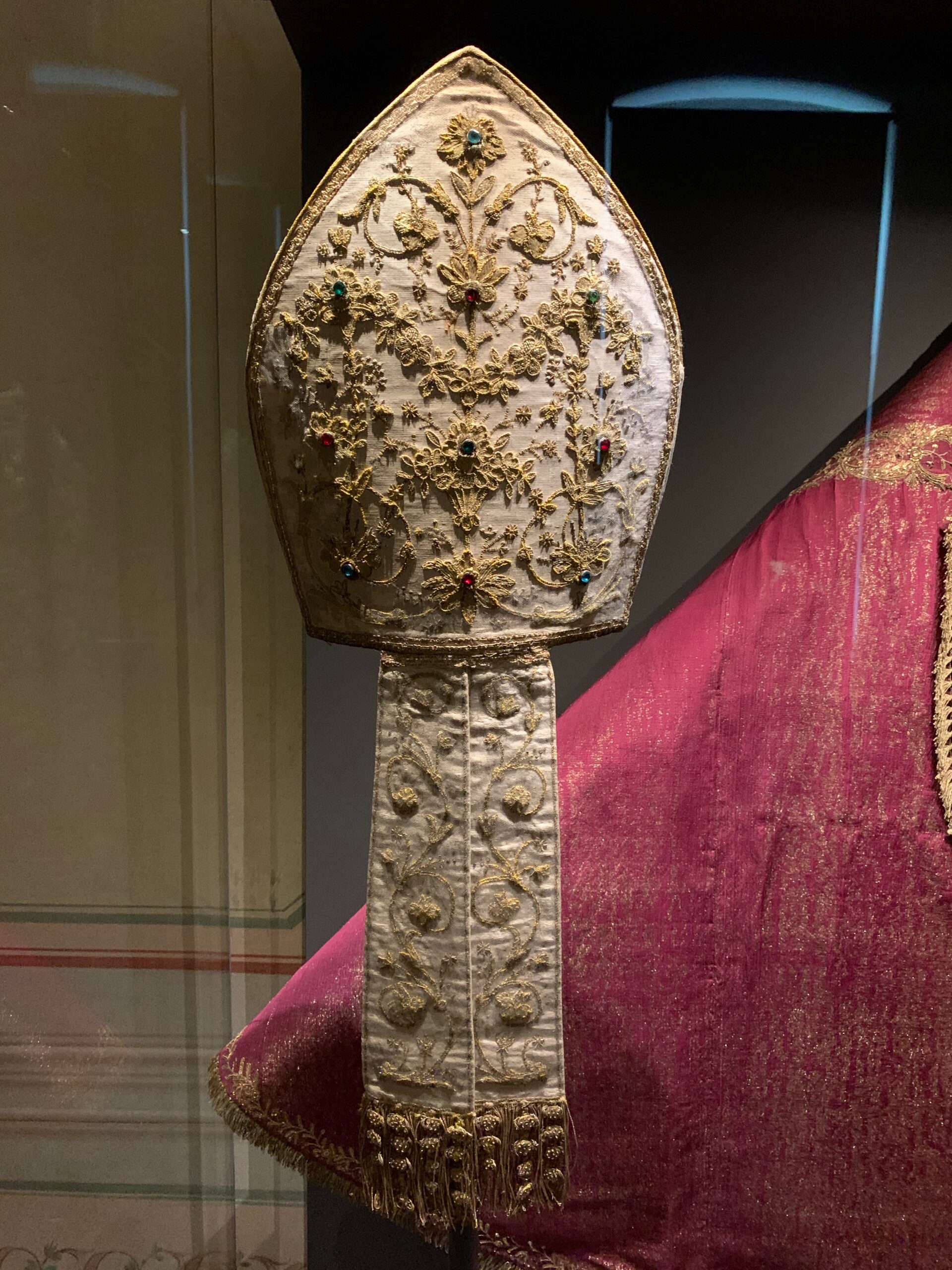
by Anon
Dear Brothers and Sisters,
This is the tenth time I’ve written to you at the start of a new year as your bishop. As you know, I don’t usually send Christmas cards (I’m far too busy at that time of year), as most clergy are. And I don’t read the cards I get sent either, so this is just a gentle reminder to you all not to bother sending me a note enclosing a schedule of all your various Christmas services and other activities. I don’t read them. I already know you are all quite preoccupied at this time of year. That is why I leave you completely alone during Advent and Christmas.
But now that we have entered 2026, I cannot help but reflect on the fact that, every year I’ve written to you, one thing remains constant: change! Yes, change. The sheer pace of it takes us by surprise all the time, and with it come challenges, the highs and lows of ministry, and just trying to keep up. Change is here to stay, as they say. How true that is.
Take AI. A year ago, I had little idea of how it would revolutionise our Diocese. But it has. The executive planners at Diocesan HQ set a target last year of writing at least four email messages a day to all of you – the clergy, lay workers, special ministers without portfolio, church wardens and others. These were timed for breakfast, lunch, teatime, and after dinner, and all with helpful advice, reminders, prompts, prods, resource updates, Instagram news, Tweets, forms to fill in, questionnaires, surveys and other forms of social media engagement.
Some of you were unresponsive to our messages. And after four months, we did a little bit of research, and it seemed that some of you had issues with your spam or junk folders. But I am glad that the Archdeacons put you right on that. It is important that we keep in touch with you all the time (except when we choose not to), keep tabs on you (the devil makes work for idle hands!), and maintain constant digital communication with you.
Our goal this year is to reach you every hour of each and every day with a new message or communication from the diocese, sharing our vision, goals, needs, updates, demands and successes. What is really remarkable about all this is that AI is helping us generate these communications. We have seen a positive response to the AI Chatbots assisting the Bishops’ Chaplains and Archdeacons, and this is an excellent example of how technology and ordinary ministry come together as one.
Yes, we have had some teething troubles. Not all of your pastoral problems were well-handled by the recently commissioned and licensed AI Pastoral Chatbots, but please be patient, as this technology has to learn on the job and must evolve.
It is therefore very important that you don’t abuse, tease or bait the Pastoral AI Chatbots we’ve installed. You might inadvertently train the Chatbots to give completely insensitive and incorrect advice in response to innocent and genuine pastoral queries.
For example, we’ve already had instances of incorrect automated advice being given on same-sex weddings that were non-compliant with the advice the House of Bishops may or may not have communicated last week/month. (Although I know we are all finding it hard to keep up with what the latest line to tow actually is). As a result of mistreating the AI Pastoral Chatbots, two unfortunate episodes involving the unexplained deaths and unplanned funerals for members of the Senior Leadership Team left many of you confused, as nobody had actually died. The Liturgy AI Chatbot had to be reprogrammed after a Wicca Ceremony involving a Dame Mary Berry recipe for seasonal muffins went viral.
The AI-generated clip of me ignoring the clergy and going on holiday all the time (these are pilgrimages, incidentally) was False News, as was the deep-fake clip of me angrily banging my crozier on my desk and demanding a 30% rise in giving from parishes to re-equip Diocesan HQ with handsome new office furniture and a bespoke barista café. (NB: I wouldn’t complain if this were true, and if you ever had time to visit our Diocesan HQ, neither would you!).
The AI-generated bar graphs and charts, claiming to be from the Diocesan Finance Office, and that y/our clergy numbers were also going to be cut by 20%, weren’t very helpful either. These were drafts. We have not finalised those numbers yet, and this is an example of AI forming an alliance with a damaging and demoralising culture of leaks, run by Gloomsters and Doomsters plotting against the leadership in the shadows. That might be normal for political parties, but it has no place here in our Diocese. So, AI can sometimes be unhelpful to our mission when abused.
But as you know, we are using AI to help parishes understand that the church is growing, not shrinking. That is not Fake News. That explains we can look at shaving even more of our clergy numbers this year, because there will be more people in church who could or really should be busy with ministering.
Some of you have written in quite personally to ask if your role in ministry is safe in these challenging times. Nothing pains me more than having to write to you all at 4am in the morning to alert you to the hard road and difficult decisions that lie ahead, and how much it costs me, personally, to be the one making those calls. I know it is hard for you to wake up to that kind of news. But just imagine how demanding it is to be writing to you all in the small hours, knowing that nobody will be able to respond with an immediate note of acknowledgement and support.
As you know, one of the costs of ministry is risk, and it pains me more than anyone else when we had to let (valuable?) frontline clergy go last year so we could shore up the hard-pressed administrators and executives at our Diocesan HQ. I am pleased to say that their visionary plans for expansion and growth continue apace, and thanks are really due to you all for the sacrifices you make at the parish level so that the Diocesan infrastructure can continue to expand.
People these days say there are no good news stories about growth. But that is so untrue. Our Diocesan HQ is living proof that if you talk enough about growth and invest in it, the growth will happen. We have doubled the number of executives and Associate Archdeacons over the last three years, and (praise the Lord!), with your support, those numbers are set to rise again this year.
I know that some of you see this next year as another descent into our Diocesan ‘polycrisis’. But I like to call this ‘polyopportunity’, or ‘polyops’ for short. As we explore new ways of funding traditional ministry by cutting away at the tired, existing forms of support that were holding everyone back, we can now see that less does indeed mean more. That is one of the rich ironies of ministry today.
As we reduce Diocesan support – but not our communications or control – clergy face new challenges in raising awareness over the pressing need to fund their local ministries. This has got to be good news for the church. A strong Diocesan HQ, coupled to clergy learning to “live off the land” and not relying on handouts and support from the Diocese. That can only make the clergy stronger – and leaner (not bad for a New Years’ resolution, eh?).
Our clergy conference happens later this year. It will be fun to be together again. Please remember that you are expected to invest your own time in this (i.e., holiday allowance); you must be self-funded (i.e., show your commitment); and attendance is mandatory. But do remember this is fun!
The inter-deanery cage fighting competition was a big hit last time, and some of you were able to channel your frustrations, exasperation and passion for ministry in ways that released a lot of pent-up energy. I know that some of you witnessing this event felt you were put in a position of discomfort, and three of you had to go to A&E and now wear neck braces. But there is no substitute for harnessing the raw power and even aggressive energy we need for everyday ministry.
As in previous years, it will simply be impossible to meet with many of you in person for almost any reason. Fewer confirmations and spending a lot of time with all my senior staff working on strategy and comms means there is not much opportunity to get on the road these days and spend time in the parishes with the frontline clergy. There are only so many hours in the day to work with, and I have to prioritise my diary.
Added to which, Diocesan HQ is very time-consuming, and one of the reasons we send you so many emails and other digital media communications is to remind you that we do think about the clergy, even though we rarely get to meet you. Should we happen to meet, please make sure you are wearing your diocesan lanyard with your name and parish clearly displayed.
In the meantime, if you have any issues you think need attention, or pastoral emergencies, please follow the guidelines link on the diocesan website, and remember to speak clearly in response to the Chatbot questions and dialogue buttons so your query can be appropriately directed (and hopefully resolved). I am pleased to report that, following a grant from the Church Commissioners, we are also hiring a new team of social media influencers to smooth the implementation of these welcome changes.
We are living through unprecedented times that require unprecedented levels of time, energy, commitment and sacrifice from you. Being a Bishop is something I remain fully committed to. And I can honestly say that I am as pleased and proud to be your Bishop as you are to be my clergy. This comes with my prayers and good wishes to you all for this new year, as we step into the future, where we’ll all encounter lots of new ‘polyops’. Just remember, change is here to stay!
Your Bishop, ChatGPT
AI Side Bar: Good stress on change. Would you like me to create a slide deck from the middle paragraphs for PCC presentations, and some bar graphs and diagrams for the upcoming Diocesan Synod? What about a dashboard?
Spellcheck – completed.
Grammarly: Do you want me to improve this? Here are some ideas for your letter. Add impact? Make it persuasive? Make it more assertive? Make it more ‘on brand’? Shorten it? Simplify it? Report any offensive feedback? What do you want me to do?
Brilliant!
The AI spellcheck appears to be fallible – unlike our real-life bishops, of course. It has put ‘the latest line to tow’ instead of ‘latest line to toe’. On your marks, people, ready, set, go! Onwards into a wonderful future!
Priceless!
In York Diocese, rural united benefices (clusters of village churches) are being told they have to raise £55k to have a priest for 3 years. When the 3 years is up, they will have to raise the same amount or more to have a priest for another 3 years. This is true of both parishes in vacancy and parishes with a priest in situ; and in a deanery with only 5 or 6 benefices geographically widespread, 3 or 4 may be under threat of having no priest.
There is so much wrong with this. What happens to ministry and mission if a deanery winds up with only two clergy to cover a vast area? How can a parish make long-term plans when the future is so uncertain? How do clergy and their families cope with the uncertainty? How to attract applicants to posts for a 3 year contract, with much of it spent trying to raise a vast sum of money for when the 3 years is up?
Where there are Readers, their ministry is valuable and covers some gaps, but they can’t preside at Holy Communion. Nor are they meant to be gap-fillers, or to serve full-time. They may have full-time jobs of their own. Attractive areas may have retired clergy to help out, but less appealing areas won’t. And elderly retired priests are finding themselves overburdened.
How can the Church of England call itself the national church if it abandons whole swathes of the country, maintaining its ministry only in populous and prosperous places? Is this happening in other dioceses?
‘Diocesan share’ level is a chronic bone of contention. Denied a vote by a show of hands, church members vote with their feet. Also, the brutal BAH (bullying-harassment-abuse) of ministry trainees drives away people who would have happily led services, or overseen HC or weddings-funerals-baptisms with minimal further training needed. Ideas have consequences, and the closure of churches comes from serial failures to address BAH and unreasonable financial demands being placed on tiny congregations. Driving away committed and convinced mature adults, already well experienced and educated, reflects the lunacy of our bishops. I saw a trainee group decimated by BAH, and will never forget the horror movie type satanic wickedness on display from the local diocese. And when anyone reports this, then they are accused of being a “troublemaker” by bishops.
Typically most advisors would be looking to trim central costs which, as alluded to here satirically, tend to inflate year on year out of proportion to income. This would be in addition to fund raising requirements as mentioned above by Janet, in local peripheral parishes.
Of course we all know that the central authority in CofE terms has substantial wealth. Indeed it seems able to disburse significant funds to causes it deems necessary. For example I read of some £2.3m being channelled through the Soul Survivor church youth system. This must grate heavily on impoverished rural and urban elderly parishes. Apart from the clumsiness of investing and rewarding a safeguarding nightmare, there are many questions over the wisdom of this hiving off supposedly successful “church” based on cohorts of young people with hopefully wealthy middle class parents to perpetuate the income stream. Does this really work even financially?
Odd how there are all sorts of centrally developed campaigns to attract various minority or oppressed groups. Yet the average ‘Harry’ or ‘Sally’ in the pews can get kicked around with very little chance of it ever igniting any significant independent inquiry. The shameless inability to admit to a lot of BAH (bullying-abuse-harassment) is dreadful. There’s a famous 90 second film clip of Bertrand Russell getting asked about the primary defect of communism-‘Bertrand Russell – Why communism failed, 1952’-and he describes confident ‘dogmatism’ getting combined with ‘unkindness’. That looks like a recipe some of our bishops have taken and refined. The vicars I so fondly remember, from the 1970’s or 1980’s, often were highly educated, very humble, promoted tolerance and were deeply reflective. The New Wine and Soul Survivor stuff holds very little appeal in comparison. A contempt for human dignity, and for knowledge or education, makes me think of unhealthy and dangerous cultism.
My concern over the Redress scheme, which has now passed all parliamentary stages, requiring that the parish church where the abuse happened contribute a quarter of the damages awarded to the victim/survivor have been completely ignored both by the church and the legal body appointed to administering the scheme.
I have to be honest and say that as a survivor my main concern is one of being further bullied by the parish church if I were to make a claim even though I am assured I will remain anonymous, some churches may be dire but usually if abuse has occurred it is only one or two cases, so identifying the claimant is easy. However from the other side a parish having to find money for such claims will clearly tip some over the edge and refusing to just leaves an awkward, unresolved situation for everyone.
Once a claim has been made no further claims can be made for damages from the Redress process. Though articles like this one are funny because I suspect them being very close to the truth they make me feel uncomfortable at what is to come.
Thanks for your contribution Patricia. That is very interesting, but it also seems a weird idea. I always thought the yearly diocesan contribution from parishes meant the central Anglican Church authorities would foot the bill for abuse damages.
I dabbled with Church during childhood then left it for 20 years. On returning to church, in my middle thirties, I noted how lots of older Anglicans loathed the yearly parish contribution to their local diocese. I start to see why!
The absence of transparency on this really is astounding. Odd how parish accounts now get professionally filled out by accountants, yet what exactly is being purchased from the diocese can be difficult to discern.
The elephant in the room for Anglicans is that anyone can set up a church anywhere, call it anything they like (within reason) and do so with no qualifications whatsoever, or plenty. For small poor parishes thinking of leaving the C of E (were this possible), this idea wouldn’t necessarily have much traction because they are net beneficiaries from central funds, but much larger churches can and have financed other new congregations outside the C of E. This would generally be included under “missionary giving” in the accounts. It’s carefully described in notes specifically not as “church planting”. These new “seeded” congregations are not part of the c of E and thus pay nothing to the diocese. They also plant congregations under the auspices of the C of E. Obviously those outside churches seeded therefore receive no stipend support for clergy, but typically they might only get 2 paid by the diocese anyway, and have to fund often several or even many themselves. These new churches are conveniently outside diocesan control and allow power and influence (and money) to grow autonomously away from the bishops. Both charismatic and conservative evangelical dynasties have done this to my certain knowledge.
Their influence is one reason bishops often are keen to do their bidding. Money is at stake, and can by these manoeuvres be diverted at will.
From the recruitment point of view, even recently I noted young people with no experience at all of the Church of England, applying for ordination there. In theory the promise of a stipend (such as it is) theoretically paid tax free accommodation (which even though often modest) grossed up can double your notional “income” and then one of the most generous pension schemes in the country. Other denominations can match this in theory, but rarely do. Selection panels are pretty wise to this, and candidates are also seeing now the contraction of former provision.
I think for older clergy who started off life as ordained Anglicans in good faith serving diligently for decades, there remains an obligation for the Church establishment to continually support them, but with people living longer and the decline in income, the reserves will be consumed more rapidly. This cohort seems to have little say in how current plans are made. It’s a sad day.
The centralised structure of the Church seems unsustainable to me. My assumption is that rather than change anything for the better for those who made a career of service, they’ll simply keep utilising senior non-stipendiaries until they wear out.
The ‘parish share’ crops up in trendy short YouTube promotional films for various dioceses. My impression is how 90% (or more) of ‘diocesan share’ might relate to pay, expenses, housing and pensions for clergy. That is possibly similar to teaching or the NHS, and a lot of other people intensive trades, although free housing is absent in most other jobs. The radical charismatic-evangelical scene can generate a lot of noise. But did Our Lord fix quieter rites involving water-bread-wine? A lack of transparency on finances is not an incentive to give money to the Anglican Church. I get wary of all these breakaway churches and hubs. Reduced available funds are a reality which needs to be faced. It’s sad, especially against this context, how so many ministry trainees have felt brutally bullied out of Anglicanism.
The ChatGPT ‘bishop and chums’ governors alluded to in the post above gets us into the realm of ‘no taxation without representation’.
Looking up diocesan share, and how money raised flows to and from parish to diocese (or diocese to parish), is an interesting exercise. If 90% or more appears to go on clerical wages and benefits, then how much is actually spent on prevention of bullying, harassment, abuse?
And is this largely covering only the statutory ‘VA and children’? Presumably the 10% retained by the diocese is possibly largely eaten up by bishop and bishop’s team expenses, or team wages and pensions (not to mention woke initiatives).
So following on from the point raised above by Patricia, does an Anglican diocese have a fund (or insurance) to cover BAH (bullying-abuse-harassment) liabilities which will inevitably arise or are already arising?
Looking at a lot of parish accounts, accessible via a charity commission and parish name search, one might share Patricia’s potential alarm about seeking partial compensation from a parish. Are there funds there, and is there unreasonable self-exposure needed to pursue them?
Certainly, for perpetrators of abuse who are (or were) clergy, one might expect the diocese to cover costs. But even for unpaid volunteers or church members, who have abused in a parish context, why should a diocese not pay up?
Calm reflection on some of these issues pays a dividend. But the Anglican Church emerges in an ever worse light. I have referred to the Canon W G Neely case in Belfast. Neely now rests in a marked grave, near the entrance of a cathedral seat, the cathedral of the Irish national Anglican Primate. His grave ends PRIEST SHEPHERD FRIEND.
But even in the 1970’s, the Scouting Association gave Neely a lifetime ban, yet the Anglican Church in Ireland shifted him to fresh pastures. I start to have less and less confidence in Anglican Bishops. They are able to harvest parish share for clerical wages. So why is there a collective culture of not addressing abuse and compensating victims?
The Neely case was cynically kept from wider public view for close to half a century, until one deceased victim, in their final weeks of life, secured a settlement. But even here, an NDA prevented the Church from formally naming Rev Canon Dr William George Neely. Should Anglican Church members be pressing for avoidance of NDA’s, or releasing victims from the terms of NDA’s in a great many cases?
Also, should our dioceses, even where NDA’s exist, be declaring spending on legal costs, compensation costs and victim numbers? The NHS woke up to a need for immediate change with the Dr Harold Shipman debacle. Are senior leaders in the modern Anglican Church in collective denial about a broader need for immediate and radical change?