Category Archives: Stephen’s Blog

Patterns of cruelty – Witnesses of God*

(* I am of course talking about JWs but don’t want this article to pop up on searches by the supporters of said group. Just as I don’t enjoy having my door knocked on, neither would I enjoy an online attack.)

My blog posts have, up till this point, been confined to examining the behaviour of Christian bodies. I don’t intend to deviate from this, but I feel it appropriate to bring to attention published material that sets out how Witnesses deal with uncooperative and dissident members of their group. I make no claim to have ever involved myself with the Witnesses so what I write is based solely on what they have written themselves. This material opens us up to a world-view and a mentality which may or may not help us to understand the mindset of other extremist cultic groups. I shall leave that for others to judge. What is true is that ‘religion’, as exemplified by the Witnesses leadership, can think and act in what seems to be a completely cruel and heartless manner towards some of their own membership.

Apart the practice of refusing blood transfusions, the practice of ‘disfellowshipping’ is the one that most disturbs the general public when encountering Witnesses. Two quotations of chilling brutality sets out the context of ostracism, as practised by the group. ‘The one who deliberately does not abide by the congregation’s decision, puts himself in line to be disfellowshipped’. One can only speculate what the words ‘abide by the congregation’s decision’ actually means. One imagines that it basically believing without question what one is told. A second quote: ‘any attachments to the disfellowshipped person, whether these be ties of personal friendship, blood relation or otherwise, must take second place to the theocratic disciplinary action that has been taken.’

I pause to consider what might be the meaning of the innocent sounding word ‘theocratic’. It literally means the rule of God, as opposed to other systems like democracy or even non-democratic systems like Marxism or Fascism. To the untutored ear it sounds like a good idea, in that brings divine values into society, rather than relying on the untidy methods of democratic debate for political decisions to emerge. In practice, there are always specially chosen groups of men, who have a ‘hot’ line to God and know exactly what his will is. History, even that of our own time, tells us exactly what theocracy actually looks like. Whether it is expressed in a Christian or Islamic form, it normally involves a fierce autocracy that suppresses any idea of cultural or social advance. It is conservative in its passionate embrace of the idea that nothing of any value can be discerned outside the group, or the society, it is trying to create. Education is about mastering the tools of literacy and numeracy but little more. Theocracy comes down hard on creative ideas or innovation, whether these are expressed among the Witnesses or in the so-called Caliphate in Iraq. To put it bluntly, you are more likely to survive in this ‘theocratic’ society if you have never eaten the apple of thinking for yourself.

Further instructions about the treatment of the ‘disfellowshipped’ follow. “Those in the congregation will not extend the hand of fellowship to this one, nor will they so much as say “Hello” or “Good-bye” to him. … Therefore the members of the congregation will not associate with the disfellowshipped one, either in the K. Hall or elsewhere. They will not converse with such one or show him recognition in any way”. Further instructions specify: ” we also avoid social fellowship with an expelled person, This will rule out joining him in a picnic, party, ball game, or trip to the mall or theatre or sitting down to a meal with him either in the home or in a restaurant.” While it is true that there have been adjustments to this system over the decades, the ‘system’ still comes down heavily on anyone who even questions, even inside themselves, the teachings of the movement. What we witness in these instructions is that people are encouraged to cut themselves off from others and silence them, not on grounds of dislike but because the Movement decides that this is right. There is a justification for this behaviour offered when instructions state: ” If you shun a person enough leaving her down and without friends, she will have no other alternative but to reintegrate the Movement and submit again to its control.” This sounds like a generous slave owner trying to recapture runaways! One’s heart goes out to such survivors who are the subject of such barbaric treatment.

I need hardly say that the line of ostracism and shunning loved ones in the Witnesses movement has caused massive unhappiness worldwide. That a body of religious leaders, at the instruction of those set over them, should decide to fracture so thoroughly human relationships of people they know well, is incomprehensible. Such a system, according to these dreadful injunctions, invites no sympathetic understanding from the outside world. Indeed it is hard to imagine how an individual could get close enough to study their beliefs and listen to them without finding their sanity and sense of identity under attack. I am not encouraged, after reading this material, even to extend the hand of friendship to those who come knocking at the door. I am even less inclined to embark on any discussion with them, knowing that our perspectives on the Bible and God are so far apart.

Witnesses are clearly outside the mainstream of Christian life in this country, but it is clear that they operate in ways that are practised by a variety of extreme religious groups and cults. What is interesting and unique about the JWs is that they have actually printed instructions for local leaders which we can read and study without having to get close to the group. We can begin to understand a deviant world of belief and practice and recognise that however much we may be enthusiastic for God, their so-called ‘ theocratic’ pattern of church life, is one that holds absolutely no attractions.

Taking stock with the Blog

blog-writerHaving written over a hundred pieces for this blog, I ask myself whether I have got anything more to say. The answer is probably yes, as long as I keep reading and drawing on the insights of wiser people than myself. What does surprise me is that I have, more or less, not deviated away from the main theme of the blog, the abuse of Christians by other Christians. I sit down at my computer two or three times a week wondering which issue to speak about. Sometimes it is easy, sometimes I find it less straightforward. What keeps me going are two reasons. The first is the thought that some of this material in the blog may help victims of various kinds of Christian mistreatment to have a clearer understanding of the forces that have been deployed against them, intellectual and emotional. The second reason is perhaps more selfish. It is a recognition that if I keep writing things down, like a student writing essays for a university tutor, I am giving myself an extra incentive for keeping up my reading in fascinating areas of study. Without this incentive, I might wonder if there was any point of keeping myself informed. As a retired clergyman , I don’t have the stimulus of adult confirmation classes or discussion/teaching groups anymore. So you, my blog readers, are a kind of substitute ‘parish’ discussion group.

This brings me on to a second point. There is a small group who make comments, not always complimentary but all of them to the point. Without these comment makers, I would feel that I was speaking into a great silence so I am very grateful to all who do comment. Beyond the group who comment there are also others who come on to the blog more or less regularly but who do not say anything. Although most of these individuals are unknown to me by name, there are some who have written to me privately to let me know of their existence. I am extremely grateful to them for this. In some ways it is more encouraging to have a general expression of support than a strong reaction of disagreement to something I have said. As an encouragement to others, I am mentioning here the possibility of communicating with me direct, via the main page of the blog, or direct to my email. My email address is stephen@parsons262.orangehome.co.uk Talking to an invisible crowd has its own challenges.

As you all know the genesis of this blog was the letter sent by Chris Pitts to the Church Times in June 2013. This letter set out way in which Chris had suffered negative experiences at the hands of other Christians. Chris and I are regular telephone contact with each other and I try to reflect his concerns in the topics of the blog. His experiences are obviously grounded in a set of particular events, past and present. I have interpreted the theme of this blog within a wider context, without losing sight of the basic theme that Christians can and do hurt each other. Some of this hurt may be unconscious or unintentional, but a lot is caused by the crassness and cruelty of human beings who use power abusively. A particular complication is caused by the fact that there are theological systems that appear to encourage human cruelty, by the use of such techniques as shunning or ostracism. I have also spoken about the use of fear tactics in preaching. Both ostracism and fear tactics can be justified from the words of Scripture, but that fact does not, according to my thinking, remove them from needing to be scrutinised in accordance with our moral and ethical reasoning. There is something quite terrifying about evil being perpetrated from the words of a book that is supposed to promote life and goodness.

So this blog post is a commitment to carry on with my posts for the foreseeable future. My determination will be increased by hearing, even briefly, from those of you out there who follow but do not comment publically. There is a programme run by Google, called Analytics which gives me total of hits each day. I cannot completely interpret them as it is difficult to decide who are regular visitors and who are those who stumble on the blog by chance. For the record there are about 35 hits each day. Not a huge number but it is sufficient to encourage me to think that there some people, even though a small number, who think this project is worthwhile. I for one think it is!

An Orthodox Perspective

saintsFollowers of this blog will have noticed that I do not resonate with various of the standard statements of Evangelical theology. In particular I have shown my unease with the standard, and to some, essential explanation of the death of Christ as a substitutionary atonement. My main objection to the doctrine is biblical. Granted that the doctrine can be read out of certain biblical texts, there are also other models. Logically, to be properly ‘biblical’, we should be prepared to hold all the models together and see them as different but complementary attempts to explain something that is by nature beyond explanation. My particular favourite model is that given in the Epistle to the Hebrews. Christ is seen to fulfil the sacrifice of the Day of Atonement. By his sacrificial death, he enters into the Holy of Holies, the actual presence of God. We who are his followers go with him into the heavenly realms. This theology is reflected in the passage in Hebrews 4.14, ‘Since then we have a great high priest who has passed through the heavens, Jesus, the Son of God, let us hold fast our confession…..’

A second reason for querying the standard protestant explanation of Jesus’ death is that there is another branch of the church, the Orthodox, that have never given much attention to our Western preoccupation with doctrines that have as their aim the avoidance of Hell. I cannot of course in this short piece, do more than outline these differences but I want to begin with a much overlooked text in 2 Peter 1.4 that has inspired the Orthodox to develop theology in a different direction. The passage reads as follows: ‘Through these (power and knowledge) he has given us his very great and precious promises, so that through them you may participate in the divine nature and escape the corruption in the world caused by evil desires.’ This passage seems to have been unnoticed by the Augustinian/Calvinistic strain of Christianity that wanted all Christians to ‘grovel’ in their utterly depraved wickedness. Instead of being required to wallow in filth and depravity, the Christian is being invited to contemplate the possibility of sharing with Christ the divine nature itself. The same theme was expressed by Athanasius who in around 350 AD summed up the Incarnation in the famous words, ‘God became man so that man might become God.’

The Orthodox have developed a theology that is optimistic and more focused on the potential of human beings on their Christian journey than in emphasising how they are a hair-breadth away from Hell. I am one of many people in the West who appreciate these positive themes within Orthodox theology, while recognising that it has suffered from many reactionary conservative forces over the centuries that sometimes make it difficult for the Westerner to penetrate and properly appreciate it. But I would like to continue with this theme of an optimistic, hopeful theology about humankind that I find in the classic presentations of Eastern Orthodox teaching.

Orthodox theology has never downplayed the fact of Original Sin and indeed the disobedience of Adam is spoken about in many texts in strongly literal way. But although there is agreement with the West over the way that corruption has, through Adam, entered the entire human race, there is a softer tone in this presentation. After the fall, humankind still has some freedom and there is nothing to suggest that total guilt and depravity is what marks the human race. When presenting the life, death and resurrection of Christ, the Orthodox put a greater emphasis on the Resurrection than on the crucifixion. The Resurrection is the climax of his life and the full revelation of the way that God and the human race are joined in a burst of glory. The story of the Transfiguration is also celebrated as an anticipation of this triumphant proclamation that God has broken into our material world. The Crucifixion is also celebrated but it is never allowed, as in the West, to be separated from the Resurrection. The two belong together.

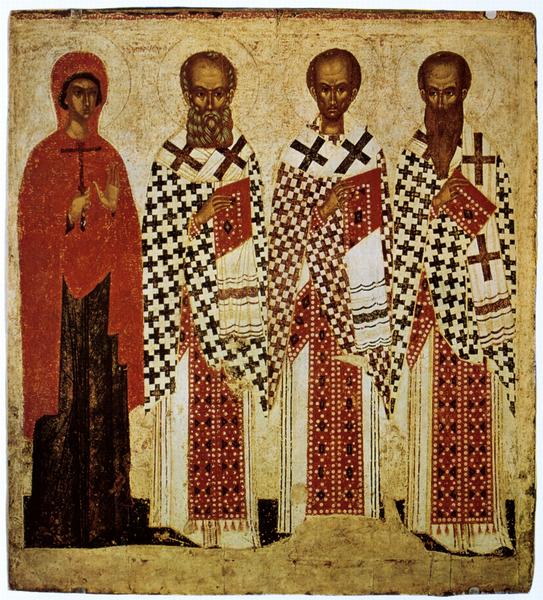
The life of the Christian following the Resurrection can be summed up in this single word implied in the 2 Peter passage, ‘deification’ or participation in the divine nature. The Orthodox point to other New Testament passages that imply this idea, notably the passage from the ‘High Priestly prayer’ in John 17. ‘As thou Father art in me and I in thee, so also may they be in us.’ Deification is a strong theme through the centuries and it undergirds what can be called Orthodox mysticism. The Orthodox also have a strong sense of the way that the human body is to be involved in spiritual practice and the literature is full of accounts of the bodies of saintly people glowing in a physical manner. The tradition of icon painting also shows how the saints and men of prayer possess the radiance of a heavenly light.

The emphasis on ‘deification’ or the transformation of human beings through prayer and attention to the sacraments of the church is a simple one. I cannot of course discuss it in any further detail at this point, but to repeat what I said earlier that it is a hopeful and attractive presentation of the Christian faith. I share it with my readers because it summarises part of the reason why I am so critical of other presentations of the faith that use fear and the threat of deep despair in promoting the Christian faith. Perhaps this short piece will help some of my readers to see that Christians who promote their version as the only version of the faith are simply wrong. There are versions of the Christian faith, far older than our own, that have nothing whatever to do with the squabbles in the West around the time of the Reformation. To breathe Orthodoxy, even if only for a time, is like breathing fresh air, after being for a long time in the fug that we call Western Christianity. From the Orthodox point of view, having never known a Reformation, our theological debates all seem rather petty and provincial!

Preaching the Gospel?

pastor-preaching-2In my ministry I have, on one occasion, been accused of ‘not preaching the gospel’. I was puzzled about this statement and I wondered how the person concerned thought of the good news contained in the bible. I began by looking to see what churches, who supposedly did ‘preach the gospel’, actually did which was different. What I discovered was not something I wanted to copy, so I knew I would never be able to qualify to be one of this select company. My investigation of what preaching the gospel meant in practice was to discover that many people go to church in order to have a profound emotional experience. The experience normally consists of three parts. The first stage is what I call the ‘grovel’ part. The audience is invited to reflect on their sin and utter degradation. The preacher will add his commentary with an account of his own ‘unsaved’ self. There will be metaphorical chest beating, spiced up with memories of how the preacher used to drink, smoke and indulge in other doubtful activities which might be described or hinted at. The second part would be a description of the moment of conversion and how all this was put behind him The congregation are invited to remember or renew their own conversion experience and feel the sense of freedom coming from this salvation from future hell and damnation. Alongside the feeling of newness and safety that the climax of the ‘gospel preaching’ is designed to promote is another feeling. That is to look out at the unsaved world around them, lamenting its descent into hell. The congregation is exhorted to preach the gospel to the unsaved around them. That is to be the mark of their discipleship, whether or not they preach and teach others about Jesus. This third section evokes feelings which combine a sense of superiority and smugness with a sense of pity for people who are unsaved.

I hope my readers will believe me when I say I have heard this ‘sermon’ many times. Its main feature, one that I do not copy, is the deliberate arousing of emotions in the listener. I suspect that my accuser was someone who associated this range of emotions with preaching. Therefore when he did not have these emotions of loss, rescuing and sometimes smug pity, the task of preaching for him was incomplete. But there is something more going on for me than a distaste for the arousing of emotions. The whole theology of ‘gospel preaching’ as I have summarised it is based on a thoroughly un-Christian reading of Scripture. Perhaps I should qualify that by saying that it is an Old Testament God who is presented rather a New Testament one. I need to explain what I mean.

At the start of the events of Holy Week, Jesus is presented as riding on the back of a donkey into Jerusalem. Apart from any Old Testament allusions that may be claimed for this act, it is clear that Jesus was acting out a gesture of profound humility. Kings did not arrive on donkeys, they mount war horses, ready for battle and domination. This is clearly how the writer in Revelation thought, when he describes the ‘Word of God … clad in a robe dipped in blood’ with ‘the armies of heaven, arrayed in fine linen, white and pure, following him on white horses’. (Rev 19.14 ) Such language echoes the concepts of God in some parts of the Old Testament, a God who clearly is understood to reflect the way certain humans behave. Thus he is sometimes merciful but at other times vindictive, vengeful and ready to smite his enemies when they oppose his will or disobey his law. (See how people are treated in these random passages, Deut. 13.12-18, Exod. 31.12-15 & Hosea 9.11-16) The model that seems to have been in the mind of the Old Testament writers who wrote in this way, was the idea of an earthly monarch or ruler. It is, we might remark, all the more remarkable that Jesus had such a different picture of God. Jesus spoke about a father who loves his enemies, one who is prepared to forgive many times, even when the child has wandered off into the desert of his own selfish desires. The doctrine of ‘infallibility’ and the cliché, ‘all scripture speaks of Christ’, has blinded us to these contrasts in the doctrines of God within the Bible. Without going to the extreme of rejecting the Old Testament, we do have to realise that at times this part of the Bible shows a God that is some way from the God that Jesus came to proclaim.

Once again I find myself needing to draw things to a conclusion for fear of overrunning my self-imposed limit. But my summary would be to say that my accuser was pointing to a presentation of God which was not the gospel of Jesus. Rather it was a presentation of a mishmash of ideas and concepts from certain parts of the Old Testament that want us to submit to an arbitrary and tyrannical ruler. The good news that I find in the teaching of Jesus is not all about punishment and separation but rather about reconciliation and forgiveness. The Jesus I follow is not one who rides on a war horse but one who rides a donkey in humility. Christians perhaps need to be braver in their reading of the Old Testament. Because many are committed to a doctrine of infallibility, they consequently have to find ways either to explain away or simply ignore the parts that are, quite bluntly, unedifying. There has to be another way and I believe it is possible to read this literature with the eyes of Jesus. It is he who reads out of scripture and the God who is found there, the qualities of mercy and compassion. At the same time he passes over the passages that seem to imply that God is only interested in revenge and punishment. A doctrine of gradual revelation will allow us to sit more lightly on the ‘difficult’ parts without denying its overall inspiration. My version of the ‘good news’ will draw mainly on the teaching of Jesus, his offer of the Kingdom, a place where the will of God, his ‘shalom’ may be done and experienced. But to this we will return …….

Christianity ‘Lite’ 114

liteweb2There is a version of the Christian faith that in effect says this: ‘Do whatever you like. If you believe in Jesus and that he died for you, then all your sins are taken away.’ In essence there are Christians who believe that all we have to do is to believe and receive. The content of what we are expected to believe is carefully set out in a few sentences. It will always include a version of the typical conservative understanding of the death of Jesus alongside a belief that he is the Son of God. There will also be a statement to the effect that the Bible contains all the truth we need. The particular teaching on the meaning of Jesus’ death is, for evangelicals, non-negotiable. It is a teaching which is commonly described as the substitutionary understanding of the atonement. I have, in a previous post, discussed the content of this belief which is one that sets out how Christ’s death is one that releases us from the punishment that we have deserved.

I have in a few words set out the faith statement of countless conservative Christians across the world. I call this version of Christianity, a ‘lite’ one, insofar as it focuses on the believing side of faith while partially or sometimes completely ignoring the behaviour and ethical teachings of the Bible. Many conservative Christians would immediately defend themselves by saying that there is a great deal about ethics in their versions of the faith. In practice, however, there is a disproportionate amount of attention on issues around sex. Conservative teaching seems to focus extensively on particular aspects of sexual behaviour. We hear from conservative preachers a great deal about homosexuality but very little about divorce. Jesus actually spoke about the latter but said nothing about the former. One is begins to see how the ‘doing’ part of Jesus’ teaching is taking second place to a stress on believing in this presentation of the Christian faith.

From a book I am reading, I can mention a scandal that took place in 1993 at the Mississippi Bible College to illustrate the point I make about the relative unimportance of doing as opposed to believing. The president of the College, one Lewis Nobles, embezzled $3 million from his college and compounded his offence by spending $400,000 on the services of prostitutes. The reaction of many people around the community was to say, ‘But Dr Nobles is a good Christian man.’ They could not accept that his behaviour was thoroughly bad, un-Christian and was undermining the integrity of the faith he was supposed to confess. Somehow the fact that Dr Nobles had said he was a Christian, that he had accepted Jesus as his Lord and Saviour, trumped the disgust that many must have felt. Making allowances for other people, who are signed-up Christians, also appeared in the trial of Eric Rudolph who was involved in a fatal bombing of an abortion clinic. One woman said of him, ‘He is a Christian and I am a Christian. He dedicated his life to fighting abortion. Those are our values.’

In thinking about the implications of this bizarre statement, we may note that such a stand is supposedly based on an adherence to ‘Biblical values’ The anti-abortion position would no doubt appeal to the commandment not to kill. But there is a grotesque irony in the fact that not only that Rudolph himself killed someone, but he seems to have completely bypassed other moral teachings of Jesus. It would be tedious to list all the ways in which the gospel moral commands are being totally ignored by Rudolph but it is hard to see how the command to ‘love your enemies’ is being followed. No doubt Rudolph was receiving support from his fellow Christians for his behaviour and, in particular, the leaders of his church. They were in effect teaching that it was not important to follow the teaching of Jesus but more important to surrender to their highly politicised version of the faith. We might summarise their message ‘Do as we say; don’t do as Jesus says.’

The emphasis of being a ‘correct’ Christian rather than actually doing what Christians are called to be and to do in the New Testament reminds one of the game of Monopoly. Sometimes the player picks up a card which says ‘Get out of jail free’. This can be played whenever you happen to fall on the ‘go to jail’ square. This ‘believe and receive’ version of Christianity is a bit like having a permanent ability to escape the consequences of immorality and evil, regardless of what you do. The kind of Christianity, that emphasises belief along with little sense of responsibility for one’s actions, will also have other unfortunate results. It will do little to encourage the Christian believer to feel any responsibility for those beyond the congregation, the poor, the hungry or the unemployed. On other occasions I have mentioned how these attitudes translate into a political world view that defends low taxes for the rich and a rejection of public funding for healthcare. I am course here speaking about the situation in the United States.

Some of my readers may feel that I am presenting a version of Christianity, which does not really exist except in my imagination. I would ask such people why it is that some Christians have failed to applaud the work and vision of fellow Christians who have laboured to transform the lot of humanity through compassionate service in countries overseas. The readiness with which some Christian groups go to proselytise in areas of the world where the Church has been long established, on the grounds that the people of the area do not have the truth of Biblical Christianity is, to my mind, a disgrace. Surely the work of decades, even centuries to transform a culture and civilisation through Christian teaching and service is something that all should applaud. I am of course thinking of the work of Roman Catholics in South America in particular. Even if we do not agree with everything that this original group taught (and I don’t), can we not perhaps recognise God at work in this mammoth effort of service to humanity?

Post Traumatic Stress

Post-Traumatic-Stress-DisorderOne of the words that commonly came up, when people were describing at the Washington conference their experiences of having been in a cult environment in the past, was the word ‘trigger’. This word signifies an event in the present that evokes very powerfully something from the past that was highly unpleasant or traumatic. The individual, in experiencing a ‘trigger’, has a past event replayed in his mind in a way that is highly distressing. Triggering is a concept that is frequently used in the context of Post Traumatic Stress Disorder. The disorder, normally shortened to its acronym PTSD, has been identified and described for some 35 years. Before it was included in the third edition of American Diagnostic Manual of mental disorders in 1980, it had existed as ‘severe shock’, ‘shell shock’ or ‘gross stress reaction’ . The new PTSD diagnosis was able to be used to describe the survivors of the Vietnam war and others affected by notorious disasters in the 80s and 90s. For us in the UK, the Lockerbie plane crash and the Dunblane shooting constituted the most memorable public traumatic events. In such incidents trauma spreads out in waves from those immediately affected to enfold those who are bystanders, members of the wider community, not to mention those who have the task of physically removing the traces of the horrors that have overtaken the communities. To some extent the horror of such events touches everyone in society.

Not everyone who witnesses terrible things or experiences goes on to develop PTSD. But among those who do, maybe through having to experience the endless loop of reliving the traumatic event, it is a highly distressing mental condition. It is in this context that the word ‘trigger’ comes to the fore. The event that sets off the trigger may be of little or no consequence but it powerfully reminds the sufferer of what he or she went through in the moment of trauma. The soldier who saw comrades blown up in war, may react violently to unexpected noise. The woman who has been raped may find that any form of touch makes her freeze and tense up. In both these situations the individual has been forced to experience again an event which had once completely overwhelmed the human capacity to process and assimilate what was happening. Something else that took place afterwards brought the original event to mind, had the power to set up a highly distressing reaction in the individual concerned. This trigger reaction is not only distressing and unpleasant but it is also mentally disabling. Normal functioning and living is put on hold for minutes, hours or even days at a time.

There is much more that could be said about PTSD, (Cindy has sent me details of an up-to-date online presentation The Body Keeps The Score by Bessel van der Kolk, MD) how it manifests itself and how it may be treated, but I want to move on to considering how traumatic stress affects those who have had abusive experiences in a church context. What might these experiences consist of? One whole area of traumatic experience might centre on the moment when an individual found themselves excluded or shunned. This, I have suggested, cuts deep into one’s experience of personhood and sense of self-worth. Although physical violence may not have been involved in the event, feelings of shame and intense abandonment may have been involved in the event. Another traumatic moment might be the shock of betrayal when there is a realisation that the Christian follower has invested years of loyal service to an organisation that is through and through corrupt and self-serving. What had been heard as the word of God was found to be the words of a dishonest and maybe greedy leader. Another area of church life, on which Chris may have something to say, is the constant exposure to guilt and shame. This is subsequently recognised to be part of a subtle and deliberate attempt to control the individual. Even after it has been so identified, the trauma of feeling constantly guilty has been so internalised that it cannot be easily shaken off. There are in fact numerous areas of awareness that are constantly drummed into member of extreme high-demand churches and groups, which continue to cause inner havoc long after the member has left. We might mention the habit of obedience without question so that independent thinking is almost impossible. Some of the particular experiences of belonging may not of themselves be trauma in the narrow sense, but they, taken together, can leave the ex-member with a mountain of baggage and traumas which affect him or her every bit as a survivor of Dunblane.

This thinking about the survivor of a cultic church and that of a disaster having areas of common experience, no doubt needs further working out. Perhaps in the earlier paragraphs I have focussed on a survivor of a disaster or trauma which has lasted perhaps only a few minutes or hours. The survivor of a trauma connected to a church or cult may be the survivor of a less intense experience, but one that has lasted for years or even decades. These two areas of experience do however seem to share the same effects in the way that past events constantly threaten to overwhelm into consciousness and disrupt and disturb the task of ordinary living. To quote one of the criteria for PSTD, ‘the disturbance must cause significant distress or impairment in social, occupational, or other areas functioning important to the person’. That anything to do with God could have such a terrible legacy in its wake, is a horrifying indictment of the way that Christianity is sometimes taught and practised in our world. Jesus came, not to bring distress and disturbance, but light, freedom and the fullness of life.

Selling Fear

ˇˇˇˇOne of the classic examples of preaching that has come down to us, is the terrifying 1741 sermon of Jonathan Edwards in America. He spoke in a sermon entitled ‘Sinners in the Hands of an Angry God’. ‘The wrath of God burns against them, their damnation does not slumber. The pit is prepared, the fire is made ready, the furnace is now hot, ready to receive them.’ Since Edwards’ time, many preachers have used similar techniques of rhetoric to quite literally terrify their congregants into a state of compliance and passivity.

The use of fear as a means of control within the church is a well-known tactic. Alongside terrifying the individual by the threat of eternal punishment, is also a teaching that sees the hand of God at work in natural disasters. To use an example from the States again, the airwaves and the internet were full of Christian Right pundits believing that they could discern God’s hand at work in Hurricane Katrina which devastated New Orleans in 2006. An anti-abortion activist, Steve Lefermine, declared: ‘In my belief, God judged New Orleans for the sin of shedding innocent blood through abortion.’ Pat Robertson famously saw the hand of God in the events of 9/11 as a punishment for homosexuality, abortion and feminism. Extremist Muslims also claimed to be able to see God at work killing Americans through Hurricane Katrina. ‘The Terrorist Katrina is One of the Soldiers of Allah’ declared Kuwaiti official, one Muhammad Mlaifi. Yet another Christian commentator, Michael Marcavage, declared that God had decided to wipe out New Orleans because of homosexuality.

I have no doubt that I could extract from other sources numerous other examples of preaching that declares God to be in total control of the unexpected disasters which are sent to respond to the sins of humankind, especially the ones that the preacher particularly disapproves of. There are various reactions to such statements that can be made. One is to see an absurdity in these claims and find them almost funny. They are, however, removed far from humour by the fact that some individuals who hear these interpretations presumably believe them to be true. That makes all such statements sinister and conducive to an alarming frightening understanding of the nature of God. Such a theology of fear needs to be confronted and named for what it is, a doctrine whose purpose is designed to threaten terror and keep control over others.

When a preacher uses terror tactics in his messages, two particular things are happening. His target is likely to be people not actually present in the building, people who are identified as enemies of faith, apostates, sinners and those who do not conform to the preacher’s ideals. So, in the first place, terror sermons are about shoring up boundaries with the outside world, helping those inside to feel safe and warning them from straying from the narrow path set by the church. In short the preacher wants to re-emphasise the boundary between us and them. In the second place the preacher is also creating a miasma of fear among his own people. Not only are they forbidden to look too much at the world outside, for fear of having their purity compromised, but they are also exhorted to cling tightly to the leadership of their pastor. He is the one who can protect them from the threat of disasters in this life and the possibility of everlasting damnation in the one to come. The God, who has designed everlasting torments for the wicked, is also behind the arbitrary events of history. His spokesman and representative in the church is the preacher and leader. His task is to declare the Word and Will of God to those in his charge. But as we can see, an important tool in maintaining his control and power is sometimes this weapon of fear.

Many people in the UK may well have never experienced the tools of fear-mongering used in their churches. It is true that all my examples comes from the States where the control of congregations through the weapon of fear is perhaps a more common feature of church life. But I would suggest that fear is used in churches quite frequently, even it is less obvious in this country. A place where there is constant reference to a God who punishes individuals horribly or who sends disasters to repay back-sliders is a setting which will always frighten people. The use of fear tactics, implied or actually uttered, will always be threat to people’s peace of mind and day to day equilibrium.

In speaking about ‘selling fear’ I am referring once again to a style of church life that, at best, is uncomfortable and, at worst, cruel and abusive. Even though in this country when it occurs, it normally remains at the uncomfortable end of the spectrum, I would challenge everyone to become sensitive to what I called the ‘miasma of fear’ that clouds the life of many churches in every part of the world. Most of the responsibility for lifting this cloud rests on the leaders. They should be challenged every time they use, directly or indirectly, fear tactics in their conduct of church life. One of the key biblical passages which can guide in this is the one that says. ‘There is no room for fear in love. Perfect love casts out fear’. To sow fear in any form within a congregation is a direct denial of the commandment to love. Is there any greater way that a church leader could fail in his or her responsibility to love and care for the sheep?

Exploiting the need to belong

belongingI am sure that somewhere among my posts are some observations on the need of every human being to belong to a human group. This theme has recently become of greater interest to me as I delve into the realm of social psychology and social rejection. My focus today is to suggest quite simply that some churches and abusive groups have exploited this need to belong in their followers. Having offered individuals a home to satisfy their belonging needs, particularly when they are young, the cultic group then is able to hold on to them for a considerable period through continuing to exploit these same belonging needs. The ability to move on from, or leave, the group when the individual perhaps starts to encounter abusive and exploitative behaviour from the leaders, is achieved only with great difficulty. It is because this member has become so thoroughly entwined with the group through the need to belong that separation is achieved only at the expense of knowing real trauma and distress.

The need to belong, as the social psychological textbooks tell us, goes back to the time in human evolution when survival depended on the ability of groups to gather food and defend themselves from rival bands who might be competing for the same food supplies. From a psychological point of view the human infant has to make secure bonds with a caring adult in order to physically survive. We call this bond ‘attachment’ and many books have been written to describe how this process works and how failures to obtain attachments can result in severe dysfunction in the emergence of the adult. The psychologist Winnicott beautifully sums up this idea of attachment when he said something to the effect that there is no such thing as a baby. There is only a baby in close emotional and physical proximity to the caring adult, usually the mother.

Many young people grow up with unfinished business with the family. No parent ever get things totally right in offering exactly the right amount of care that is needed by their off-spring. Some parents give too much and some too little in the way of parental care. Most children, thankfully, have sufficient ‘good-enough’ care for them to be able to move to adulthood without serious problems. But even if parents are near perfect in rearing their children, few young people do not experience pangs of worry and concern as to whether they can indeed go it alone in the journey towards maturity. The picture that comes to mind is the butterfly emerging from the chrysalis. For a few moments the butterfly, even though perfectly formed, has to dry itself in the sun so that its wings will function properly. So the young person may have several months of uncertainty as to whether he is a child or an adult. That time is one of uncertainty and vulnerability.

Every young person has to pass through the transition from being dependent on parental figures and peer groups to the independence of adulthood. This period of ‘wobble’ may happen at any time between the ages of 16 and 25. It is a bit like a car changing gear. It may be a smooth transition or we may hear the gears grinding horribly as they struggle to go at the new speed. But the need to affiliate or bond is strong and powerful right through the process. The object of dependency is constantly changing. In younger teenagers the need to belong is focussed on membership of gangs or strong peer groups. Many churches are important places for young people to gather in what is hopefully a healthy environment while they are exploring the loosening of parental and home ties on the way to a new adult identity. The cultic or high-demand church that appeals to the almost adult of 18+, is however working in a different way. They use the need to bond or belong as a way of drawing the young person deep into the group. This is done so that the individual will want to give away their financial and emotional soul for this reassurance of ‘belonging’ and being on a journey to salvation beyond the grave. The ‘conversion’ process, however it is done, will hook deeply into the psyche of the individual so that he/she feels an overwhelming sense of safety in the new package of belief and belonging that is being offered. The depth of conversion, is, in my thinking, proportionate to the degree of vulnerability being experienced by the young person as they are moving from one stage of their lives, that of dependence, to independence. The cultic institution, however, in practice stops that process from being completed. The young person swaps one sort of dependency, parents, peer groups etc., for another, that of depending on the cultic group and its leaders.

The model I am offering for the vulnerability of young people entering extreme churches or cultic groups, also explains why many find it so hard to leave. As long as they are in the group, their belonging needs are being satisfied in much the same way that a child ‘belongs’ to his or her parents. It is when they leave through expulsion or unhappiness that they discover that the growing up process, the movement to independence, has never been completed. They cannot, to use the butterfly analogy, fly on their own. The task of supporting such people who have recently left high demand groups and churches is hard precisely because the task of growing up has been left incomplete or short-circuited. The group has taken away something extremely precious from the former member. It has deprived that member of the context and setting in which to grow up and mature. By latching on to the common human need to belong, it has betrayed that member, for the time being, of the chance to escape the dependencies of youth for all the possibilities of mature adult living and awareness.

Ostracism – some reflections

ostracismWhile writing the piece on shunning for this blog, I experienced a degree of passion that made me realise that this area of suffering by ex-members of abusive churches needed more investigation. I started to do a word search in Amazon books to see what had been written on the subject. As might be expected I was directed to some novels describing the Amish experience where they have a special word ‘meidung’ to denote it. As shunning in a religious context is much wider than the Amish, I looked at other synonyms for the word. What came up was the word ‘ostracism’. This did produce a number of books but it appears, as far as I can determine, that no one has written a study on either shunning or ostracism in churches or cults. It is also intriguing to note that a new body of literature on the subject of ostracism has emerged over the past twenty years to look at the subject from a social psychological point of view. A book that I have ordered, looks at this same area of study but it uses the expression ‘social exclusion’ in its title. We tend to think of social exclusion as being the fate of people who through poverty, age or illness fall outside the usual networks of social support and thus become isolated. The book, however, seems to treat ‘social exclusion’ as a synonym for shunning and ostracism, i.e. a deliberate act on the part of groups or individuals towards others. The chapter headings in the book do not indicate that any of the scholars who are looking at the problem have considered the church as an area worth studying. So this may be a topic that I can give some further attention particular in my presentations to people interested the problem of cultic matters.

The book that I am now reading on ostracism has given me (and you the reader) a simple model from which to work. It suggests that ostracism, although operating at different levels of severity is a method through which to exclude and control individuals or groups of people. Most typically ostracism involves ignoring others, giving them the silent treatment and pretending that they do not exist. The most effective (and most cruel) forms of ostracism take place actually in their presence. Silence, not speaking, avoiding eye contact and speaking over them are all ways through which an individual can be made to feel utterly scorned. The book makes clear that the individual receiving this treatment, the target, is deeply wounded by this behaviour. It is far worse to be ignored than to be hit in the face because the human need to have their existence acknowledged is at least present when someone chooses to punch you.

I want now to list the four areas of human well-being that are undermined by ostracism according the book I am reading. There are, according to Kipling Williams, an Australian social psychologist, four areas of need that are important to every individual and each of these come under threat through being ostracised. They are respectively the need to belong, the need to have self-esteem, the need to have control over your life and the ability to make sense of life, to have a meaningful existence. Each of these human needs is undermined by the experience of being the object of ostracism. The picture that comes to my mind as I record these four human needs is that of a tent. The human individual, in order to function properly, has to have four guy ropes tethered to the ground for the tent to stand up properly. The ropes are connected to four tent pegs and these are symbols for these four fundamental areas of need. Ostracism effectively is an attempt by others to pull up the tent pegs, so that the tent collapses. In other word the ostraciser is effectively trying to make our fundamental sense of who we are collapse by this cruel and barbaric treatment.

I refrain, for reasons of space, from giving examples of ostracising behaviour because I am sure my readers have encountered it somewhere, whether in church or in another institution. But I want to mention the fact that being the giver of ostracism is also a fairly unhealthy experience for the individual. It may not become quite as bad as being ostracised but it is certainly harmful to well-being in a variety of ways. It hardly enhances a happiness or a sense of belonging if your leader instructs you to cut dead or ignore people that were until very recently your friends and part of the group. To put it mildly, shunning or ostracism is very bad news for both the target and the perpetrator. That it should ever be practiced in a religious organisation, let alone a Christian one, defies comprehension.

I concluded my review of shunning by asking whether anyone should every join an organisation which practised such horrible barbaric behaviour. I need hardly give an answer to this question but asking it helps to enable us to see how corrupted and evil certain Christian organisations have become. I certainly want to continue to study this question because, as I said before, it lies right at the heart of abusive Christian behaviour.

If you find your way to this blog post, you might want to watch the lecture I gave at the International Cultic studies Association in Stockholm in June 2015. Type in Stephen Parsons 2015 on the youtube search.

Islands – images of longing 109

island fantasyMy wife and I have recently returned from a few days away in Scotland. Our time away included a brief day trip to the islands of Orkney. I do not propose to inflict on my readers a geography lesson but rather reflect on the way that islands have a deep attraction for many people at quite a profound level. The island represents a place that is away from it all, a place of escape, a place of peace. How many people nurture the fantasy that, if they won the lottery, the thing that they would buy would be an island so that they could live out that fantasy of escape and retreat?

The urge to escape and find a place of peace and rest is something that is found in all religions. Many of us can hear the music of Mendelssohn and the words from Psalm 55 sung by a boy treble, ‘O for the wings of a dove, far away would I roam…’ Church appears to offer such a sanctuary and we could say that part of the attraction of church is that it remains a place that is unchanging in a changing world. To attend church is to retreat, to some extent, to somewhere safe.

To return to our picture of islands as the place of refuge from a world that makes many demands on us, the salient feature of the island is the fact that it surrounded by water. This surrounding water makes it difficult for anyone to land on our island. The owner of the island will make sure that he or she restricts the access so that it would be very unlikely that anyone would called unexpectedly. Thus the home that is built on the island would be a place of peace but also one of isolation. The very security of the boundaries would shut out the wider world. Just as the world outside finds it difficult to land on the island, so those on the island have to make some effort to maintain contact with those on the mainland.

I imagine that my reader may have already guessed that I am seeing the island to be like a cult-type church that has closed itself from contact with the wider world. The world outside this ‘island’ church is variously seen as apostate, heretical or generally hostile. The surrounding barrier of water is needed to protect those within from contamination and wrong ideas. The higher the barriers, the greater the expanse of water around our island, the more those on the island are thought to be kept safe. Their safety is however only possible at the expense of a loss of contact with all that lives beyond the island. The longer they remain in this ‘island’ church community, the more difficult they find it return to their old lives on the mainland. Let us suppose that the people in the ‘island’ church have had to learn to speak a new language to enter this community. How difficult it will be to return to speaking the language of the people they left behind years or decades before.

The rich owner of a small island paradise may revel in the isolation that his territory brings him. But there are few individuals who are able to stay for long periods of time without becoming imprisoned by this isolation from other human beings. The tight barriers are liable to become prison walls very quickly. In the same way the church with tight boundaries can quickly become a prison. The special ‘island’ language, the jargon that Christians often indulge in, is barely understood outside their circles. ‘Island’ churches are wonderful places to join but very hard to leave. The sense of disconnection from the mainland of ordinary human living is attractive but ultimately detrimental to our emotional and spiritual health.

Chris is often reminding us of the marginalised people in society and how such people feel little for a church that ignores them and their plight. If this complaint is a valid one against mainstream congregations who support food-banks and give generously to good causes, how much more valid is it against those churches that revel in their ‘island’ status and their success in keeping their members ‘pure’ from the contamination of the world. The ‘island’ cultic church has become doubly disconnected from people with real spiritual and social needs. It is so concerned with the issue of ‘saving’ individuals from what it sees as a wicked and corrupt world that it feels no responsibility of any kind towards those left behind. A few years ago I read some of the literature connected with beliefs about the Apocalypse among conservative Christians in America. It appeared that those who believed that they would be raptured, taken up into the air with Christ had absolutely no compassion towards the 98% of the human population who would not be saved but would by contrast meet a horrible and fiery end. There is something deeply pathological about such beliefs. There is a whole series of fictional books written by one Tim LaHaye, the Left Behind novels, to feed these bizarre and unwholesome notions.

The fantasy of living on an island whether literally, or metaphorically through your church, would make living the Christian life far from easy to achieve. Jesus spoke of his followers being those who feed the hungry, clothe the naked, care for the sick and visit the prisoners. I have had little experience of the last of these, but in my brief time as a part-time army padre, I always made it my business to call regularly on those locked up in the army barracks cells in Dreghorn, Edinburgh. My reflections on the stories the confined soldiers used to tell can be recalled on another day. But however we understand our response to these words of Jesus at the end of Matthew’s gospel, it is clear that it will involve, not our separation from the wider world, but our readiness to get our hands dirty at times, to go to places that we would rather not go. Whatever it involves, it does mean that we are not called to live on islands, however attractive they may be, but on the mainland where the rest of humanity lives.