Category Archives: Stephen’s Blog

98 Use and abuse of Scripture

ft-lauderdale-fiveIn a comment made to me recently, it was suggested that many of the cultic facets that afflict parts of Christianity in Britain are the result of the Charismatic movement. Whether this general point is or is not true, what is apparent is that many charismatics in Britain took a severely wrong turning when they embraced the shepherding movement in the mid-70s. There was a particular gathering in Britain in 1975 when a large numbers of British charismatics heard an American speaker, Ern Baxter, address them on the topic of discipling. The idea that ‘submission’ was a necessary part of Christian discipleship was enthusiastically welcomed and it passed into the mainstream of charismatic thinking for a number of years. The Fort Lauderdale four (or five), who were a kind of overseeing group to this movement the USA, in fact soon found that what had been unleashed on both sides of the Atlantic was a kind of monster. To summarise the history of Shepherding, the original four, Derek Prince, Don Basham, Bob Mumford and Charles Simpson, all in different ways repudiated the teaching that they had promulgated in the early 70s. Officially it was dead by 1985. But the genie had been let out the bottle. Too many people had benefitted from the cultic notion that submission of all Christians to a leader was necessary and biblical, for it to die that easily. The Bible had been mined to extract passages to support these ideas and many leaders who had started to run their churches in a cultic, authoritarian and controlling way chose not to tell their people that the ideas had been discredited, both on biblical and psychological grounds.

I may well return to this topic of the history of the discipling/shepherding movement as it is a fascinating one. But in this blog I want to talk about a book that appeared as recently as 2001 trying to revive the appalling ideas of shepherding on biblical grounds. The focus of this post is to demonstrate the principle that individuals who want to prove some theological point from their reading of the bible will use and abuse the words of Scripture when it suits them.

In 2001 Thomas Nelson published the book by John Bevere entitled Under Cover. I understand that it has become a best-seller, being translated into 20 languages. It could be seen to imply a revival of all the ideas and practices that made charismatic Christianity so unhealthy and cultic in the late 70s and early 80s. Perhaps this toxic side of Christian leadership has reasserted itself so that the ‘sheep’ can once again be brought into submission. I need to do a lot more reading to discover whether the shepherding impulse is equally strong as it was thirty years ago. But we need to look at the Bevere book to see if the biblical material has any credibility.

The title of the book uses a concept that is itself not biblical. The only time the New Testament talks about covering is in connection with women’s heads. But the word sounds biblical and can disguise that what is being talked about is in fact old fashioned submission and shepherding straight out of the 70s. The book is, as far I can tell from the summary, an examination of the biblical texts, both well-known and obscure, which appear to support this position. I have not, of course, got the space to examine more than a handful of these texts but I want to give some examples of the abuse and distortion of scripture that Bevere goes in for. This is, in this instance, not a case of conservative interpretations being chosen over more liberal ones but examples of what seems to be wilful manipulation of the Bible text to suit the writer’s purposes.

One of the texts examined is the account of the council held in Jerusalem and recounted in Acts 15. In some translations the summing up by James is described as a ‘judgement’. From the whole context of the passage it is clear that there has been a debate and discussion and that James was articulating the consensus of the gathering. That the council was a consensus-led affair is also indicated by the fact that immediately after James’ words of ‘judgement’, the ‘apostles and elders’ decided to choose people to support Paul and Barnabas in Antioch. There is absolutely no way that this passage reads like a hierarchical theocracy which is what Bevere wishes. Such misreading of Scripture, to further a support for submission, is dangerous and sloppy to put it mildly. The use of the word ‘judgement’ does not mean that everyone was in submission to James as some kind of hierarchical apostle. It is worth noting that Derek Prince, mentioned above, uses this passage to argue for the complete opposite, that ‘the final decision…… was a unanimous decision of the whole group’.

Teachers of covering theology find various examples from the Old Testament with which to buttress their arguments. The confrontations between Moses and the Israelite people in Numbers might suggest an excessive use of power to many of us. The shepherding writers quote the fact that the followers of Korah were swallowed up and burnt for opposing Moses in Numbers 16 with approval. Watchman Nee, an early and influential proponent of the submission theology ideas, declares ‘God and his delegated authority are inseparable … If they would submit themselves to the authority of Moses and Aaron they would then be in subjection to God.

Many of us would not see Moses, as revealed by the book of Numbers, to be a blameless paragon to be followed by Christian leaders today. Bevere wants to press for the infallibility of Christian leaders and suggest that any rebellion against a Christian leader is not only out of order and can even be seen as a kind of witchcraft. To arrive at this startling conclusion, he takes an idiosyncratic interpretation of I Samuel 15.23. Most translations render the passage as ‘rebellion is as the sin of witchcraft.’ Samuel wants to get Saul’s attention by making such a comparison. The natural meaning of the Hebrew (I am told) is to compare the two things but not actually to equate them as being the same thing. Because the King James version has the ‘as’ in brackets, Bevere thinks it is optional to the meaning and so he is able to say that disobedience to Christian authority is opening your self up to the demonic realm. That is a very strong claim but Bevere really wants to beat down the idea that the Christian ‘sheep’ have any right to challenge their leaders. He arrives at this conclusion by his ability to misread and mistranslate the actual words of scripture. (There are other examples in my sources)

I have now crossed my thousand word limit for a blog post, so I cannot go further in examining this highly discreditable and distorted use of the Bible to resurrect a highly dangerous form of cultic theology. Sadly, particularly as my American readers will testify, shepherding theology is alive and well among some Christians who occupy the world of charismatic theology. Thankfully for those who find themselves trapped in this dreadful place of shepherding, there are resources to help the individual read other approaches dealing with the well worn texts, and see that there are other ways to be a Christian.

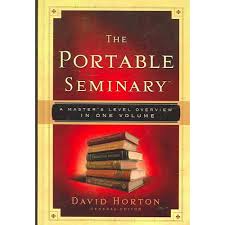
The Portable Seminary

portable seminaryIn my local charity shop earlier this week, I encountered a large volume called A Portable Seminary. Curious I opened it up to see how two or three years (as it used to be!) of residential training could be crammed into a single volume. The title also suggested that one who finished the book would have an overview of theology at ‘Master’s Level’. Although my initial thought was to leave the book on the shelf, my curiosity has sent me back to buy it although the experience of reading it is making me thoroughly depressed.

In the first place, the whole volume begins with a short chapter on the doctrine of Scripture. Part of this is written by a dinosaur of conservative theory, Carl Henry. As is typical of this kind of reasoning, the arguments go round in circles. The Bible says that it is ‘God-breathed’ or inspired and so this argument for its absolute authority is taken as a fundament. it is a similar argument to the idea that we can ‘know’ that an individual is not a liar because he declares this to be the case. All arguments about the cultural context and accuracy of Scripture can be wished away because of the utter reliability of God’s word in the text. Before we go on to look at the Bible is actually dealt with, we should pause at this point to consider the way the conservative ‘creed’ is set out in this book. If there were a such a thing as a creed based on this book, it would begin with a statement I believe, not in God, but in the Bible. I remember an evangelical joking about the doctrine of the Trinity. He said that for evangelicals, the three persons were God the Father, God the Son and God the Holy Bible. From the Portable Seminary, we might deduce that for some conservative Christians, the Bible was the first person of the Trinity.

The book does remind the reader that it does not offer a substitute for a proper college-based training. But even having made this apology for the lack of depth in some of the material, the sections on the Bible are extremely thin. By contrast the doctrine sections and even the summaries of Church history and other religions have some substance, even if you disagree with much of it But to return to the summaries of the books of the Bible. The overarching authority of Scripture enables the unwitting reader to assume that God revealed the entire first five books of the Bible to Moses, apart from the account of his death. The Pauline authorship of Ephesians is assumed without discussion. The Gospel of John, summarised in a single page, is an account of the ministry seen from his ‘inner circle’. After surveying the New Testament in 20 pages, the reader is directed to just three books for further reading, two of which contain the word ‘survey’ in the title.

I have long held a theory that the only way that it is possible to hold on to a theory of ‘plenary inspiration’ for the Bible is by not actually studying it at depth. In a book of 707 pages, to give 20 pages to the whole New Testament is totally out of proportion. Needless to say the Bible does play a major part in the book in being quoted constantly to support different areas of theology and doctrine. That is perhaps the way to characterise the use of the Bible by conservative Christians. The Bible is a mine from which to extract ‘treasure’ which supports doctrines that you already hold. I am reading another document off the net which shows the cavalier way that biblical texts are misread to support the ideas of shepherding or ‘covering’ as it is sometimes called. This will form a separate post in due course.

To summarise my brief perusal of this massive tome, is to see something of the way the ‘system’ works. The Bible is placed on a pedestal. Once that ‘worship’ is inculcated in a congregation, the task of creating a system of teaching that they will be forced to follow, can begin. To repeat what I said on the gay issue in a previous post, this topic is in fact of minor interest to the totality of Scripture. Nevertheless it has become important because, for political reasons, conservative Christians in leadership have chosen to make it so. Having coerced their congregations to ‘worship’ Holy Scripture, even the obscure passages that speak about gay topics can be blown up to take on an immense importance.

To repeat points made elsewhere, the Bible is being used in this and other works as a tool for control. By discouraging study of the Bible as having an integrity of its own, people are being conditioned to seeing it only as a source of authority for those in the pulpit. No one is allowed to question pronouncements from the pulpit, because the ‘the Bible says’ has become the final word in every discussion. The way I studied scripture is to see that, before you can extract teachings from it, the text must be allow to speak for itself in its cultural and historical context. Not to do that is to distort it and render it ultimately meaningless and empty. Having owned the Portable Seminary for a full 24 hours, I am thinking of taking it back to the shop where I found it. The only thing holding me back is the thought that some unwitting Christian might actually believe that Christianity can really be learnt in the way!

96 Updates of Sabah and Brentwood

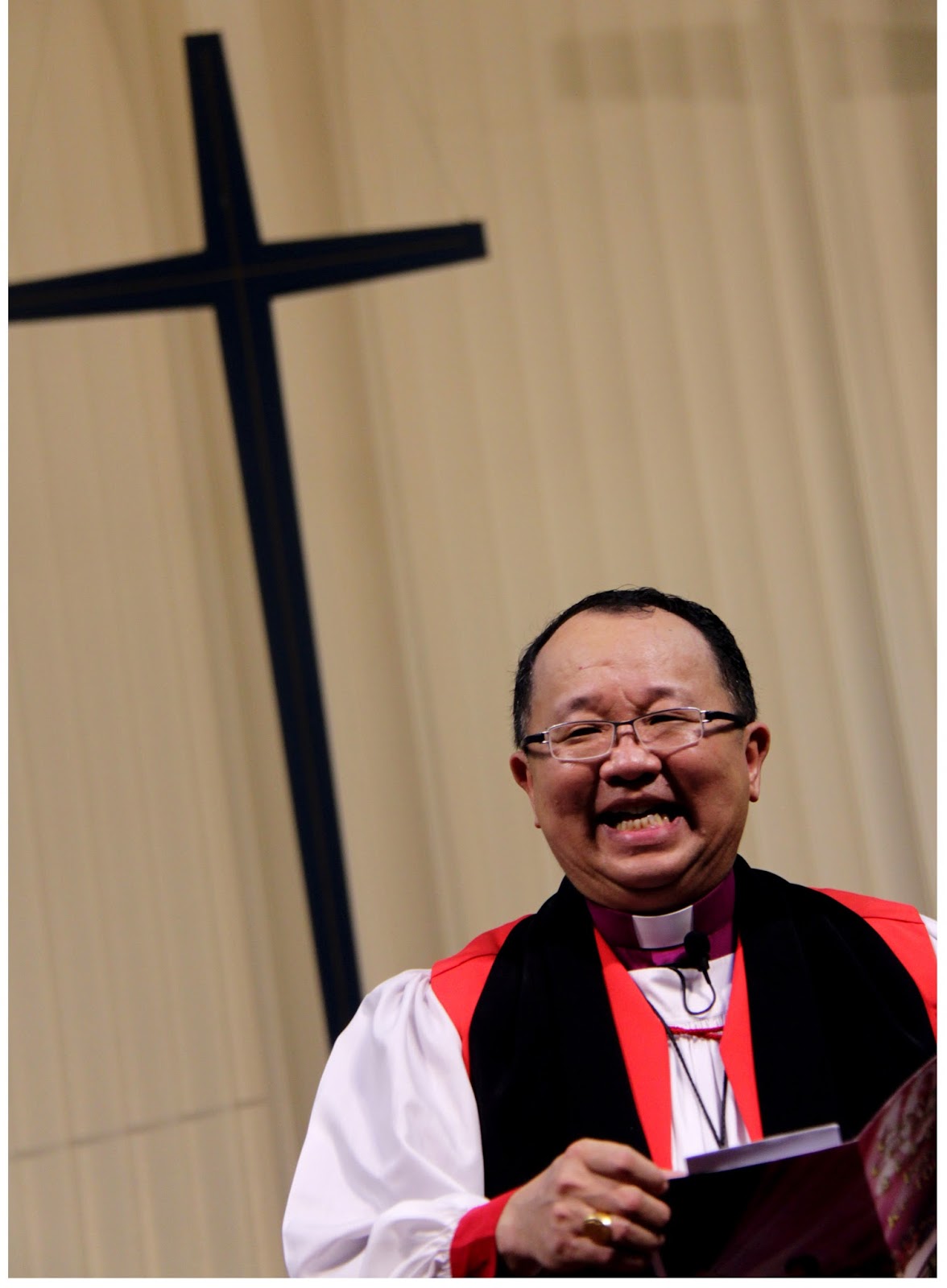
Bishop Vun

Some months ago I posted up two case studies of abusive churches(53 and 58), one in Britain and one on the other side of the world. The information posted up is freely available on the web, so I make no apology for using them here as exemplars of what happens in churches when leaders give way to power games over church members. Arguably such power abuse is exercised as a way of relieving some deep inadequacy in their lives.

The saga of Bishop Albert Vun has come to a sort of conclusion with his expected death from pancreatic cancer on the 15th July. I say ‘sort of conclusion’ because it appears that even after his death, he had the power to accuse and disturb those whom he had treated badly in life. The funeral service was expected to be a recalling and honouring of his memory organised by other senior churchmen. Instead what the congregation received seemed to be a kind of rant from beyond the grave, directed at those who had tried to oppose his alleged tyrannical behaviour while alive. This was organised by his widow and family. Bishop Vun had known that an accusation of financial impropriety hung over his memory. The response was to tell the congregation that everyone at some point has stolen money. Somehow that bizarre statement was meant to make everything OK as far as he was concerned. He in fact only admitted stealing from his grandmother, not the large scale expenditures that have occurred under his watch. There were other attempts to put himself in the victim role by a posthumous pardon of those who had accused him. The attempt to forgive his accusers, while avoiding any explanation of his actions did not seem to resolve anything. Rather it was experienced as a continuation of the verbal lashings out that many had experienced from him during his life. A DVD of his final sermon has been made and this, with all its bitterness, is thought to be suitable to be shown in every church in the diocese.

The situation of complete demoralisation in the Diocese continues and no obvious successor is in the wings to take over. Apart from a number expensive vanity building projects which need to be wound up, there is the no small matter of various institutions being run by members of Bishop Vun’s immediate family. Nepotism runs deep and it is likely that all the main posts have been filled with the Bishop’s ‘ yes’ men over recent years. While my information is based on the admittedly biased opinions of those who opposed the Bishop, there are enough objective facts, including the report of the Provincial Working Party, to suggest that things will not recover easily. Last but not least is the low educational calibre of the young clergy ordained in recent years. It will take a tough person to sort all this out. I will keep an eye on things and report further news to the blog when there is something to report. In passing it should be mentioned that mention of Bishop Vun has brought us a number of readers from the Diocese of Sabah. They are most welcome.

The other saga on which I reported some months ago is that of Trinity Church Brentwood. There is in fact little to report here as the chief pastor refuses to move towards the many victims of the church in any meaningful way. A flicker of interest was aroused a few weeks ago when an invitation appeared on the church web-site inviting those who believed they had been wronged to approach the church for a conversation. A brave individual called Catherine did as was requested. Although she details some terrible examples of mistreatment towards her and her children, the apology she received seems to have been neither heartfelt or particularly deep. She regrets the time and emotional energy that was put into making the contact. Peter Linnecar, the chief pastor, made no attempt to meet up with her. The original wording on the website which expressed ‘regret’ at the past was also vague and lacking in real understanding of the depth of trauma of the Peniel victims. The conclusion of all of us who watch this process was that church was trying to make the gesture, not to help victims, but to address an audience of its own current members. I still find myself putting on some quite trenchant comments about what I see happening in this church. I suppose that my trip to the States has given me a greater awareness of the appalling things that churches can and do do to their members.

These two churches I just two examples of situations that go horribly wrong. In each case there is hope because somebody has been prepared to challenge the status quo using the power of blogs. It is remarkable that the way the Internet gives power to people who want to stand up against tyranny and evil whether in the churches or elsewhere. In the past abuse had still greater power for the fact that it was hidden from sight. Now the light of public opinion can mitigate to some extent the evils that have been done by individuals through the abuse and exploitation of others.

95 Getting the gay issue into perspective

Once upon a time, the issue of whether or not people were gay was little discussed. Within the Anglican church however, it was quietly understood that there were places which were, if not accepting, at least tolerant of a gay lifestyle among the congregation. If a clergyman was gay, it was understood that his bishop could place him in an inner city parish where no one enquired about the domestic living arrangements of the Vicar. It is no coincidence that the Diocese of London is, by reputation, the most gay friendly in the country.
The situation of an uneasy ‘truce’ had existed for around thirty or more years. The motto, ‘don’t ask and don’t tell’ seems to have worked after a fashion fairly well. As long as a gay clergyman was not appointed to a small village or country town, where everyone knew exactly what was going on in the Vicarage, all was well. The ‘difficult’ parishes which had local schools totally unsuitable for clergy children could continue to be manned and served by an Anglican vicar.
This situation of ‘don’t ask, don’t tell’ could not, of course, last for ever. Two things forced a change in the landscape of the Church of England. In the first place, the section of the Church which was quite clear that gay life-styles are incompatible with biblical laws became more prominent and powerful. This evangelical conservative section of the church began to speak out about the issue, having been shut out from the cosy collusion that existed within the liberal and high church end of the Church of England over the years. Whether it is true of not, these conservative Anglicans claimed not to have known about the uneasy acquiescence of gay lifestyles in parts of the church. They began to make their voices heard and increasingly join up with Anglicans across the world to protest against this rampant evil, as they saw it. The conservative position received particular support from African Anglicans where cultural taboos made gay sex a especially sensitive issue. The second thing that was taking place was a revolution in Western public social attitudes to the problem. Just as the general public as a whole was beginning to become more tolerant and catch up with what had hitherto been radical liberal views in society and the church, the conservative part of the church was beginning to protest loudly against these changes.
The situation we have today is one that is deeply damaging to the church. On the one hand the suppressed voices of the gay lobby are finding a voice after the decades of secrecy. On the other hand the voices of reaction, that believe that this issue is the most serious threat to the church’s integrity that has ever existed, are also being heard. In the middle are the vast swathes of people who wish that the whole debate would go away. ‘How can’, they think, ‘the church’s position on the gay issue be that important? The world is full of so many other problems on which we should be focusing our energy. Is not peace and reconciliation and the relief of hunger far more important than what people do in bed together?’
It is clear that the church needs to come to a mind as to how to tread a path through the challenges thrown up by the new legislation on same sex marriage and the many changes in society that follow it. It is equally clear that the disproportionate amount of energy that continues to be expended on discussing the topic has gone too far. Sadly the voices of those who oppose the legislation are perhaps the loudest so that the general public believes that the word ‘Christian’ means homophobic. Because of this vast amount of implacable opposition to gay sex by conservative Christians, the voices of their opponents are also beginning to be heard, sometimes in a strident way. There is one blog site, which I occasionally follow, of St Mary’s Episcopal Cathedral, Glasgow. The issue of gay rights is so prominent that one gets the (perhaps wrong) impression that nothing else is ever preached about or discussed. Clearly the pro-homosexual lobby in this case may have gone too far. It is one thing to take up a worthy cause but it is another to allow an issue to take precedence over all others.
As editor of this blog, I need to reiterate my position. There are issues to be discussed and debated around this matter but clearly my readers will not expect me to believe that the whole thing is sorted by an appeal to selected and fairly obscure Scriptural texts. The conservative part of the Anglican church has, for a variety of reasons, made the gay issue a defining one. Those who do not agree with the ‘biblical position’ are deemed to be heretical and outside the orbit of what it means to be Christian. This attack on non-conservatives who do not agree with the position of traditionalists, is not tolerable. It is one thing to have a point of view and draw on scripture to support it. That is a possible and legitimate position to take. It is quite another to declare that those who oppose your arguments are un-Christian or failing in some fundamental way to follow Christ. Throughout my previous 90 posts on this blog, I have consistently repeated this position. People can say and believe what they wish but they should never be allowed to shut down dialogue with those who disagree with them. When that is done, that is the beginning of tyranny. Where there is tyranny, there is the abuse of power.

94 Four reasons not to be a conservative Christian

I have been reflecting further on the issue of what makes an individual a conservative Christian. Whatever the reasons, whether from personal psychology or from circumstances of life, I can think of several practical reasons for not wanting to be among their number. Apart from the issues around surrendering my independent thinking to another individual or institution, let me list four practical reasons for resisting the temptation ever to go down this path.
1. This conservative Christian is committed to a belief in the utter reliability of Scripture. Such a position means that there is no wriggle room and possibility of change or development in thinking about the ultimate things in life. The implication of this belief is that no one, beyond the small group of fellow conservatives, has anything to teach you. Also absent is the possibility of a good discussion with another point of view where each side can learn from the position of the other. This is indeed a sterile place to be. Never having one’s mind changed, or allowing this as possibility, makes the world an extremely dull place.
2. Arising out of a sense of the utter reliability of Scripture, there is no sense that the future has anything new to reveal to the earnest Christian. It has all been discovered already. Words like creativity, newness and its accompanying excitement will have no meaning. Of course sometimes someone will reveal something fresh about the teaching of the Bible, but this will be done in a highly controlled way. There will always be a background sense of anxiety in case the ideas are found eventually not to be completely ‘sound’. By and large the future is only important because that is where death and a final reunion with God in heaven is to be found.
3. Along with a sense that the future has nothing to bring to the world, there is also a profound pessimism about whether or not individual ambition and striving have any real meaning to the conservative Christian. It may be possible to earn money and even to do a reliable responsible job, but is there any real joy in such an occupation where no real discovery and possibility of change are part of that vocation? No, the occupation that one undertakes is purely for practical reasons of survival and has little to do with the real business of being saved and encouraging others to enter into this relationship with God.
4. A fourth reason for not being a conservative Christian is a partial or complete absence of humour in your life. The conservative Christian is unlikely to be comfortable or familiar with the ideas of paradox and incongruity. Everything is normally black or white and thus there are no greys. It is unlikely that such a person will understand humour which depends so much on ambiguity and word meanings that are not tied down and fixed. The earnest and humourless caricature of the evangelical Christian is not far short of the reality.

These four characteristics of a conservative Christian can be summed up in a single adjective – boring. All the qualities I have mentioned, or lack of others, end up at this description. People who cannot discuss, have no sense of the newness of life or indeed its humour, are unlikely to be good conversation companions. By choosing to stand apart from broad mass of ‘unsaved humanity’, many Christians have become unattractive company for the rest of society. Perhaps others can suggest other reasons not to be a conservative Christian. I would hazard a belief that most of the characteristics that we do not want to possess, would also come under the broad category of being boring and without humour. If there are good reasons to be this way, perhaps someone could help me understand. Jesus for all his seriousness, seems to have been able to see the humour of life. Although this is a discussion for another time, the parables and his use of them show him to be a teacher with a strong imagination, flexibility and sense of humour.

93 Further reflections on women bishops

The decisive vote on women bishops in the Church of England has thrown up some interesting comments from the rest of the Anglican Church. I am not going to comment on these in detail but we should note that the woman bishops decision has been welcomed by the Anglican church in Uganda. The Archbishop of Uganda, who has welcomed the vote, leads a church that is part of the GAFCON group. As we noted on this blog large parts of the GAFCON grouping are virulently against the idea of women becoming priests, let alone bishops. These churches, particularly the Diocese of Sydney in Australia, would claim that their position is made inevitable by the passages from St Paul which speak of men being in a position of headship over women. Their position is well summed up on the REFORM website by their leader Rod Thomas. To be fair to members of GAFCON, they did admit at their conference in Nairobi last October that their members differed on certain issues, including their position on women. But one still wants to ask: ‘If you can differ about this very serious issue in the life of the Church, one that has caused grief and pain for large numbers of your members, then should you not come together and learn how to read the bible together? It is after all the same bible that you are reading.’

Coming at this issue from a quite different perspective, one would suggest that the reason Sydney, Uganda and members of REFORM disagree about the ordination of women has nothing whatever to do with biblical interpretation but everything to with history and sociology. I do not have all the facts to prove this point but if we were to look at the church history of Uganda and Sydney respectively, I would expect to find particular personalities and local traditions that caused the bible to be read in these different ways. To suggest that the leaders of the Australian diocese of Sydney read the bible in any other way than strict Protestant scholarship allows them to, would of course be thought by them to be insulting. But it would seem obvious that local factors, many of them not theological, can be found to account for the way this particular tradition in Australia grew up. One idea I have seen floated is that the paucity of women in the convict period of Australia meant that men were disempowered by the ability of women being able to extremely choosy as to whom they took for husbands. Whatever the reasons, the Sydney position is one that diverges not only from mainline Anglicanism but also from fellow conservatives in Africa.

Some might wonder why I have continued this discussion about women bishops. The answer is simple. Those who claim to follow the bible as being the inerrant word of God seldom agree as to what it actually says. Even those who gather in great international assemblies such as GAFCON 2008 and 2013 for the purpose of undermining, even destroying, the Anglican Communion, cannot agree on what the bible says. One response to this failure to agree on women’s ordination might provoke a response of humility. We do not agree, therefore we will seek to discern in humility and patience what God might be saying on this and other contentious issues. There is in fact not a smidgeon of humility in either of the statements from Jerusalem 2008 or Nairobi 2013. If we were to summarise the tone of both statements, they might be held to say simply ‘We are right and anyone who does not agree with us is wrong. ‘

The number of Anglicans who read the bible in the Sydney way and believe in the notion of headship is, thankfully, tiny. But there are many who read their bibles in a way that leads to dogmatic and fiercely partisan oppressive ways. Many women and children have suffered over the centuries because the male sex has taken upon itself the right to dominate and control everyone else. It is a serious matter that the Bible is claimed to be the source of this dominance. If the bible is a cause of stumbling for many, then let us learn to read our bibles in a new way. If we cannot manage that, let us at least introduce a note of humility before we declare that we KNOW what God’s will is for our fellow human beings.

92 Women bishops – a reflection

women bps

I belong to the generation which once accepted as cast in stone that the clerical profession in the Church of England was male-only territory. My own acquiescence in this situation was reinforced by a knowledge of the way that the Eastern Orthodox (and the Catholic Church) thought on the matter. They were unable to accept change in this area (or in any other!) and I assumed that Anglican church would never decide to abandon its claim to ‘catholicism’ by considering the claims of women for priesthood, let alone episcopacy.

By the time the Anglican Church in England accepted the right of women to be ordained in 1992, my thinking had shifted considerably. I had begun to understand some of the deeper reasoning that prevented the Orthodox Church from accepting women to occupy a sacred role in the church, and it was not very edifying. According to Scripture (Leviticus) an issue of blood, including menstruation, made the individual unclean. In the Orthodox book of rules, called the Rudder, or Guide, no woman could receive communion or even enter church at the time of her period because of this uncleanness or impurity. Behind this reasoning lies a primitive horror of blood that makes her taboo. Such a reaction to the mystery of menstrual bleeding is of course far older than Christianity or even Judaism, but has been there in primitive thinking from the dawn of time. This kind of reasoning, I felt, was way out of date at the time of Jesus. It could hardly be appealed to in the twentieth century (or the twenty first!). An attempt to argue women out of priesthood was to some degree steeped in this kind of pre-rational sensitivity.

Knowing the history of an idea often helps one to remove its power to impress and convince. Once I had personally encountered some of these unedifying roots of misogynist attitudes in the church, I was not likely to be convinced by all the special pleading of those who argued that Jesus only chose men. No, as far as I was concerned, the prejudice against women being ordained was far more rooted in cultural, pre-rational feelings than any serious theology. How could anyone seriously argue against the equality of the sexes when at least some of the reasons for their inequality had been exposed by this appeal to history and anthropology?

The case for the ordination of women is not just about equality and fairness. My own studies in the nature and dysfunctions of leadership have shown me that in some important respects, women are less likely to abuse their power than men. In particular they are statistically less likely to suffer from the personality disorder known Narcissistic Personality Disorder (NPD). The exact reasons for women being less likely to be drawn into this disorder cannot be discussed here but probably are connected to the fact that women, as a rule, seek a consensual rather than a confrontational solution to problems. I hate generalisations about the sexes as much as anyone else, but it is apparent from common sense observation that there are differences between the sexes and some of them make women better able to perform the functions of priesthood. It would probably also be true to say that each of the sexes brings different strengths and gifts to the tasks of priesthood. I am still pondering from the lecture earlier this week the implications of the theology of God as ‘mother’ and the idea of mothering as being an apt metaphor for the pastoral care.

Having placed women firmly into the role of priesthood, it is but a small step for them to become bishops. Episcopacy itself in the Anglican Church has become far more challenging today than it was and it is no longer possible for a bishop to get his/her way by simply expressing a point of view. Like with all authority positions, bishops are under challenge as never before. But there is a particular reason for welcoming bishops from the ranks of women priests at this time. This is because it is suggested that the pool of talented men to serve in this function has begun to dry up. Able candidates for the top jobs are in short supply. To have a cohort of able women to draw on for the next generation of episcopal appointments may give the leadership of the Church of England a shot in the arm which it needs. Perhaps the women bishops about to achieve preferment may bring in an entirely new feel to the Church of England. Perhaps they will also bring into the church a sensitivity to the issues of power abuse with which this blog is concerned. Let us hope so.

91 Modern Church Conference

This week I am on yet another conference, but this time in Britain.  It is a gathering of around 80 people who are supporters of an approach to theology which is broad, liberal and inclusive.  I have not been to the conference before but I decided to come because the organisation has graciously over the past couple of years published four articles by me so I felt it important to meet them.  As is typical of conferences of this kind, the conversations are the key part of what brings one to these sort of gatherings.  I make a rule never to sit with the same person twice at meals so that I have met up with a wide range of people as a result.  There are also two or three individuals who I knew from college days 40+ years ago and it is good to meet up with them again.

Among the talks we have listened to over the past three days on a variety of topics, there was one that stood out as being good to share with the blog.  It was a discussion on a little known passage in I Thessalonians 2.7-8 where Paul likens his ministry to that of a nursing mother.  Emma Percy, the speaker,  sees the nursing mother as a paradigm for pastoral ministry.  This surprising metaphor seems to work at various levels.  It points to a relationship of tenderness and care between the pastor and congregant.  Although there is an obvious mismatch of power between mother and child, there is no way that a mother would ever abuse that power and harm the infant in any way.  In the context of our concern to see that power is not abused in the pastoral relationship, it is of interest to ponder the nature of a  relationship where the ’leader’ cannot abuse the relationship.  I place the word leader in inverted commas, because the nursing mother metaphor makes it a decidedly inappropriate word to capture the nuance of Paul’s metaphor.

A further way in which the metaphor of nursing mother works as a description for the relationship of pastoral care, is the way that the supply of milk is (normally) experienced as inexhaustible.  Emma pointed to the way that  infant’s milk is something that flows through the mother.   It is as though the mother just has to put the child to the breast for the miracle to begin again.  This she likened to the experience of the Holy Spirit filling the pastor with the words of comfort and consolation that appear apt to each occasion.  That is indeed my own experience of pastoral care working properly.  Meeting people at times of need, does seem to draw on a fountain of wisdom and grace which flows through one in a most extraordinary way.  Once again power abuse is ruled out of any pastoral encounter of this kind.

There were other points made in the talk but it was refreshing to have set out a model of care that ruled out the possibility of power manipulation.  The New Testament is full of metaphors of this kind.  Each one can form a bulwark against the possibility of a ‘leader’ harming a congregant in order to satisfy a craving for domination.  Let us all be sensitised more and more against this sad andtragic feature of church life.

90 Academic theology – friend or foe?


As part of my theological formation over quite a number of years, I learnt to respect the academic tradition of study and writing. For a piece of writing to be considered ‘academic’ it must be presented with rational arguments. Statements cannot be plucked out of the ether, but they must be backed up by argument or an appeal to the position of others who are considered authorities in the field. Each discipline of study has its own rules, but they all look ultimately to the scientific model to validate their worth. Science itself always looks for proper evidence, repeatable experimentation and other factual material. This overall method of testing and scrutiny is applied, as appropriate, to all disciplines across the board. Theological writing of course does not have to read like dry scientific study to justify its worth, but neither would it be able, in academic circles, to appeal to a Biblical ‘proof’ text to justify a truth claim. A proper method of seeing a text in its historical and theological context would have to be undertaken first. All theology has to be argued with clarity and rationality, drawing where necessary on other disciplines such as philosophy and history. Where there are in addition relevant archaeological or psychological insights to be noticed, these also should be considered.

While at my American conference last week, I came to an insight about the cavalier and confusing use of historical material by many extreme religious groups. History, when written by professional historians, is normally presented as an interpretation of events in the past. Historians can and do differ in the way that such events are interpreted but overall there is a consensus about the facts of historical events. If there are gaps in the records about a particular period, then the historian will be ready to admit to the limits of his knowledge. They will then proceed to a presentation of what can be reasonably surmised from the existing evidence. When I was at school and studied Roman history, I initially wondered why the syllabus stopped at 180 AD. The reason turned about to be that the 3rd century is lacking good contemporary historical writers so that we know comparatively little about this period.

Last week I was confronted by two distortions of history that are put out almost universally by extreme religious groups. The first one is the story of their origins. In many cases the facts of how a particular group came into being is a story of conflict or a massive falling out between individuals and groups. Michael Reid, whom I have mentioned on this blog before, was asked to leave one Christian group for his aggressive behaviour. He then went off and founded another group which grew into Peniel church. The ‘success’ of this in terms of numbers and finance cannot be disputed but the people who still attend after 30+ years have bought into a massive distortion of many historical facts about exactly what went on, in terms of lies told, corruption in money matters and sexual scandal. This church, even after Michael’s departure, is still suppressing the history of its past.   The dispassionate scrutiny of good historical enquiry will never be applied to this church. How many other churches gloss over history to sanitise the story of their origins?

The second ‘lie’ that permeates almost every Christian cultic group, and many others for that matter, is the one that says; ‘Our teaching according to the Bible is the one that is completely true, and no other church reads the Bible in the faithful way that we do.’   When we consider this claim, which is being made up and down the country and across the world, it beggars belief that anyone can fall for it. How likely is it that God’s final correct revelation should end being correctly interpreted by an often poorly educated Pastor in a small out of the way place in, say, deepest Oklahoma? The only way that such a claim gets accepted is because of a chemistry between charisma on the part of the Pastor and need on the part of the congregation. I would want to say more on this but now is not the time.

Back in February the bishops of the Church of England put out a statement on their position on same-sex marriage. Within the statement they spoke about the way that church teaching on marriage issues and the law of the land had always been in harmony. Professor Linda Woodhead, a distinguished academic from Lancaster University, immediately emailed the Director of Communications, Arun Arora, to challenge this claim. The examples from history she gave of the church and state diverging in the teaching about marriage, are not important here, but what is important was the response that came out of the debate a week or two later when other academics had become involved. A disparaging email was sent to the Archbishops from Mr Arora describing the challenging of historical fact as taking a different ‘view’ and that it was being organised by ‘liberals’. In one sentence the ‘establishment’ of the Church of England seemed to be turning their backs of properly argued debate and suggesting that ‘academic’ equals ‘liberal’. The second word was being used in its political sense and there was the strong implication that the Bishops knew best and how dare anyone challenge them. If the Church of England ever does turn its back on the academic theological/historical contribution to church teaching in favour of subjective, arbitrary dogmatism, that will be a sad day. It is hard to see, in such a church, how there will even be the potential for the bishops to stand up the powerful forces of obscurantism and fundamentalism and help the victims of this theology. This blog, or at any rate its editor, recognises the need of good academic theology, to help fight for truth in the battle against abuse. Much of that abuse, as we have seen, comes from the bad theology preached in cultic churches.


Thoughts on the American experience

It is now four or five days since the last blog but my small band of readers will understand when I tell them that getting back from the States was complicated and tiring. A plane to Reykjavik from Washington was delayed and I missed my connection to Manchester. I was then put on a plane to London which was also delayed and so I was scrabbling around to find the hotel booked for me in London after 11 pm. The final indignity was the discovery that the boarding pass for Manchester did not work at 6 this morning so I missed my plane while getting a replacement pass. Luckily another ticket was given me so I finally arrived home safely, but 24 hours late!

I am still in a state of jet-lag tiredness but I wanted to say a few things about the way the conference touched on the themes of this blog. I am hoping that some new American readers, recruited at the conference, will want to join in the discussions with their ideas and experience. They are very welcome.

One of the overarching themes of the conference was the way that laws of different countries approach extreme religious groups. I think I mentioned before that the American system is very reluctant to interfere in any situation where religion is mentioned. Thus cases of extreme emotional cruelty towards children are sometimes tolerated on the grounds that they are an expression of religious belief. The laws in this country are also confused in this area. An interesting point was made by one person on the issue of grooming. Legal processes are having to take into account that children are gradually sucked into an abusive relationship by the person wishing to abuse them. A legal definition of ‘grooming’ might well prove useful in describing the way high-demand groups operate and provide some legal recourse over cult’s more nefarious activities with vulnerable individuals. When I use the word ‘vulnerable’, I do not use it in the normal way because it seems that there are a multiple list of ways in which people are vulnerable and thus capable of being drawn into extreme groups. I personally believe that every young person negotiating the passage into adulthood is ‘vulnerable’ in my sense. There are in fact very few people who are never in a state of this kind of vulnerability and thus potentially capable of being drawn into this kind of leadership and idealism. Vulnerability is a notion that needs to be re-interpreted and re-defined.

The conversations I had with individuals who had spent anything up to 30 years in groups were fascinating. One of the things that came out of discussions and conversations was the fact that the early 70s was a ‘golden age’ for starting new religious groups. It was a time when the anti-Vietnam protestors and political agitators shifted from the outer issues to the inner. Hippiedom sometimes became a spirituality of an extreme kind. This is a theme that I know I have discussed before, but somehow the understanding of this historical fact achieved new depth when I talked about the way the world was in 1968, 1972 or 1975. My own memories of this period gave me fresh insight into what made some groups attractive and how the idealism of the times was tapped into by these same groups.

There will be various other themes that I want to share on this blog arising from the conference. But I want to finish this post with one particular insight. One discussion was speaking about the way that a powerful leader can affect the personalities of every member of his or her group. In various subtle ways the member will reflect the characteristics as well as the weaknesses of the leader’s personality. This is to preserve the leader’s power over the follower’s personalities. One aspect of this insight is to note that not only will followers subtly reveal aspects of the leader’s unpleasant characteristics -paranoia, hubris and contempt for the world outside, but also their personalities will never be able to grow beyond that of the leader. The insecurity of the kind of leader we are talking about, the brash charismatic controlling leader, will prevent the flourishing and creativity of all the followers which belongs to their uniqueness and individuality. The merging of minds, emotions and hearts which is sold as ‘Christian community’ is in fact an assault on integrity and personhood. Such cultic behaviour, wherever it occurs, is something that is to be resisted and fought. Love, as I have said elsewhere, wants human flourishing. In the same way, the loving Christian leader will allow the untidiness of difference, even if everyone has to live with the potential conflict that will arise when people are allowed to live with the discovery of who and what they are.