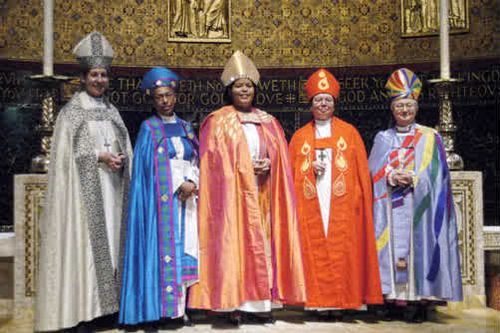
The decisive vote on women bishops in the Church of England has thrown up some interesting comments from the rest of the Anglican Church. I am not going to comment on these in detail but we should note that the woman bishops decision has been welcomed by the Anglican church in Uganda. The Archbishop of Uganda, who has welcomed the vote, leads a church that is part of the GAFCON group. As we noted on this blog large parts of the GAFCON grouping are virulently against the idea of women becoming priests, let alone bishops. These churches, particularly the Diocese of Sydney in Australia, would claim that their position is made inevitable by the passages from St Paul which speak of men being in a position of headship over women. Their position is well summed up on the REFORM website by their leader Rod Thomas. To be fair to members of GAFCON, they did admit at their conference in Nairobi last October that their members differed on certain issues, including their position on women. But one still wants to ask: ‘If you can differ about this very serious issue in the life of the Church, one that has caused grief and pain for large numbers of your members, then should you not come together and learn how to read the bible together? It is after all the same bible that you are reading.’
Coming at this issue from a quite different perspective, one would suggest that the reason Sydney, Uganda and members of REFORM disagree about the ordination of women has nothing whatever to do with biblical interpretation but everything to with history and sociology. I do not have all the facts to prove this point but if we were to look at the church history of Uganda and Sydney respectively, I would expect to find particular personalities and local traditions that caused the bible to be read in these different ways. To suggest that the leaders of the Australian diocese of Sydney read the bible in any other way than strict Protestant scholarship allows them to, would of course be thought by them to be insulting. But it would seem obvious that local factors, many of them not theological, can be found to account for the way this particular tradition in Australia grew up. One idea I have seen floated is that the paucity of women in the convict period of Australia meant that men were disempowered by the ability of women being able to extremely choosy as to whom they took for husbands. Whatever the reasons, the Sydney position is one that diverges not only from mainline Anglicanism but also from fellow conservatives in Africa.
Some might wonder why I have continued this discussion about women bishops. The answer is simple. Those who claim to follow the bible as being the inerrant word of God seldom agree as to what it actually says. Even those who gather in great international assemblies such as GAFCON 2008 and 2013 for the purpose of undermining, even destroying, the Anglican Communion, cannot agree on what the bible says. One response to this failure to agree on women’s ordination might provoke a response of humility. We do not agree, therefore we will seek to discern in humility and patience what God might be saying on this and other contentious issues. There is in fact not a smidgeon of humility in either of the statements from Jerusalem 2008 or Nairobi 2013. If we were to summarise the tone of both statements, they might be held to say simply ‘We are right and anyone who does not agree with us is wrong. ‘
The number of Anglicans who read the bible in the Sydney way and believe in the notion of headship is, thankfully, tiny. But there are many who read their bibles in a way that leads to dogmatic and fiercely partisan oppressive ways. Many women and children have suffered over the centuries because the male sex has taken upon itself the right to dominate and control everyone else. It is a serious matter that the Bible is claimed to be the source of this dominance. If the bible is a cause of stumbling for many, then let us learn to read our bibles in a new way. If we cannot manage that, let us at least introduce a note of humility before we declare that we KNOW what God’s will is for our fellow human beings.