One of the ways that this blog is maturing is in the way that it is beginning to develop a feeling of ‘we’ about it. One regular contributor spoke of Surviving Church as being for him a virtual church. I am not going to argue for or against this notion but I am certainly pleased when commenters say they feel ‘safe’ in each other’s company. I am always grateful when there is a contribution to what I write in terms of new information or helpful discussion. Today I am particularly grateful to ‘Froghole’ both for having interacted with one of my posts and set me off on a new path of reflection about the Church of England. Froghole gave us the vivid fantasised image of someone important at Church House sitting down with an actuary, in order to make a decision about the way that the Church of England was going to deal with future claims of compensation for past abuses. This process of calculation, he suggested in a memorable phrase, would be based on ‘balance sheet thinking’. The outcome of the calculation in this fantasy exchange produced the conclusion that it was better for the Church’s future survival never to admit liability. Froghole suggested that the ‘ethical and reputational pain’ which the Church would suffer as the result of this calculation would be regarded as worth it for the sake of the future financial viability of the institution.
I want to think through this picture that Froghole has shared with us. The key points in the current survivor/Church fall-out are made easier to grasp by this construction from the imagination. It has the effect of simplifying a quite complex issue into a simple us-them scenario. On the one side we have the as yet uncalculated number of people who have legitimate claims against the church. They need to be heard and receive all the help they require, financial and otherwise, for the abuses they have suffered. On the other side is ‘them’, leaders of a large wealthy institution, the Church. The leaders of the Church evidently believe that they have to do everything possible to protect themselves against these claims. It is a potential nightmare scenario for the Church, especially as it has no way of estimating the potential financial liabilities that may be demanded of it in the future.
Setting out the problem as a confrontation between two sides who have such different perspectives obviously risks becoming a caricature. But there is enough of value in this picture to help us tease out further nuances that are present. Because we are talking about the Church in this scenario, we have to recognise that there will be ethical factors to be taken into account. The most obvious of these is the imperative of the priority of love. This has the practical effect that ‘adversarial’ encounters with claimants should be declared inappropriate and unbecoming. If you claim to love everyone as part of your faith position, it is then not possible to treat them as an enemy. Nor is it right to set up obstructions which prevent a claimant finding the best solutions to resolve pain and promote their healing. We would expect to see dissonance in the body language of someone who is trying to promote love and balance sheet thinking at the same time. That, sadly, is exactly what we did see in the body language of the Archbishop of Canterbury when being interviewed about safeguarding issues. He often appeared conflicted in these encounters. On the one side he showed real and genuine remorse for the sufferings of the abused. At the same appearing unable to say anything practical or pastoral which might have sounded really helpful to survivors. It is as though there was a mysterious powerful force just off camera. This was controlling him and preventing him going further in his expressions of regret and sorrow.
Our commentator, Froghole, has something further to say about the power that exists at the heart of the Church. He suggests that we should not look to Synod to find the source of real power in the Church but to the Bishops and the Commissioners. This group (Diocesan bishops are ex-officio Commissioners) forms an ‘executive’ where most of the real power is invested. This power, Froghole claims, arises from their access to the funds of the Commissioners. Decisions as to the extent of financial support of abuse survivors will be, no doubt, decided by small committees within this group. Within these committees will be mainly the voices of those fully immersed in the ‘balance sheet’ ways of thinking. It is unlikely that the minutes of such meetings will ever be shared with ordinary church people or even the members of Synod.
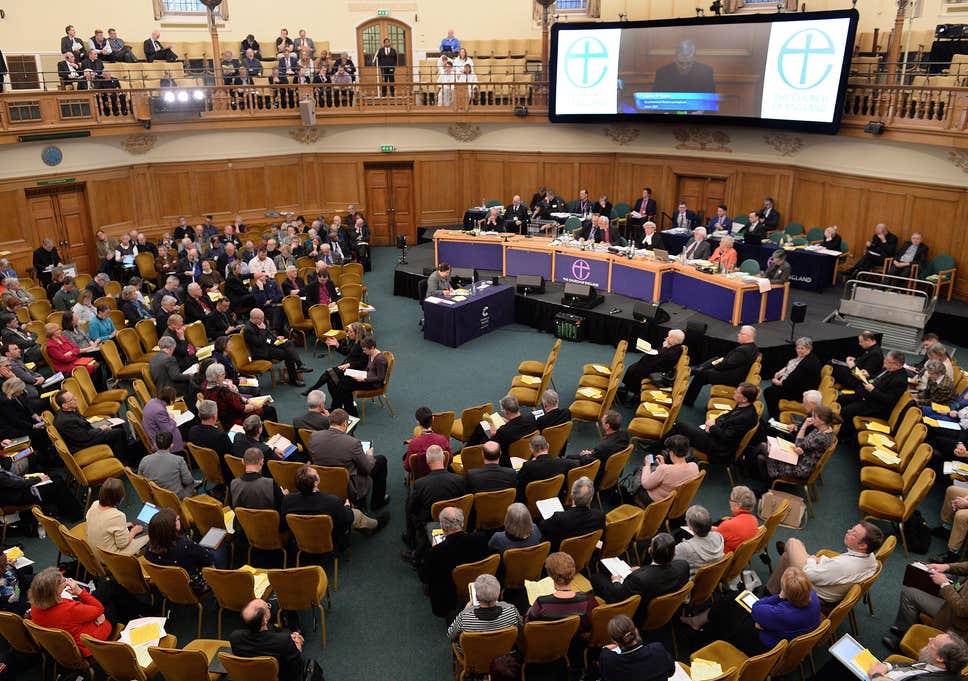
The public face of the government of the Church of England is General Synod. It is, however, becoming clear, especially over the past few months, that the ‘managers’, members of the powerful ‘executive’, are in charge. At the same time these managers are becoming increasingly out of step with GS members. The points of disagreement seem frequently to be over the same issues that concern this blog – safeguarding and abuse. A recent attempt by the executive to control the interests of members was seen in the way that an amendment by David Lamming and Martin Sewell on safeguarding was peremptorily declared to be out of order. The original content of that proposal is to be found in one of the comments from David on a recent post. The detailed points that are made in this amendment are not important here, but it was the way that a challenge to the centres of power was received. That is telling. As I write I am aware that something is being rescued from the rejected motion and the drama will be played in the course of next week at the full meeting of Synod in London.
In my own mind, thanks to Froghole, I have begun to think of the management of the Church of England as being a bit like an enormous juggernaut of power, similar to a political system in the former East Germany or Soviet Russia. Each authoritarian political system has its own public elected body or parliament. They pass laws but real power lies elsewhere out of sight. In the case of the Church of England, power seems to lie not with Synod but with its executive, the Commissioners or the committees that do its day to day work. In recent history, the juggernauts of power represented by Apartheid or the Eastern European regimes were replaced, not because of direct confrontation but through subtle pressure over a period of time. The final victory came about because the powerful side glimpsed how, in the long term, it has to give way to justice and ethical behaviour. It will always be wrong to oppress and pile on suffering on those who are already in pain, as is happening with survivors. The challengers to the ‘balance sheet rulers’ of the Church of England are the survivors, their supporters and the weight of moral opinion in society at large. The pressure is continuous and continuing. At some point in the not too distant future it will occur to institutional leaders that, although they still have structural and institutional power, they do not have moral power. Without the latter they must know that their stance towards survivors cannot be sustained in the long term. It was the moral authority of Nelson Mandela that destroyed Apartheid. There is no obvious single Mandela figure to defeat the balance sheet thinking of our church leadership. There are however a number of us who claim that it is right to continue to struggle on behalf of many who have endured decades of pain, made worse by the indifference of a Church that still seems so often not to understand.