by Martin Sewell
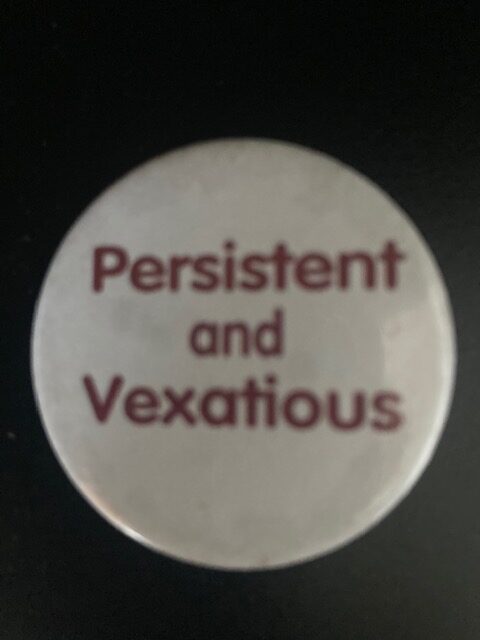
During my time serving on General Synod, having acquired a reputation for raising criticism of Church Safeguarding, a survivor presented me with a lapel badge bearing the words “Persistent and Vexatious”. It was a description which had been bestowed upon him, and I was flattered to be included in the club.
Readers of this blog may call to mind various worthy candidates for such a badge – survivors, journalists, bloggers, and some clergy.
As the story of “Survivor N” emerges into the public domain[1] (rather like the Post Office scandal), some will want to add him to the list, understanding that, as usual, the Church of England will always throw their critic under the bus rather than hold power properly to account.
It will come as no surprise that Survivor N has been engaged in a battle for justice since 2018; it is not quite over yet, though avid readers of this blog will not be overly optimistic about the likely outcome. I shall be appropriately careful not to compromise ongoing process, but already we can draw two very obvious conclusions.
First, Canon Law does not reliably deliver a timely fair trial to anyone who encounters it in a safeguarding context, especially if the complaint touches the handling of a matter by senior people. Second, the way the various dioceses apply the current sub-optimal legal provisions can only be described as a capricious lottery.
Let me illustrate this by sketching out how the Survivor N’s case contrasts with the treatment of the former Dean of Christ Church, Oxford, Dr Martyn Percy. Both cases took an unconscionable time to reach resolution, to the disserve of everyone involved: for that reason alone we should recall that “justice delayed is justice denied”. Nobody should be in limbo and emotional turmoil for the timescales which CDM participants endure. The CofE is a rich institution, with the privilege of administering its own justice system. It should resource properly all who are forced to engage with its Byzantine complexity, both complainants and respondents.
Both the Survivor N and Percy cases have significant backstories, which I shall set aside for the purpose of simplifying this analysis. Essentially, both boiled down to the need to try an issue of whether a single alleged act occurred and, if so, whether it constituted “significant misconduct”.
Arguably, neither case was overly complex. In the Percy case, the disputed allegation was of touching hair for a maximum of ten seconds; in the Survivor N case, the allegation was that of groping a groin without consent—plainly, and unambiguously, an allegation of sexual assault.
In the Percy case, immediate and prolonged suspension followed. In the Survivor N case, the respondent accused cleric did not spend a day under suspension and was never asked to “step back”. This is odd.
What should happen in such cases is that the period of suspension should be minimised by a swift but thorough investigation, surely including the routine commissioning of an assessment under the Safeguarding (Clergy Risk Assessment) Regulations 2016, so that independent expertise can be brought to bear to ascertain what risk (if any) an accused person poses in his/her ministry. That minimises risk and maximises speed, as well as introducing a degree of independent oversight.
For reasons still not explained, normal process was sidestepped. Dr Percy was made subject to an irregular “in-house” process, rather than the Bishop of Oxford requiring an assessment by one of the dozen risk assessors approved by the Diocese.
The metadata of the resulting report was examined, and its provenance questioned, by the professional cyber document examiner and member of General Synod and its Archbishops’ Council Audit & Risk Committee, the late Clive Billeness. He suspected that there were more contributors than disclosed on the face of the documents. At the time of his death a year ago he was urging Archbishops’ Council to have the suspicions raised by his data analysis independently professionally reviewed and verified. The powers that be continue to evade doing so, and one can only conclude that they are terrified of the implications if Clive were to be proved correct in his concerns. The PR interests of this institution always come before justice.
In the Survivor N case, inexplicably no risk assessment at all was required by the safeguarding team in London diocese. Purportedly, this was because the police had determined that they did not have sufficient evidence to charge the accused under the CPS guidelines. Two observations should trouble us.
First; the evidential bar for a criminal prosecution is set at a significantly higher standard to that triggering a clergy risk assessment. Second, Dr Percy had been treated by the police in precisely the same way as the respondent to Survivor N’s complaints, by those same standards, but had been suspended. Consistency there ain’t – and that troubles me.
A further contrast relates to the different ways in which the complaints were facilitated.
The Oxford accuser was immediately “protected” by the adoption of her complaint by a cathedral canon, who was the formal CPS complainant and who brought in significant logistical support from both college and diocese in the form of the diocese’s legal advisors Winkworth Sherwood LLP and PR consultants Luther Pendragon.
Survivor N received no such support whatsoever; quite the reverse—though he is universally acknowledged to be a “vulnerable person”.
The term bears a moment’s consideration. It does not connote intellectual impairment, or complete lack of judgment. Dr Percy’s complainant was competent and assertive; she was accorded protected status, and significant resources went with it. The processes of Canon Law are complex and labyrinthine. The Percy complainant was insulated, guided, and professionally supported throughout. I have no problem with anyone being fairly supported through such processes – but “anyone” isn’t.
In sharp contrast, Survivor N was abandoned to his own devices, notwithstanding his patent disadvantage. The human rights principle of “Equality of Arms” requires both sides of a dispute to have a fair and proportionate opportunity to formulate and advance their case. This did not, and routinely does not, happen in the CofE.
As a safeguarding lawyer, I was a member of the panel authorised by the Official Solicitor. Members assess those with potential litigation disadvantage and act on the vulnerable person’s behalf, informed by their wishes and feelings, while reporting to, and receiving ultimate instructions from, the Official Solicitor. These lawyers are the “eyes and ears” of the OS, who oversees good and fair process. The secular world gets this right; Canon Law makes no such provision.
For years, Survivor N was left without continuity of support and the vital over-view which this brings. The Church made multiple admitted mis-steps along the way, adding to his confusion and frustration. Canon Law presents to lay people as a series of complex, unfamiliar—sometimes hostile—legal procedures; unsurprisingly these complexities can overwhelm the vulnerable. Survivor N ran out of his own initial financial support and thereafter begged such intermittent support and legal advice from friends as he could secure from time to time. He is pitifully grateful for any pastoral support or guidance he was able to source.
Within a history of confusions and alleged errors in this case, do not minimise the importance of continuity and overview which the role of the Official Solicitor offers to the secular vulnerable, helping them to focus their submissions – sifting the wheat from the chaff and advancing the best points coherently. Amateur passionate pleas for justice are no substitute for forensic analysis. Canon Law doesn’t do overall justice; Canon Law does Canon Law.
Survivor N has struggled with two specific problems.
He presents with a disclosed, medically authenticated, Obsessive Compulsive Disorder (‘OCD’). Although highly intelligent and articulate, this presents him with a real and constant difficulty in “seeing the wood for the trees”. This is the major feature of his condition, of which he is conscious.
Advised early on that if he did not present evidence comprehensively, he might have difficulty introducing it later, he sent everything in, often unfiltered and duplicated; then the Diocese lost track of the case for years. Although he couriered his large bundle of papers (500+) to the published diocesan address and office of the bishop, the office had moved. The examining registrar accused him of not presenting the evidence (foolishly quibbling when he produced the courier receipts) and he had to spend hundreds of pounds on duplicate photocopying that should not have been necessary.
Had Survivor N enjoyed the same support as the Percy accuser, the case would not have “sunk without trace”, with evidence bundles seemingly lost. He would not have “banged his head against the diocesan wall”, feeding a sense of injustice, frustration and despair. The issues would have been identified early, and the evidence on his behalf would have been collated properly and professionally, to the benefit of himself, the respondent, the diocese and the CofE. The case would not have stretched over ten years, only to be “fast tracked” in panic once the institution realised the horror of the position into which its structural and pastoral incompetence had delivered itself whilst under the public gaze.
“Somebody” briefed the Bishop of London to tell the media that his abuse allegations against a member of the clergy had been “fully dealt with”, only for her to have to backtrack days later.
The now Archbishop had received “survivor trauma” training along with all members of Archbishops’ Council after the Jay report excoriated the Church. Additionally, she, with Archbishops’ Council, had received the independent psychological report which Dr David Glasgow delivered on behalf of survivors, setting out the harms this kind of institutional cruelty inflicts upon victims. She had every reason and opportunity to appreciate and act upon the kind of harm from which Survivor N was/is suffering.
Throughout this time, this vulnerable person – who was asking nothing of the Church except basic competence and justice- was constantly remembering how he had been dragged into a grotesque game of ecclesiastical whack-a-mole.
They cock up, he complains; they do not resolve it, they cock up again. He keeps pointing it out and, at the end of all this, HE is the one being called vexatious!
However, most serious point is this; farce almost became tragedy.
As Bishop of London, Sarah Mullally held formal responsibility for the “unfortunate’ overall handling of the case by the diocese, like the respondent to the original complaint she has not been suspended for a day.
The bishop’s defence—that she merely followed diocesan advice and had no general safeguarding duty—is irreconcilable with the document – House of Bishops’ Key Roles and Responsibilities of Church Office Holders and Practice Guidance (2017), which states unequivocally that ultimate safeguarding responsibility always rests with the diocesan bishop. Nobody has explained how this core principle was honoured in practice.
I remind readers of the stark contrast with the swift suspensions of Dr Percy and, in 2019, of the former Bishop of Lincoln, Christopher Lowson, who became the first Bishop suspended for not handling a case well[2].
Archbishop Sarah’s record is arguably more serious; she was formally responsible for diocesan failures when the infamous “brain dump” of tittle tattle resulted in the suicide of Fr Alan Griffin and the distress of multiple clergy, who also fell under ill-informed diocesan suspicion. Little says “dysfunctional diocese” more strongly than a highly critical coroner’s reference to the then Archbishop of Canterbury of a regulation 28 ‘prevention of future deaths’ report.
This final part is crucial to taking these matters seriously.
I have Survivor N’s consent to place in the public domain that, during this dreadful saga, he, too, has suffered mental breakdown and has been driven to attempt suicide – twice. The “powers that be” know this. On one occasion, he was saved by a casual passer-by who discovered him in a public place. Archbishop Sarah and the Church are deeply indebted to that anonymous good Samaritan who saved them from a second coroner’s report.
Survivor N is known and respected for his work amongst a wide and diverse community for his commitment to peace and reconciliation; both there and beyond. Every person who has heard his story (except within the Church of England Establishment structures) is appalled by what they have witnessed – every… single… one.
I am ashamed by the new President of Tribunal’s decision to designate this victim’s complaint, in these circumstances, as “vexatious”. Describing a vulnerable person, a known suicide risk, in such a way carries plain and obvious welfare risks bordering on the irresponsible. You might have assumed that in the light of past history, and amidst all the publicity, somebody in the CofE legal team, NST, Diocese of London, or Lambeth Palace, would have thought it prudent to initiate a check on his safety and wellbeing. None has.
Lessons have not been learned.
To have his complaint termed “vexatious” by an institution which persistently behaves in such a manner towards the vulnerable is no disgrace. I hope Survivor N will join me and many within the survivor community in embracing the term as a badge of honour.
[1] See the (redacted) decision of the President of Tribunals, Sir Stephen Males, posted on the CofE website at the request of the Archbishop of Canterbury: section-13-review-decision-n-v-mullally-12.2.26.pdf. It is also on the Archbishop’s website: Publication of independent decision by the President of Tribunals on a complaint brought under the Clergy Discipline Measure against Archbishop Sarah | Archbishop of Canterbury.
[2] For a discussion of the legal issues related to Bishop Lowson’s suspension, see the article, published on Thinking Anglicans: Suspension-of-Bishop-of-Lincoln-article-24.5.2019-v.2.pdf.
This story, including reference to other victims in the case, is reported in the Daily Telegraph and Premier Christian Radio
https://www.telegraph.co.uk/news/2026/03/09/church-throws-out-abuse-victims-claim-mullally-archbishop/
https://premierchristian.news/en/news/article/church-of-england-dismisses-alleged-abuse-survivor-s-appeal-against-sarah-mullally
The President’s decision, and Archbishop Sarah’s comment in response, are also reported by the Church Times: page 3 of the 13 March 2026 issue and online at https://www.churchtimes.co.uk/articles/2026/13-march/news/uk/safeguarding-complaint-against-archbishop-of-canterbury-dismissed-on-appeal-as-vexatious
Zero surprise at any of this!!! A Cambridge educated university professor, an experienced schoolmistress, and a recently retired NHS medic, all saw a man in a state of emotional shock after a meeting with a New Wine course tutor. The quivering student victim was almost speechless, and was timed crying for well over an hour in my living room. A middle aged farmer/businessman is not the kind of person any of the three witnesses expected to see in such a state. Within several weeks two of the three witnesses also had every good reason to feel accused of sexual misconduct by the same New Wine tutor. How many times do bishops or archbishops need to see an identical or similar pattern emerge before fixing a formal and independent inquiry? It is close to a decade since the incident referred to above was reported in writing to an Archbishop. There is still no sign of any formal inquiry. Why was Sarah Mullally ever elected as Archbishop, and why is she not being asked to resign?
I think drawing comarisons between survivor N and the person who is termed the Percy accuser is unneccesary and weakens the tone of this post into old grievances and polarised positions, and has presumably been done without the consent of the Percy complainant.
I was saddened for survivor N but equally not surprised, being medically vulnerable is not an asset it simply gives the church reason to abdicate responsibility as the survivor has already been proven to be ‘mad and bad.’ I know, it has happened to me but I am female so unlike survivor N I am also assumed to have ‘had an affair’ with my abuser, ‘led the poor chap on’ etc because that is what female survivors still have to tolerate. My CDM was also termed vexatious on appeal, it hurts, but is equally unsuprising as the system is very emmeshed and patriarchal.
I wish survivor N (and the Percy survior) well.
What is the common denominator in a great many cases of concealed Anglican BAH? That’s maybe where we need to apply Occam’s Razor!
Does a blasphemous contempt for biblical principles of natural justice underlie countless cases of BAH cover up? A bully throws their weight about, gains confidence, repeats their maltreatment of people and sees victims get silenced and/or driven away.
They gain a reputation for being untouchable, and it can then take an eternity for somebody to stand up to them. Cronies and cliques protect the clan at every twist within the Church. How else can we explain the Smyth-Fletcher-Pilavachi cases and countless others? And when totally cornered, some senior Anglicans engage in-“lawfare”-or NDA use to drive away whistleblowers-witnesses-victims.
Anglicans have to choose. It really is a case of depart, or else think of better strategies for unmasking Anglican Church bullies and the clerics who shield them.
I need nobody’s consent to use material in the public domain to make an obvious comparison which demonstrates inconsistency in the CofE handling of closely comparable cases.
I term it a capricious lottery: my wife wisely corrects me. In a lottery, there is a minimal but real chance of winning.
Bringing a case which the Church does not want brought, against senior figures has no chance of success.
As in a crooked casino the Bank controls the game and always wins
My failed CDM complaint was described as discursive. I was distressed that the Deputy President was unable to be less abrupt in his ruling. He and the Bishop (sadly the same one alluded to by Susan Hunt) seemed to have an ingrained mindset that clergy never lie. My evidence was more than ‘he says she says’ but they didn’t see it that way. Nearly one year since the new bishop came into the diocese and I’m still waiting for her or her PA or her chaplain to respond to my emails, including a safeguarding concern.
Peejay, I am interested in the similarities of our two cases including your view that we originally shared the same bishop.
Your experience was that the Bishop and Deputy President have ‘an ingrained mindset that clergy never lie’. Ours is not only that, but that the Bishop believed the Diocesan Safeguarding Officer never lies. In believing the DSO, despite all evidence to the contrary, the Bishop was perpetuating her untruths with no hope on our part for any justice or truth.
You, as well as ourselves, had a failed CDM. Ours was filed against a Canon who, we read from Subject Access Request information, had undue influence within the Core Group, enforcing her own negative views of the Respondent on the group. She was close facebook friends with the boy complainant and his mother. This inappropriate friendship was not declared on the forms at the Core Group meetings. During the CDM investigation the Canon was promoted to another cathedral.
When the conclusion to the CDM was finally published the Registrar, Chancellor and Bishop claimed that my friend was a ‘choir member ‘ implying he had easy access to choristers. In sixty years at this cathedral my friend had never been involved with the choir. This was officially pointed out but there was no response or recognition of this false information. Neither do we know where it came from.
The power of the DSO in having the total support of the senior clergy in her untruths overwhelms us and in the face of this collusion we realise there can be no realistic expectation of any justice for my friend.
That doesn’t mean we will give up if an opportunity presents itself. I am still here.
Thanks for that response Susan. I also had bad experiences of the Registrar (the one who died an untimely death), a late entrant to the legal profession and seemed to know little about the CDM process.
I had no involvement with the Chancellor (the one who served a short term; he and others in the diocese were heavily criticised in a Dean of Arches judgment).
My contact with the DSA was positive. I don’t know if she was the one dealing with your tragic long running fight for truth and justice. The DSA was very supportive when my CDM failed, the only one who could see why I was gutted at not being believed.
Many years ago I used to worship at the Cathedral in the time of John Petty and Peter Berry. I didn’t know ‘Kenneth’ personally but I recall his contribution. He’s blessed to have strong advocates but it’s clearly taking a toll.
Patricia, I’m sorry you’ve had such a tough time with the Church. You’re not alone, as you know; I hope you’ve found some support.
But I’m a little surprised, in the context of the Church’s mishandling of so many abuse cases, of your apparent dismissal of ‘old grievances’. Grievances remain grievances until they are settled with justice and compassion for all parties. The passing of time, without such resolution, does not invalidate or weaken them, and citing them does not weaken a case being made.
You are right Janet to pick me up on this and I would not normally term matters in this way but I find it very triggering when the Percy survivor is treated so carelessly. In the blog whilst the author says he does not mind anyone finding support he also clearly draws a distinction in seriousness between having ones groin touched and having ones hair touched. If he was not making that distinction he would find no need to add, for under ten seconds. As a survivor I find it extremely unhelpful to grade situations in matters of seriousness.
I am not in any position to make any judgement on the Percy case but I know how I would feel if I read that about myself in a blog, hurt, dismissed and invisible especially as the author feels he does not need to be trauma informed and seek the survivors permission.
I should, I agree, not read anything by this author as it often ends up down this rabbit hole but I genuinely am deeply saddened for survivor N and very much felt they deserved a blog post about them without muddying the water with other cases.
Thank you Patricia for your thoughtful comment. Unfortunately the person who made the complaint about Percy had been inexplicably blocked from making any comment on this blog and so isn’t able to speak for herself here. I know she appreciates your comments.
It’s probably wise for her not to engage with this blog post for her own wellbeing, but shocking that a survivor would be blocked from posting here.
I’m also thankful for your posts Patricia and agree with all you say.
It’s unhelpful and hurtful to impose a hierarchy of abuse on survivors, when we cannot judge the impact on individuals.
It’s a DARVO tactic to deliberately minimise the experience of victims and not something that has any place on this site.
I won’t say more because this should be about Survivor N, not undermining the complainant in the Percy case.
Being labelled vexatious because action and accountability only happens when you are persistent is another form of DARVOism which sadly too many of us are familiar with. I’m sorry Survivor N has had this added to his long ordeal.
Thank you again for this Patricia re the Percy complainant, who is also a survivor who deserves the same consideration as the rest of us.
I’m sorry that your CDM also was given the hurtful and unfair label of vexatious. As you know I can relate to the issue of abuse of adult women being dismissed as ‘affairs’. I’m not sure how we change the pernicious culture that maintains this. I wonder if the tribunal officers have ever had any training on spiritual abuse, consent and trauma-informed practice?
A most welcome blog.
A timely reminder to the hierarchy of the Church of England that their abusive safeguarding practices will not go away until they make positive and speedy changes to their attitude. It must be humiliating to have such reminders as this and to be so publically exposed. I really cannot understand the reason senior clergy do not seem to be thoroughly ashamed of themselves. They appear not to have any guilt about the lives they have destroyed.
There is no excuse for such an attitude because the Church has the Jay report recommendations to follow, for which they paid financially to have such an eminent and honourable person to investigate. That would be a just and honest start for change; it is already laid out as to what needs to be done.
I was particularly interested to read Martin’s reference to the role of Bishops. The original diocesan bishop in our case (where for six years I have supported a friend in a sexual allegation for which there has never been an independent investigation) had met with us for more than two hours and scrutinised in detail our documented evidence based on Subject Access Request information. This showed that the DSO had singularly failed to follow fifteen procedures laid out in the house of Bishops Guidance.
Later, the DSO gave the bishop erroneous facts and untruths which he accepted as the excuse not to help my friend saying he could not, “override the advice given”.
Why could he not override the advice he was given? Martin quoted a reference saying, ‘safeguarding responsibility always rests with the diocesan bishop’. Surely our bishop knew that? Anyway all that was before he received promotion and became even more senior in the Church.
As Martin says,‘the PR interests of this institution always come before justice’
Martin Sewell makes the point that the ‘House of Bishops’ Key Roles and Responsibilities of Church Office Holders and Practice Guidance (2017)’ “states unequivocally that ultimate safeguarding responsibility always rests with the diocesan bishop.” That this responsibility cannot be delegated was affirmed by the judgment of the previous President of Tribunals, Dame Sarah Asplin, when dismissing an appeal by Bishop Christopher Lowson against his suspension by former archbishop Justin Welby, the legal issues relating to which I discussed in my article referenced at footnote [2] above.
Two months before his suspension Bishop Lowson had delegated his safeguarding responsibilities to the suffragan Bishop of Grantham. At paragraph 29 of her judgment Dame Sarah said this:
“In my judgment, therefore, section 13(15) [of the Dioceses, Mission and Pastoral Measure 2007] makes clear that a diocesan bishop remains ultimately responsible for safeguarding within his/her diocese even if the actual functions have been delegated. Accordingly, he remains responsible for the act of his delegate, for ensuring that good safeguarding arrangements are in place and that the appropriate practice is adopted and effected within the diocese by the delegate. A bishop cannot divest himself of such ultimate responsibilities, even if the day to day tasks or functions which he would otherwise be required to perform personally have been delegated.” (Decision dated 27 June 2019)
Although Bishop Lowson’s suspension (under section 37(1)(e) of the Clergy Discipline Measure 2003) was upheld, it should be noted that in a subsequent decision under section 17 of the Measure on 20 December 2020, the President ruled, after receiving the designated officer’s investigation report, that the bishop had no case to answer in respect of two alleged safeguarding failures that had been the basis of his suspension.
“….ultimate safeguarding responsibility always rests with the diocesan bishop…..” Does this inevitably often set us on a path to disaster? A Bishop must face an inherent conflict of interest when dealing with allegations of bullying or abuse by their diocesan clergy. A Bishop may well lack legal credentials, and also lack psychology-psychiatry-trauma credentials. Is there a strong likelihood of many Bishops being defective in both of these domains? We quite simply have an Anglican system designed to produce failure after failure ad nauseam, so should not be surprised by what we see time after time.
I was a GP and NHS hospital doctor prior to retirement. In the final years of NHS service I did a 2-year New Wine course as a diocesan student. A GAFCON bishop, who was running our diocese, appeared profoundly uncomfortable with me being unmarried and sharing a home with my female partner.
My partner has had a range of health problems, and we mutually decided a long time ago how the sex and reproduction game was something unwise in our situation. This issue really was absolutely none of the GAFCON bishop’s business. The bishop refused to meet me and my partner. We felt insulted and disappointed by this.
The GAFCON bishop operated through an intermediary, a New Wine tutor attached to a local parish. The tutor accused me of “living in sin” and told me my presence would “defile a pulpit”.
It felt as if the diocese went out of their way to break national law, fail to observe Anglican Church rules and blasphemously disregard biblical principles of natural justice. A very senior Methodist minister was shocked and advised me to insist that the GAFCON bishop commission me as an evangelist, but to then urgently leave the local diocese to avoid threat of further trauma and bullying.
Latterly I have served for a number of years as part-time medical member on judicial panels. Although there are undoubtedly highly specialist matters regarding church law, are the universal fundamentals of law often shown blatant contempt in Anglican Church cases? The fundamental basics do matter. They are also biblical basics.
An attacking rugby team will often aim to recycle the ball quickly from a ruck, and then fix to rapidly conclude a successful scoring move . The Anglican Church systems do the opposite of this. Diocesan teams have every motivation to shield bishops from criticism and let serious complaints (with absolute credibility) metaphorically sit in drawers-or inboxes.
Peejay, thank you for that information.
My friend remembers both John Petty (who was the last Provost before the post was named ‘Dean’) and Canon Peter Berry very well as he had worked closely with both of them, especially Canon Peter.
I am very glad you were supported by the Diocesan Safeguarding Adviser, now of course called ‘Officer’. This is in sharp contrast to her attitude to my friend as readers of this blog are well aware and which makes these differences even more puzzling.
Martin’s piece has not only again highlighted the Church of England failures and inconsistencies but, through yours and mine comments opened up those of the particular diocese of our cases.
For my friend it has not been just the safeguarding group who have been involved with safeguarding decisions. In the early years 2020-21 the intervention by the boy’s mother played a large part in this. It seemed there was a personal prejudice on her part against my friend which was never challenged by the DSO. The mother spread untrue rumours and idle gossip (of which I have evidence) which the DSO and Core group accepted as being true without any proof.
This was the same attitude as in the Ghosh case which featured on Surviving Church and which made the link in that blog between the Reverend Anne-Marie Ghosh and my friend:
https://survivingchurch.org/2025/08/22/false-allegations-rumours-and-assumptions/
One cannot help but wonder what other bungled safeguarding cases there are in that Diocese. After all there is the Philip Aspinall case that we also know about.
Surely there must be some way for the people responsible to be called to account. If they were then the C/E might be galvanised into taking action throughout their safeguarding or is this too optimistic?
I did not choose to spend ten years of my retirement reprising my professional expertise ( for no reward!!) My wife wishes I had not, but the two things I hate and cannot let pass are injustice and stupidity.
The Church of England Safeguarding culture displays both constantly and I am sadly in a somewhat unique position to make analyses and draw important comparisons. People trusted me with their stories knowing that I would not betray them; I use portions of what I know to highlight bad practice when I can. It is not always possible. One of the cases that most outrages me is one where the victim was paid off to save a Bishop but placed under a Non Disclosure Agreement; where the substantial monie came from and how they were accounted for remains a mystery.
Some reader may know that I instigated Synod questions about this. In fairness Archbishops Justin and Stephen both deprecated the practice but it still goes on. We do not know how much pew money is spent on cover-ups neither do we know how many such agreements have been imposed throughout the Church. the Bishops remain unaccountable. Survivor N is but the later to take a punishment beating at the hands of the Church lawyers “pour decourager des autres”.
I do not apologise for this blog laying two cases with significant similarities side by side and highlighting that they had rather different modes of handling. I do say that “anyone” engaged in these processes ( complainant and respondent) should be properly supported but demonstrate that this does not happen:that should lie the focus of concern here.
I do wish people would read my posts with the same care with which I write them.
Nor should you apologise, Martin. We, and the Church as a whole, desperately need people with a strong sense of justice who are willing to stand up and be counted. All survivors and our allies have reason to be grateful for your unremitting and costly work on General Synod and elsewhere.
Sadly, the arcane bureaucracy that lurks underneath the surface keeps most stuff hidden – such a disconnect between the church of the people of God and its lawyer dominated hierarchy! (Not a general disparagment of lawyers, Martin!)
Indeed! Across the Bible ‘2 or 3 witnesses’ are enough to settle a matter. But with some Anglican scandals can it feel as if X200-300 witnesses-whistleblowers-victims are nowhere near enough? The absence of professional barristers or judges, independently analysing evidence of BAH (bullying-abuse-harassment), is what has repeatedly brought shame on Anglicanism. The absence of immediate and incisive legal input is surely what has been missing in ever so many cases of BAH allegations not being addressed.
Michelle Burns has extended the conservation on the “ Guarding the Flock” blog
https://x.com/guardintheflock/status/2033699788189819245?s=46&t=cMgva0Hqx5rcbPzjAeZauw
An excellent short article! Thanks.
We speak about DARVO. It maybe should be DARVO-T. Deny-Attack-Reverse-Victim+Offender is cynically effective, but ‘T’ is the icing on the BAH (bullying-abuse-harassment) cake. T is for “troublemaker”.
Essentially we have a church system crafted to present whistleblowers-witnesses-victims of BAH as “troublemakers”. I made a formal statement to an Archbishop in 2017 about an incident where a teacher-medic-prof saw a student in emotional meltdown after a meeting a New Wine tutor.
The student claimed he felt accused of adultery in foul language. Within weeks two of the three witnesses also felt unfairly accused of sexual misconduct by the same New Wine tutor. Close to a decade later there is no sign of any formal and independent inquiry.
How many professional eyewitnesses of an adverse incident are needed before the Anglican Church gets a grip on things? The biblical 2 or 3 should surely be enough!
I think you mean ‘conversation’, Martin – but perhaps you had in mind conservation of reputations!
Thank you Martin for this blog and for fighting the good fight against the failures of the church to protect its flock.
I would echo this comment from Margaret. There may be some who are casual about your writings but there are many many more who appreciate what you are doing.
I have spent the last five years since I ‘discovered’ you, quoting to the diocese the challenging words in your blogs, letters and documents. In the early years I could not understand the reason there was never any response to what you had written but I continued to quote just the same.
In our diocese at least it is lack of respect for any sense of Honesty or Truth.
Keep going Martin we need you.