One of the outcomes of the internet revolution is the arrival of virtual meetings. People can gather across national boundaries and time zones and see and speak to others who share their concerns. Information can be shared and matters of common interest discussed in real time. Zoom meetings have come to stay and we are still exploring their full potential in the Church and elsewhere. We are well on our way to creating a radical revolution in international communication which is every bit as earth-shaking and transformatory as the original take-up of email in the 90s. The barriers of distance are now no longer so high as they once were, even if we have some way to go in making this new technology available and useable by all of us.
If Zoom is the new word to describe the ability of people to meet others across the world, YouTube is the name of the technical medium which enables us to have new experiences of Christian worship. My wife and I have been virtual attenders of a variety of acts of worship around Britain. While physical participation in worship inside a building is obviously the best option, there is something to be said for witnessing liturgy and music being conducted to a high standard and listening to a different preaching voice from one’s normal fare. More recently I have started attending acts of worship quite different from what I am used to so that I can learn something more about C/E congregations that sit lightly on the patterns of traditional Anglican worship. I am particularly interested in exploring the worship styles of the so-called Resource Churches and the way that this way of worship is carried over into many church plant congregations. I freely admit that there is a great deal that I have yet to understand about the culture of worship which is charismatic and might be described as post-liturgical. But, being able to experience it via YouTube does allow me as the observer to get a glimpse of what is going on in these congregations. I can thus ask myself whether I could ever identify with a form of worship using such styles. My first impression is to note the enormous gap between the traditional Parish Communion hymn-book styles of liturgy, that prevailed during my entire ministry, with the bands and ‘gospel music’ cultures of today. It is an important task for both these styles to try and understand each other. This is what this blog piece is attempting to do from a liberal catholic perspective.
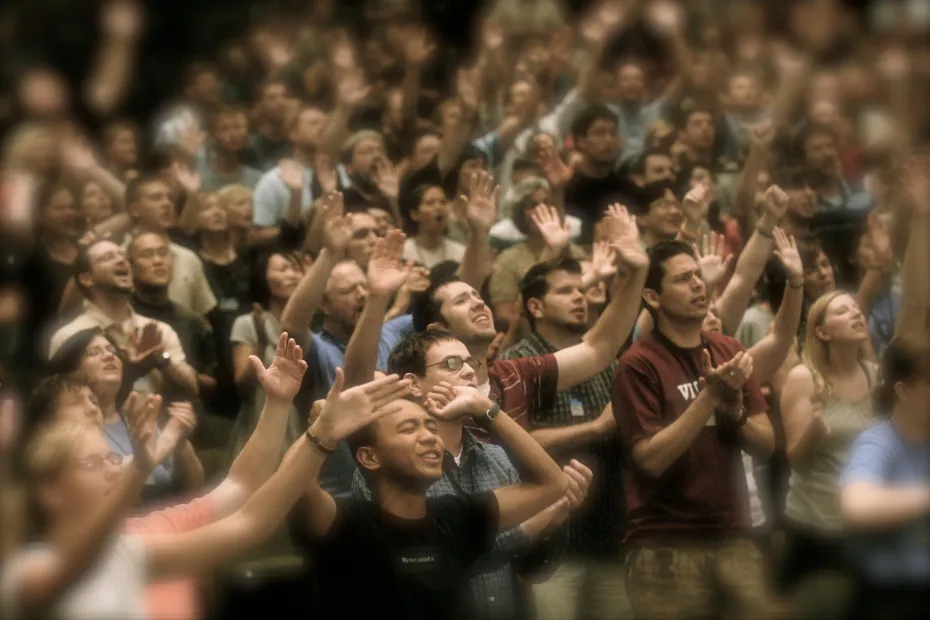
It is only since Christmas that my visits to important centres of charismatic/evangelical worship in England have taken place with any depth or persistence. The three that have been visited are Holy Trinity Brompton, Gas Street Birmingham and Soul Survivor Watford. The one I have returned to the most is HTB and most of my comments will mainly reflect my experience of its practice and style. The first comment I have to make is the sheer power of the music at all the services I witnessed. The typical music played is at a physical level often overwhelming. It has this ability to enwrap the individual worshiper in what feels like being submerged in warm water. The overwhelming sound created by the professional musicians with singers and instrumentalists is hard to stand apart from, however much one wants to calmly evaluate this music theologically or musically. In my attempt to get a grasp in what was going on, I was quite grateful to have the distance that YouTube was providing to help me hold on to a measure of objectivity. If I had been in the building trying to be a detached observer, I might well have failed. The length of the solid block of music confronting the worshippers at the start of the service (15-20 minutes) felt like being thrust under a waterfall of sound. I would be interested to read a study that explained how such loud emotionally laden music affects the brain’s workings. The waves of sound and repetitive music certainly reached quite deep areas of the mind. In some ways the experience was enjoyable but in other ways I felt as if I was being deliberately taken over to become part of a crowd process. I felt that the music was demanding a complete surrender. If the singing and guitar playing on a computer screen could have this effect on me, what would happen if I was there in the building. Perhaps I am now too antique to be able to cope easily with negotiating compelling music of this kind which was leading along a scale to something resembling trance and hypnosis.
The critical part of my brain was able to function in this experience, especially because YouTube allows one to press pause and listen to songs more than once. I was able, I think, to identify techniques being used by the musicians to increase the compelling nature of their contribution to the worship. I observed the extensive use of repetition in the words of the lyrics as this also applied to the music in general. Particular words like ‘Praise’ or ‘Jesus’ were repeated many times and so such words or phrases came to inhabit the mind in a kind of ‘ear-worm’ experience. Even without constant repetition, phrases of music would remain because of the fact they were ‘catchy’ and designed to linger inside the brain. I am wondering whether the analogy of eating chocolate captures the experience. Something inside the brain is sweet and enjoyable to the tongue but, having eaten it, one is left with the sweet after-taste which is less enjoyable.
In trying to analyse the musical quality of the songs I was hearing, I recognised at least three distinct patterns of musical sound. Each of them is powerful in their own way and no doubt I was experiencing sensations shared by others at the service. Some of the songs seemed to have a bouncy, happy quality. These were the joy, celebration songs and it was evident that many of the worshippers were expressing this feeling by the way they moved their bodies. Typical words in these centred on strength and the victory won for us by Christ. Towards the end of the cycle of songs of this type, the mood changed. Instead of bouncy music, the songs focused on the individual relationship with Jesus and how the worshiper has experienced love, forgiveness and salvation. The music for this was slower and more contemplative. The typical words of these songs spoke of peace, rest and acceptance. The change in style was also visibly expressed in the way that the singers, whether those leading or congregational members, moved their bodies in a quite different way. There was now no bounce in the movement; instead, the movement resembled the way a mother moves when holding an infant in her arms.
A third style of music that I have identified across the worship services that I have attended, is the effective use of a single note used as a background to intercession and prayer. In some ways this use of a background drone note is one of the most powerful moments in the service. What I think I was observing was an unrehearsed prayerful interaction where the power came from a real sensitivity in the leader to both the congregation and what he/she was picking up from the spiritual temperature of the building. . The single drone note was not music as such but an atmospheric sound which I found to be extremely moving, deserving the description of spiritual. In contrast to the rest of the service which felt to be tightly controlled and even somewhat manipulative, I sensed in the drone backed prayer something unrehearsed, spontaneous and open to the Spirit. In short, the point I felt most in tune with the spirituality of the service was in the moment where the leaders seemed to move the mood of the service from control to a time of spontaneity and into what felt like real freedom and tangible spiritual content. The online viewer is of course not allowed to witness the time of ministry and healing that seems to take place at the end of many of these services, but I felt, even as a distant participant, that the atmosphere somehow was consonant with the possibility of inner change and healing.
My ‘visits’ to the headquarters of charismatic styles of worship in England have opened up for me memories of past special services which have participated in a genuine atmosphere of Spirit-filled worship. There have been occasions in my personal worship experiences when I have sensed a pervading mood of spiritual content where anything seems possible. On such occasions, healings, transformations and spiritual growth have taken place. The key point about such precious moments was in their spontaneity. Spontaneity is something very hard to manufacture. My criticism of the worship style of HTB, Soul Survivor and their imitators is a mixed one. A good proportion of what was on offer felt far too formulaic and repetitive to be acceptable or even comprehensible to all. But I also sensed moments of genuine presence of Spirit. HTB and its imitators have, in my opinion, found some genuine kernels of spiritual reality in what they do, but their worship would be still more impressive if they were to discover how to be open to the richness of other strands of Christian worship and tradition. Like other Christians, the leaders of HTB need to recognise that they are on a journey, one which can be more open to the dazzling diversity of what it means to be a Christian in today’s world. Any complacency from a Christian that what they have has put them beyond the place of leaning and discovery, is likely to make them, over the years, become stale and devoid of spiritual power.
I have tried very hard to be positive and fair in describing a little of my experience of on-line worship in a tradition that is not my usual spiritual fare. Perhaps I have opened up in myself a memory and maybe a longing for the possibility of a true spontaneous worship that is not manipulative or controlling. Is there somewhere in Britain that understands what this kind of worship in Spirit and in Truth looks like? I think I might recognise it when I see it.
Interesting-as always-it goes without saying really. The paradigm shift, now so shocking to older people like me, has an acute on chronic character.
The radio and TV, and general internet use/access for quite a long time now, means that Webex prayer or worship is not as alien as it initially seems. That music dimension (of worship) has been visited remotely for decades. But a brief liturgical HC service, or a small group prayer meeting, has a raw authenticity.
The mega church can have a school assembly flavour. Talk about ‘The Church family’ can ring hollow. Would anyone really be rapidly missed from the crowd, in lots of megachurches where ‘The Church family’ metaphor is bandied around?
A fixation on youth and youth work is understandable, and a healthy or necessary obsession. But do lots of single, childless or widowed church members feel very lonely in a church context?
This ‘church family’ theme cuts into church BAH (bullying-abuse-harassment) concealment. Would the average family step aside and neglect glaringly obscene BAH?
‘The Church family’ metaphor can ring hollow when we see how lots of ‘Church family’ members suffered at the hands of Pilavachi-Fletcher-Smyth. Why did the Church family not blow the whistle on it?
You’re brave, Stephen, to enter into these places albeit remotely! And you can appreciate that the worship production is a powerful experience, particularly when it is done as well as HTB does it.
I’ve mentioned my own experiences of actually being in the band doing this stuff, and why I left.
I agree particularly with your observations and feelings about the “spontaneous” bits. I’ve been involved in these too, and they can be deeply profound experiences.
To create an environment like this, I should add as an important caveat, takes a considerable “production machine”. HTB is the best at this, but many other places come close. It requires top level sound and visual equipment, a dedicated and highly talented crew of technicians to get up at the crack of dawn, to set up and run it, and rock concert level musicians to play and sing. The best musicians and crew I worked with could generate these moments of spontaneity once or twice a month. They can play with their eyes closed, millions of notes, from memory, from hundreds of songs, and create soothing sounds more or less at will, often unscripted.
Many other churches, with fewer resources, both human and technical, have a reasonable go at this, with variable success. I attended more than one where the spontaneous bit, was announced as planned. They didn’t appear to see any irony in this.
How much meaning can we allow ourselves to give to these special moments? Is it God?
When you read about our Saviour in the bible, he doesn’t really mention it. He does talk about helping people who have been beaten up, and taking care of them.
In Amos (5.21-4 Message) the writer suggests God is saying ‘I’ve had all I can take of your noisy ego-music.
When was the last time you sang to me?
Do you know what I want?
I want justice-oceans of it.
I want fairness —rivers of it.
That’s what I want. That’s all I want.’
It’s enjoyable and compelling to participate in these worship sessions. They may even be of God occasionally, but it’s a small fraction of what He wants in my reading of it.
The Amos message above could apply to larger charismatic-evangelical churches, where somebody gets savagely maltreated but absolutely no one supports them. We rightly lament cliques of bishops or vicars who cover up bullying, and we deplore sham inquiries by diocesan employees who are not motivated to expose bullying. But congregational silence in the face of sinister bullying cover ups is a problem as well. There can be an acute-on-chronic crisis present, where behind all the emotion expressed in a gushing fashion, the relationships between members in a big church are shallow or meaningless. Handshakes and hand slapping can be superficial symbols, and devoid of deeper real meaning or value. Lots of congregations welcome new members and contributors. But connections can be superficial and shallow. A poor response, to savage and sinister bullying, is a sign to escape from a congregation. I have found smaller clusters of people, as found at tinier midweek gatherings, an antidote to mega-church disco sessions and BS.
I recently discovered this thesis which folk might find interesting. It’s very readable. https://etheses.durham.ac.uk/id/eprint/15626/1/LEACH000632971.pdf?DDD32+
Please could you check the link as it does not seem to work?
I just checked, it works for me. Try this: https://tinyurl.com/9t7b4vth
I heard John Leach speak when he was a curate at St Thomas Crookes. He was very good.
Does he refer to NOS in his thesis?
Yes, although not at great length. He quotes Roland Howard’s book and talks about the malign charismatic power of its leader over his followers. NOS may have been before Leach’s time at St Thomas Crookes, I’m not sure.
Leach was at St Thomas Crookes until 1989, so would have overlapped with NOS. However, I think it was during that time that NOS gained greater independence from St Thomas. NOS continued until it all imploded in 1994 or 1995.
https://en.wikipedia.org/wiki/HTB_network
(avowedly an incomplete list by the article compiler)
(my old one isn’t on the list I see today, whether as a result of slight changes I heard about, or not, I’m not sure)
Having established that the physical is the spiritual, and that financiers are to dictate their half baked idea of “strategic”, will Gumbel and his many lookalikes be up to the challenge to practise good enough care and belief which I didn’t see, promote “actual” worship and not that pretend stuff, make real Bible meanings known which I didn’t see?
Parishioners and public in those places need our prayers about (the real) God’s priorities among the obscure and unfashionable.
Once the catalysers have dictated that your church has been at least semi obliterated by their “strategy”, is one allowed to get the support of a bishop to get “unplanted”? (The so called “Church Society” incidentally uses the same methods as HTB.)
Obviously in a number of neighbourhoods there is far too much monopolising. In one or two, I would feel glad to see a church “resourced”, but the moral imperative is on the high-ups to be honest, and the lowly to be loud, about all costs in deprivation via the HTB tentacles’ solely material dimension.
Even self-proclaiming “anti evangelical” or “anti (faux) charismatic” churches sank to mirroring the same sole material dimension (by essentialising their own ceremonies).
(For example an “inclusive” church makes a closed circle at Thursday “eucharists” so if one uses a common gesture to indicate one is “sitting out” – a privilege I insist on at every individual’s discretion – one is compulsorily subjected to wobbly hands all over one’s head unless one noisily negotiates to the contrary. Whereas on Sundays one can easily self-exempt oneself from “everything” by just staying sat.)
The nation will turn round when a pious and competent person proclaims matins and evensong daily (e.g 1980 version) to all comers in every place. Let deafening, dumbing down and uncaring be made an irrelevant minor option in luxurious enclaves and not a default.
HTB are very professional. As a newcomer to church, then in my late 30’s, I visited HTB. The music and worship were slick, as was the-“welcoming”-after the service. All-Souls Langham Place had a more intellectual or academic sermon, but as an outsider its vastness had a cold sort of assembly hall flavour. There is always something mysteriously special about the unexpected and the spontaneous.
I remember staying with friends in Camden, and popping out to a near empty Methodist Church close to the tube station. The worship and warmth were memorable, as was the incredible diversity within the small congregation. That place felt more like heaven than HTB or ASLP.
The depth of spontaneous worship and prayer, at Free Church of Scotland services in the Highlands or Islands, can be very profoundly moving. Hebridean Gaeltacht services I attended in the past were memorable. The congregation appeared to have a total expectancy before worship, which you rarely seem to see in a lot of other settings.
The Anglican liturgical situation is interesting. There may be an attraction in dispensing with Morning Prayer, and running with weekly Holy Communion. This can be more attractive I find if done with a simpler service from a pamphlet (or screen).
The Bible is a hard enough book to grapple with. A heavy BCP, with multiple services or service variants, running through various seasons, can get incredibly monotonous. The idea of ‘ordinary time’ does not make the BCP year sound very attractive.
I form an impression of a great many people now favouring smaller group services, or prayer meetings, or bible studies. The scale of bullying within our denomination could be one reason for this.
There can be nothing much more sickening than a congregation where bullying is openly tolerated, yet the vicar repeatedly talks about the intimacy of “the church family”. Few real families want to see members abused or maltreated. But the “Anglican family” can be different!
Thank you Stephen for an eye opener about church music. Most of my life I have
enjoyed singing and playing in various churches believing I was worshipping God and helping the spirit to work in services. But I see now that that it was more of an ego trip, however pleasant and well meaning. I agree with Steve and love the Amos quote! I have learnt after so many years that I was a slow learner and that the church slowed me down on my pathways to truth.
I’m a slow learner too, Margaret, and I’m still trying to figure this out as a pensioner!
I do wonder how clergy in places like this square this type of worship with their vows to adhere to forms of worship allowed by canon. Has HTB and its friends de facto but not de jure left the C of E?
The thesis I’ve linked to above does explore this question, and how HTB-style clergy (or their bishops) justify their practices.
I’ve had it explained to me, years ago, that bishops can’t really enforce liturgical guidelines for charismatic churches without also enforcing them for Anglo-Catholics. So if a charismatic church got into trouble for omitting much of the liturgy, catholic ones would have to be disciplined for using the missal, holding the Exposition of the Blessed Sacrament, and so on. A kind of balance is maintained by not acting.
A Church so broad it simultaneously believes in little, nothing, anything or everything. Or maybe it has ceased to even believe in belief?
The Belfast summer meeting of the Anglican Consultative Council (ACC-19) will see Archbishop Sarah Mullally visit Bishop David McClay in Belfast. Would it be unfair to parody this as cult leaders convening, a woke priestess and a fundamentalist firebrand?
It is easy to see why so many people are leaving the Anglican Church, or minimising their commitment in the face of leadership incompetence and immorality getting uncovered on a massive scale.
Ask McClay about Rev Canon Dr William George Neely, a child abuser buried in a prominent cathedral slot with his tombstone ending PRIEST SHEPHERD FRIEND. Did McClay and his team fix up an NDA to avoid having to name Neely as a child abuser?
And ask woke priestess Sarah about covered up maltreatment of Fr Alan Griffin, who took his own life in the face of completely unjustified attacks on his reputation by the Church? Hope ‘Boy Dave’ and ‘Sweetie Sarah’ have a nice Belfast tea party in the summer. But don’t mention cynically covered up sadistic and savage abuse of innocent people!
‘Boy Dave’ is ever so trendy. A parish in his diocese features in this Olive Tree Media YouTube film posted 30.1.22: ‘Karl Faase interviews Joe Turner for Jesus the Game Changer Season 2’.
Odd to see armed and hooded terrorists feature in the opening of an evangelical parish promotional film. But it makes a nice change from vestments and Bo-Peep sticks.
Expect Bo-Peep stickery and tons of vestments at McClay’s white elephant cathedral when ACC-19 kicks off. The White Elephant Cathedral has a much needed and ever so useful £850,000 spire. It makes money spent on NDA’s seem sensible, and a wise use of Church member contributions .
James, you’ve let yourself down with this post. I don’t know anything about David McClay and I’m no fan of Sarah Mullally, but there’s no need to be nasty when discussing the shortcomings of either. Reasoned criticisms are fair enough, but it seems to me that abusive terms like ‘‘Boy Dave’ and ‘Sweetie Sarah’’ don’t fit with Surviving Church’s ethos as a safe space.
Happy Easter!
There were around 3,500 deaths from violence as a result of the Northern Ireland ‘Troubles’. Yet a parish promotional film-for a Belfast Anglican parish called Saint Brendan’s-opens with a picture of hooded and armed terrorists. That really is quite obscene in my estimation.
But will anyone among the senior clergy in Down and Dromore Diocese-or the Church of Ireland Primate (Archbishop John McDowell) and House of Bishops-directly ask Bishop David McClay a very simple and relevant question: “what the hell is going on here?”
The YouTube film in question was posted 30.1.22 by ‘Olive Tree Media’ (see ‘Karl Faase interviews Joe Turner for ‘Jesus the Game Changer Season 2 ‘). Do Anglicans turn a blind eye to all sorts of daft nonsense like this, and then get puzzled at Anglican Church collapse?
The vestment and Bo-Peep stick spectacles of the ACC-19 conference in Belfast will see Bishop David McClay welcome visitors to St Anne’s Cathedral in Belfast. But behind that shop window gloss of ACC-19, do serious questions need to be asked about the Saint Brendan’s promotional film?
Secular authorities in Belfast are making an effort to remove unpleasant imagery related to The Troubles. So why does the Anglican Diocese under David McClay allow a parish promotional film to use such grim imagery? That’s surely a fair and reasonable question.
‘Boy Dave’ and ‘Sweetie Sarah’ are very tame words, compared to what has been reported to me, or what I personally experienced. A New Wine tutor savagely attacked two out of five Anglican students in my 2015-2026 ministry trainee year group.
The tutor accused me of “living in sin” and said my presence would “defile a pulpit”. They tried to coerce me into getting married and declined to accept my declaration of celibate status.
Elements of the Anglican Church struggle to respect national law and Church rules. There is also a blasphemous contempt for biblical principles of natural justice.
A second student in my year was witnessed crying after a meeting with the same New Wine tutor. They claimed to have felt accused of adultery in foul language: “Any of us might fancy a change of breasts”.
I timed the man crying and almost speechless for an hour in my living room, after their extended contact with the New Wine Tutor. Their mental state resembled that of attempted murder victims I saw as an A&E medic.
The student was also observed by a Cambridge educated university professor and a senior schoolmistress. Both ladies left the local Anglican diocese after feeling savage student bullying was not addressed by bishops or archbishops.
Bishop David McClay (Boy Dave) will probably don fine vestments and pick a special Bo-Peep stick to welcome visitors to the ACC-19 conference in Belfast this summer. But what is he hiding behind the scenes?
Bishop McClay (Boy Dave) and his team appear to have used an NDA to avoid having to name a deceased child abuser called Rev Canon Dr William George Neely. Neely rests in a grave site by the cathedral seat of our Archbishop of Armagh (equivalent to the Archbishop of Canterbury). Neely’s grave epitaph ends PRIEST SHEPHERD FRIEND in block capitals. A photo of it appeared in Sunday Life newspaper in December 2025.
Bishop McClay was alerted to sinister and savage allegations of sexual misconduct being faced by a Belfast professor, a retired medic, a schoolmistress and a businessman/farmer. The case for a formal and independent inquiry was compelling in my estimation. But this did not happen.
The New Wine tutor, as accused by victims, appears to be a personal friend or exceptionally close work colleague of Bishop McClay. Why did Church of Ireland Bishops or Archbishops allow what seems to be a very clear ‘conflict of interest’ to arise? Bishop David McClay should not have been overseeing any inquiry into savagely brutal ill-treatment of adults by one of his own right hand men.
I have already outlined concern about David McClay in regard to the Olive Tree Media film about one of his parishes. Should Bishop McClay be seeking the deletion of this film? The film opening shows hooded men with weapons. Olive Tree Media posted-‘Karl Faase interviews Joe Turner for Jesus the Game Changer Season 2’-on 30.1.22.
The film reports a thrilling revival at St Brendan’s parish. Locals think it’s highly unlikely for this film to be used at ACC-19 by Bishop McClay. Why has he not requested the film’s deletion? And why did he, or others, allow the horrible opening sequence to be used in the first place?
Yes, that sounds logical.
Anglican Article 34 opens as follows: ‘It is not necessary that Traditions and Ceremonies be in all places one, and utterly like; for at all times they have been divers, and may be changed according to the diversities of countries, times, and men’s manners, so that nothing be ordained against God’s Word……………….’
But the absence of a BCP related HC type service, even if greatly reduced-simplified, and just available one to four Sundays a month, might raise eyebrows.