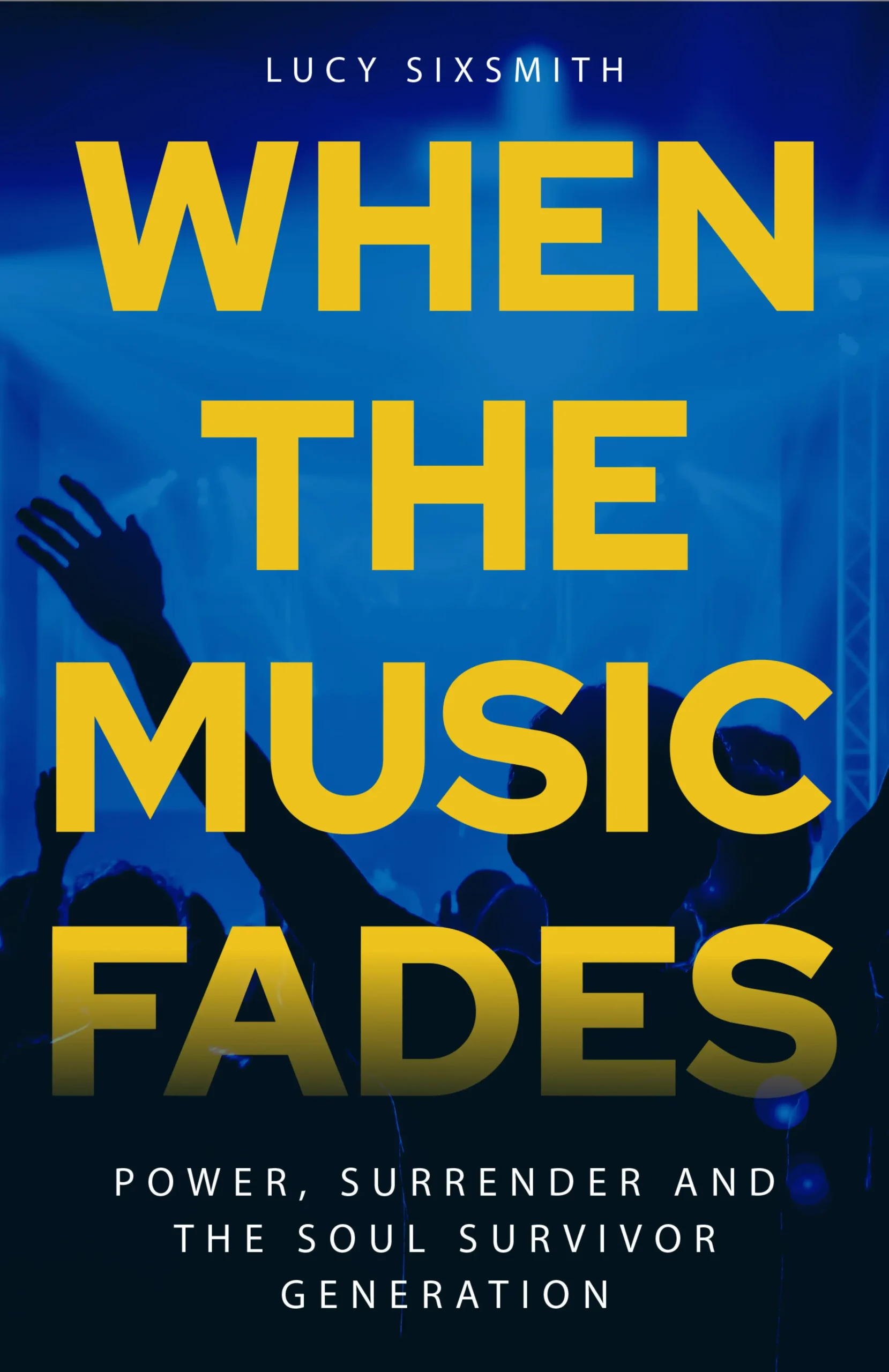
After reading this new book by Lucy Sixsmith on Soul Survivor (SS), the notorious and controversial movement formerly led by Mike Pilavachi, I had to ask myself what genre of writing was being employed. The blurb on the back cover uses the word ‘memoir’ to describe the book. It is, however, much more than a memoir. I find it easier to describe it as a written conversation between various parties of which the reader is one. The central character is, of course, the author Lucy who, in her mid-thirties is trying today to make sense of her past exposure to the enormously influential movement for Christian young people, which flourished in Watford for some thirty years. As part of our initiation into the strange (for some) world of charismatic beliefs and practice, we are introduced to a younger Lucy. The teenage Lucy is also a party to the conversation. As a young impressionable teenager confronting ideas and experiences that she cannot fully process, she initiates us into the religious worldview of a religiously inclined teenager from the noughties. By the end of the book, the reader will have been introduced to a variety of ideas and notions that may be novel to many older Christians, but the effort will have been worth it for two main reasons. In the first place, charismatic Christianity is becoming the dominant expression of the faith in Britain today and Lucy’s description of the ideas and assumptions in the movement, whether as a teenager or as someone speaking from early adulthood, is not a bad place to start. The second set of insights being offered, especially to non-charismatic Church people in leadership, is an understanding of some of the dynamics that are around when churches allow obedience and surrender to a maverick leader. Such practices can easily tip over into manipulation and exploitation of impressionable and vulnerable young lives. SS was allowed to function for thirty plus years without anyone asking the penetrating questions that might have better protected the young people it purported to serve.
I write this short review as a charismatic ‘sympathiser’, having been an observer of the scene for a number of decades. My own ability to identify with the leaders of the movement ceased with the passing of an earlier generation such as John Richards and John Gunstone. For a variety of reasons, the movement turned in a new direction in the 80s. The baton of leadership was passed on to a group with a more sectarian outlook. To use political terminology, the soft left charismatic style of the 70s became the hard left controlling leadership of the later 80s and 90s. Having myself found a small niche in the charismatic world in the early 80s, so that I was even invited to speak at healing conferences about my interest in this ministry, I ceased to be regarded as ‘sound’ by the end of the decade.
The SS generation of the nineties and noughties to which Lucy belonged, alongside many of her Christian contemporaries, brought forth a manifestation of charismatic practice which was strongly identified with the conservative evangelical camp. What Lucy describes of her home church and her experiences of SS camps breathes a Christian culture that I would have found unbelievably stifling and restrictive. For those of us who had been warmed by the early pioneer days of the charismatic movement, it had been a cause of sadness that our ‘liberal’ opinions made us a cause of suspicion and threat to the generation that came after. Lucy’s memories and descriptions of her Christian pilgrimage as a young person growing up in this later culture contains much material for reflection. We have laid out for us the kind of teaching that was shared by Mike Pilavachi with the tens of thousands of young people who imbibed the Christian faith from this somewhat uncompromising conservative narrative. The importance of the book is found in the way we are invited by the author to share in her struggles, her questions and doubts. It is as though we are invited to participate, through the reflections of the book, in a journey of faith from the perspective of a very young, but highly intelligent mind.
When the Music Fades is not in any way meant to be a hatchet job of the damaging ministry of Mike Pilavachi. Lucy clearly understands the implications of all that has been revealed of the harm and trauma that has befallen a group of young men – the massages and the dangers of inappropriate closeness to Mike. This typically involved being at first favoured before being discarded. There was much more going on and, as the title of the book suggests, Lucy recognises fully the part played by music in creating a distinctive style within the culture of SS, one which was highly attractive to young people. The sections of the book discussing music, as far as this commentator is concerned, are the ones that are most difficult to engage with. Perhaps music taste will always be an area of partial incomprehension between the generations. But I still find myself asking the question whether the style and emotion revealed through the music of SS takes us into the presence of God or whether the same music is a tool of manipulation and control. One of Lucy’s chapters is entitled Surrender. Is this word a description of an emotion deliberately cultivated by leaders and musicians to create a power dynamic which was of benefit to the leaders, in terms of gaining kudos from the wider institution? However much ‘surrender’ seemed to describe the spiritual place where the young participants thought they wanted to be, it is a word that has strong undertones of vulnerability and control. Telling a large crowd of potentially vulnerable young people the importance of surrendering to an emotion-laden atmosphere is a situation of great potential danger. Do teenagers have the necessary discernment and capacity for self-protection not to be sucked into something that may harm them at a deep level?
As a university academic Lucy is alert to the need to respond to many of the searching questions that she recognises will be asked by her potential readership. She includes helpful material from a variety of disciplines which help to give the context for the phenomenon we know as SS. Her understanding and presentation of material connected with the history of evangelicalism leading up to SS is instructive and helpful. She tells us about Charles Simeon, Henry Martyn and Moody and Sankey. Little by little we find ourselves absorbing the message and significance of SS from these other perspectives, those of theology, history, psychology and direct experience.
The value of the book is perhaps that it throws down a challenge to church leaders, asking them to state where the boundaries should be drawn between something that is orthodox, wholesome and life-giving and other cultures which may be exploitative and harmful. The perennial issue about the place of music needs fresh scrutiny and attention, since we cannot simply assume that because something is popular it is necessarily spiritual and healthy. Lucy makes a serious attempt as a newly minted adult to communicate the feelings and strong emotions aroused in these young people by the evangelistic youth culture of today. My own level of incomprehension at the genre of musical style within this culture suggests to me that there may still be a considerable problem for the Church to overcome. Mike Pilavachi was allowed to practise a risky, even dangerous style of Christian ministry for so long, partly because church leaders did not understand and therefore could not monitor intelligently and perceptively what he was doing. The author, the grown-up well educated Lucy, offers a bridge enabling other Christians outside charismatic circles to understand what was being attempted in these camps. Many of the themes of an earlier charismatic culture: prophecy, tongues and healing were still present. My own impression from the book’s descriptions is that these gifts were being practiced with a level of wackiness. There is also a sense that gifts are being practised, sometimes without any proper idea of what was going on. There is a vivid description of the author emerging from her tent one morning at camp to discover her friend prophesying to a group of younger boys. These boys were in Lucy’s words ‘sceptical, but magnanimous’. There was some level of acceptance in that they stayed to listen even though they seemed unconvinced. Lucy’s own home independent charismatic church had been deeply impacted by the Toronto Blessing so she was wide open to wacky episodes in church, along with vivid displays of emotion. The adult Lucy is offering us keys to understanding something of this culture. That understanding will allow the rest of us to feed on its energy and vitality, even when we feel a necessary system of checks and balance is absent.
The adult Lucy Sixsmith provides us with something extremely precious: a direct personal penetration and insight into areas of church life that is strange to many of us. We feel privileged to enter such an unfamiliar place, the Soul Survivor camps, but with Lucy as our guide, we are better able to understand and certainly not be harmed by the experience.
***********************************************************
Some readers may have seen the news about the legal case involving Jonathan Fletcher. Surviving Church wrote on the earlier stages of this case aboutwhich readers might like to remind themselves. https://survivingchurch.org/2020/12/22/bishops-safeguarding-and-jonathan-fletcher/
As regards music, despite not singing a note for over a decade, I found reading Dr Sixsmith’s book had a profound effect on me. Almost every song, including Redman’s almost iconic one, upon which the book title refers, has been going round and round my head! This includes “These are the days of Elijah” which I must have picked up from a SS DVD back in the day when I lead a band for the 20s 30s group in my then church. Probably this is one of the sad reasons I avoid most music. I don’t want to get dragged back into the mentality of those days. You could almost say worship music was addictive. As a side note, I grew up largely only with classical music or hymns, and church was decidedly conevo, hands-by-your-sides, no funny business.
I converted to charismatic evangelical over a period of many years, because I found the straits of conevo hopeless for dealing with the realities of life, only to find my new genre slowly but surely a cause of harm, both to me and others.
I had planned to review Dr Sixsmith’s book, but there is so much wisdom and stimulating areas for discussion in it, that I’ve had half a dozen “drafts” in my head, and as many pages probably as she wrote! I’m so glad you beat me to it Stephen. Each chapter could provide its own blog post in commentary.
As an eyewitness she has had the courage to speak out on the impact of SS. She is part of a vast diaspora, so where are all the others? Even those of us who didn’t attend know deeply of its impact on not just the Charismatic churches, but on the Church of England as a whole.
How many of us were lied to, when we swallowed the idea of being “history makers” in some way? Pilavachi, or one of his facsimiles speaking prophetic words of how we were to have special significance in our futures? It happened to me at least twice. And how many of us changed our careers or jobs, or deferred what we could have been doing, or forewent potential relationships which could have been so valuable? Because of him.
Often there was a covert romantic or sexual attraction behind these “words of knowledge”. It can be hard to prove individually, but with the evidence we have collectively, surely there can be no doubt?
Yes, I did a 2015-2016 ministry training programme course run by New Wine, after a selection interview with the local Anglican Diocese. It now feels as if there was some form of sinister manipulation. Always great new initiatives-‘something big just round the corner’-‘you are all really special and we have lots of future places for trainees like you’……….
But after committing time, money and emotional energy, I was bashed around and falsely accused of sexual misconduct in foul language. Out of the five students, in my diocesan year group, two complained about the same New Wine tutor savagely bullying them. This was after enduring two years of trouble. My partner is a Cambridge educated professor. She was aghast during the training time at woeful New Wine standards. She advised me how none of her undergraduates would have tolerated how New Wine treated students.
It was devastating. I dread to think how younger people might have been permanently damaged, placed at risk of suicide, or have given up on the Apostles’ Creed. To falsely accuse people of sexual misconduct in crude language is ghastly. But the local GAFCON-led Anglican Diocese response was essentially to just sweep it all under the carpet. Lightning rapidly striking twice should make senior Anglican clergy or New Wine leaders sit up and take notice. But nobody seemed to give much of a toss, apart from protecting the Church and para-church reputations of anointed leaders………..
The publishers of the book sent me a copy gratis so I was obliged to write something. Being sent a pre-publication copy does not happen very often! I agree with you that there should have been a more audible protest, considering how many potential victims there are. Lucy is speaking for tens of thousands in her description of the dissonance between the idol worship towards MP and the the later revelations about his behaviour. Total silence was the most frequently heard sound!
Yes! Grooming and sexual abuse dominate media coverage. But are elements of the charismatic-evangelical Church gigantic hotbeds of more mundane-BAH-bullying-abuse-harassment? Nepotism and cronyism have certainly done a lot of damage. But is blasphemous contempt for biblical principles of natural justice what drives so many people away?
“To use political terminology, the soft left charismatic style of the 70s became the hard left controlling leadership of the later 80s and 90s.”
Given the conservative nature of the charismatic scene, it seems like you have your political compass flipped.
The charismatic scene of the early 70s was not particularly conservative. It was highly ecumenical and grew out of the hippie and protest scenes of the 60s. It was indeed in the 80s and later that it became more evangelical and hardline. Stephen’s comparison was apt.
I agree. It encompassed some High-Church Anglicans and Catholics – to the extent that “classic” Pentecostals and Evangelicals were quite wary of joining in. What it did not include, fairly obviously, were theological sceptics of the “Sea of Faith” ilk, nor Reformed Christians who were sceptical of emotional displays. The Fountain Trust did try to give “renewal” some theological undergirding and space for reflection.
Sure, but then the accurate description is that it swivelled to the right during the 80s and 90s.
I don’t think the left/right metaphor applies that literally. And there was a flourishing Catholic charismatic movement into the late 90s and perhaps still is. Witness eg the ongoing availability of numerous Marilla Ness CDs.
To add, I am not being deliberately pedantic. To name something is to describe it, and the position as ‘hard left’ fails to capture the extent to which — even in the 80s but especially by the 90s — the charismatic church had taken on the logics of neoliberalism (even if stylistically they were more comfortable with a post Thatcher/Reagan articulation of the same)
Certainly this framing was adopted at the institutional level, and the internal communication was very much coded as either growth business of that era or – later -third sector organisation.
The charismatic movement, as Lucy rightly observes, have had many streams from its earliest days. These have included both the “wackier” end, as evidenced by her own church at the time, and those which are/were more orthodox, including SS. Indeed Lucy observes how SS wasn’t always a super-spiritual movement but got its supporters involved in down-to-earth issues of world development, justice and the like. I think that these were genuine concerns, not issues adopted in order to give SS legitimacy.
The topic of manipulation by music is not recent, nor is it restricted to style. Billy Graham was criticised for using the hymn “Just as I am” while enquirers were moving to the front; when he responded by leaving the auditorium in silence that too was criticised. I suspect that Moody and Sankey (with his “kist o’whistles” and Gospel songs) received similar comments. One must also wonder about the extent in which “hwyl” contributed to the 1904 Welsh Revival – certainly Dr Martyn Lloyd-Jones, a generation on, was very critical of emotionalism (although, in later life, not theologically opposed to the basis of charismatic teaching).
I think we must look at the wider issue of influence and manipulation, especially of young people when they are meeting together and away from their home environment. I’m not just thinking of SS nor the erstwhile “Bible Weeks”, Spring Harvest and Keswick gatherings, but of Christian youth camps – not just Bash/Iwerne but Scripture Union, Urban Saints/Crusaders, Boys’ and Girls’ Brigades. In each of these lurks the possibility of manipulation even though it’s not something that the leaders intend or desire.
I do remember attending a service in a charismatic Anglican church which left me feeling very uncomfortable. It was an evening service; the building featured focussed lighting and was decorated by strings of “fairy” lights. Towards the end of the service we “moved into” a prayer time; music played softly and a youngish worship leader suggested a number of brief points (about ourselves, not intercessions) separated by pauses for reflection. The intent was, I’m sure, to be helpful; I went away feeling that I had been manipulated.
But, then, what am I to say? As a Baptist minister I do my best to craft my services carefully: not just the sermon but the hymns, prayers, reflections – everything else (although we don’t have a music group or fancy lighting!). And yes, I am unashamedly seeking to lead the congregation along a certain path, although hopefully also offering the possibility of disagreeing or thinking issues through. Surely this is something which every public speaker, be they preacher or politician, aims to do? So at what point do unhealthy manipulation or control begin to manifest themselves? I’m not sure.
I have heard a couple of interviews with Lucy Sixsmith and found her very insightful, thoughtful and reflective. While I wasn’t very involved in SS other than going to some Saturday night meetings and one summer festival, I found her thoughts about it relevant to my Christian experience in the wider charismatic/evangelical world.
I also identified with her description of her younger self in one interview – a teenager who was still struggling with her identity and confidence with every day matters while being told to “change the world”. She describes herself as someone who was still struggling at doing things like make a phone call, much like myself as a teenager, and the basic tasks of direction and living in the world.
Yet the church seemed only to care about us attending its meetings or projects rather than supporting us with what we actually need.
The devil is hidden or mingled-quite literally-in the detail often. We possibly never ask the right question. Does being radically spiritually open get equivalent to UK defense policy under Starmer, where droves of unidentified people land on beaches in rubber boats, confident of hotel-food-assimilation-citizenship?
If we believe in a supernatural dimension, and some plain form of good-evil duality, then counterfeit and hijack of the charismatic church movement makes total sense. The BAH bullying-abuse-harassment, of ordinary people by fallen charismatic leaders, and cover up of BAH, disgraces the church.
‘Ideas have consequences’ and the words of Leslie Newbiggin come to mind on Pharasaism: ‘…picks on a few sins and is quite merciless towards them…’ Why the obsession, liberal and evangelical alike, with same-sex attraction, when the abortion needle is probably the most lethal weapon in human history?
I challenged a Bishop about horrifically covering up maltreatment of people. UK law was cast aside, as well as Anglican Church rules. Biblical principles of natural justice were blasphemously ignored. The ‘infallible’ and authoritarianBishop, who glibly ignores professionals with far better credentials on trauma and BAH, is not merely stupid.
There are almost certainly much darker forces at work in Anglican BAH cases. Why would any church continue in self-destruct mode, after so much hidden abuse has already been exposed? We are looking at something akin to the UK abortion scene. Have people like Mullally and Welby metaphorically got into bed with the devil on UK abortion?
Why can our leaders not follow the example of Catholic Bishops, and affirm Christian doctrine on abortion? We see solid improvements in Catholicism, on exposing and evicting abusers and bullies. But the breaking story with Rev Kesh Govan shows how Anglicanism remains rooted in the dark ages on BAH. Feed them manure and keep them in the dark-the mushroom farmer’s mantra-is the way Anglican lay members are treated.
There is no mechanism to filter out ‘bad actors’ in contemporary churches. The warnings in Paul’s letters about ferocious wolves and loveless, clanging cymbals (both fair descriptions of narcissistic predators) go unheeded because no church today is anything like a close knit 1st century Christian community. Everything is now ‘transactional’ – say the right Jesus words and you are in. It’s not the case that everyone in church is a fraud but that manipulative, deceptive individuals can easily fake what it takes to be accepted in modern congregations and leadership roles.
I think John Stott refers to-‘proximity without community’-in one of his writings. That may be borrowed from someone else. But it describes lots of town and city churches. You often seem to get extravert and confident cliques who like coercion and bullying. The tragic headline grabbing cases, of abuse and bullying, tell a tale. But the bigger scale tale is of many people voting with their feet. I think the Christian population of the UK may now bear limited resemblance to Church stats.
“droves of unidentified people land on beaches in rubber boats, confident of hotel-food-assimilation-citizenship”
Is deeply insulting to refugees.
Do you mean people fleeing some horrific conflicts wash up on these shores (if they are fortunate not to drown)? And are pretty much locked up in grim places, often with far right thugs chanting outside, not allowed to work and treated like sh*t by multiple UK systems? Who then get stuck in a massive backlog in the asylum system for years.
People come here because of Britain’s hideous colonial past, seeking sanctuary where there is a familiarity with culture and language
People cross the channel now because Brexit means the UK is now separate to Europe and under international law ppl are allowed to seek sanctuary
An actual Christian response is ALWAYS to welcome the stranger. That theme runs throughout the Bible
Can we please not descend to far right dog whistling
Would a-‘Kindertransport’-type work now be impossible? We are an overcrowded island, so does ‘open beach’ access fly in the face of maximizing places available to those who most genuinely need to seek asylum?
Er … this discussion has nothing to do with Lucy Sixsmith’s book and should surely be taking place elsewhere.
Anyway, read the book, see what you think
Thanks Stephen for bringing this to our attention.
I agree with the fact that when entering a church ‘service’ and we are hit with the energy and vitality of loud emotional music we check whether it is drawing us into an unbalanced situation. I have been fooled even as an adult and have opened myself to the thrill of it all regardless of my own instincts. I should think that young people must be vulnerable and can be preyed upon.
Absolutely true – but can we also be lulled into a false sense of security by attending a well-ordered liturgical service with beautiful, ethereal music? A different vibe, certainly, more aesthetic than emotional – but still seductive, I think.
Yes Andrew, music can be seductive and we must be aware of this. Meditative or high energy, slow or fast all affects us. Standing back, assessing the situation perhaps, but God gave us the gift of music …… It can transmit love and harmony and church music can do this.
Some of the most exquisite music I heard was the choral chanting at All Saints, Margaret Street. I attended for a few months a long time ago. But here the environment was, in effect, carefully controlled, with no “altar calls” to receive potentially life changing “prophecies” and other challenges to one’s boundaries. It was a lot safer, on reflection.
The demographic was a “congregation” commuting in some distance from outer suburbia, receiving the beauty and the Eucharist, shaking hands with the priest, and quickly disappearing again. This latter didn’t seem quite right to me, but at least they kept closely to their own boundaries.
Another possible significant difference may have been that there wasn’t a “high pressure” leader running the show.
Yes, that’s right. Almost the opposite I suppose.
Does music from communal human voices, not amplified, and without instruments, have a special place for lots of people? Chanted English psalms, Latin psalms, and the Gaelic psalms of Hebridean Calvinism, have a special character. Instrumentals featured in lots of classic hymns, some connected closely to great past revivals; but human voices alone, in the very plainest simplicity, must surely have a very special place in spiritual terms. As a child, or as a teenager and student, older broadcasts of Radio 3 evensong used to draw me. Even if uncertain about belief, there was something mystically addictive about the emotions raised by those pieces.
‘Priest Holes’ [Private Eye, p38, 15-28 May 2026 edition] spells out the full scale of BAH horrors in Anglicanism when looking at Archbishops-Bishops in England Wales. Most Church members and members of the public have yet to realise just how bad the situation is.
I’m only on Chapter 3, and enjoying it. It seems to me, so far at least, that the genre is narrative theology. I’ve dabbled in it myself, but the most notable proponent of narrative theology was Stanley Hauerwas. The idea is that you tell selected parts of your own story (a memoir), recounting how you worked out your theology as you go.
What does surprise me is that Lucy Sixsmith’s chapter on the history of evangelicalism makes no mention of Luther, Calvin, Zwingli, or any developments on the Continent. The conservative evangelicals I grew up among, and whose churches I attended into my late twenties, owed much more to Calvin than they did to Wesley. The famous TULIP formula, often used to define conservative evangelicalism, is certainly more Calvinist than Wesleyan.
I’ll read on!
Janet – I think a lot depends on which “strand” of Evangelicalism one grew up in. There is an Arminian/Holiness stream (think Church of the Nazarene, most Pentecostals, some Methodists and Baptists) whose members, in my limited experience, seem largely unaware of the Reformers and their children. Lucy came, from my reading of her book, from a church at the wackier end of the Pentecostal/Charismatic spectrum. It probably said little about church history!
Yes, Andrew, I am inclined to agree with you. I did a certificate level course at a traditional Anglican college many years ago. The focus or drive seemed to be liberal, and intensely questioning, even possibly to the point of excessively doubting central tenets of the Apostles’ Creed. A later MA demanded much more skill in terms of writing and exploring topics, and there was an emphasis on defining and defending orthodoxy .
After this I did a 2 year ministry traineeship course overseen by New Wine. It felt as if there was a total lack of interest in apologetics or Church history with New Wine. There seemed to be zero interest, or these subjects were even held in contempt. The intellectual basis for faith (strong evidences like ‘creation’ or ‘conscience’, or the evidence for the ‘historical Christ’ and ‘resurrection’) did not seem important to New Wine teachers. That was my firm impression. It felt as if there was an emphasis on the brand, and leaders, and jazzy music.
BAH (bullying, abuse, harassment) and silencing of VWW (victims, witnesses, whistleblowers) was painful to watch or discover. A distinguished senior cleric took me aside, and advised me to escape from New Wine bullying to avoid further danger.
Some of the charismatic-evangelical scandals perhaps make more sense when you recognise how emotionalism can choke sane intellectualism in cults. The ‘troublemaker’, who has the wit and courage to reflag savagery, can often get evicted by charismatic bullies.
I dread to think of the danger to younger people. It’s easy to see Pilavachi as the cherry on the icing. But is Pilavachi just another raisin in a toxic cake mix. Are there loads more bullies lurking in cult groups?
The author of the blog wonders in their conclusion: “is Pilavachi just another raisin in a toxic cake mix. Are there loads more bullies lurking in cult groups?”
Of course if a large church employs staff they are capable of writing reviews on their work on such sites as “Glassdoor”. So a reader of the blog with time could read through reviews for churches on Glassdoor such as where Pilavachi is mentioned?
Taking as an example, simply because it is a large and well known church – Holy Trinity Brompton, it currently has a score of 2.6 ” which is “below industry average”.
The average score has been reducing since the new vicar has been in post and the reviews include such things as
“Toxic work community. Favouritism comes first”
“They have zero concern for their staff’s mental well-being opting to burn people out and replace them from the large pool of applicants they can draw from.”
“Largely male leaders who have poor training, accountability and support with issues like previous trauma which often means the people they are “serving” get caught up and hurt by their unresolved trauma and need for control. The church as a whole seems to magnetise people at high risk of repeating abuses. When someone behaves questionably or abusively, it’s either always excused, ignored or “victims” dismissed with no action or follow up.”
“There is a lot of emotional and spiritual manipulation to ensure that you go above and beyond your role. There is a tendency to involve themselves in your personal life and the leadership at the top is toxic.”
“Advice to Management: It is advisable to maintain distance from [name clearly visible on Glassdoor but removed here] , as he has exhibited manipulative and destructive leadership behaviours. Challenging him may lead to attempts to ostracise you by turning others against you. He has been likened to a young version of Mike Pilavachi in terms of his approach. In general, the senior leadership does not receive feedback well.”
Maybe readers of this blog will have more insight as to how to improve leadership and governance. The reviews and the allegations in them cover an extended period of time.
You can’t improve leaders like these, as they have too much power. It took 30+ years to remove Pilavachi and you need a major scandal to do it. General harassment and bullying probably still isn’t enough. The massaging of young people on his bed probably did for him, due to the sexual implications, and their evident youth. It was fairly obvious the National Safeguarding Team had a long personnel file just waiting for the “final straw”, owing to the speed they acted with. They never normally act swiftly like this.
What we can do is stop attending these churches, stop recommending our young people to serve “on team”, and start or continue to support those many folk who are being mistreated in the ways described.
I’d vaguely heard of glassdoor. How much data do you have to give, to sign up? Thanks for the insights you gave.