by Daniel Caerwyn (pseudonym)
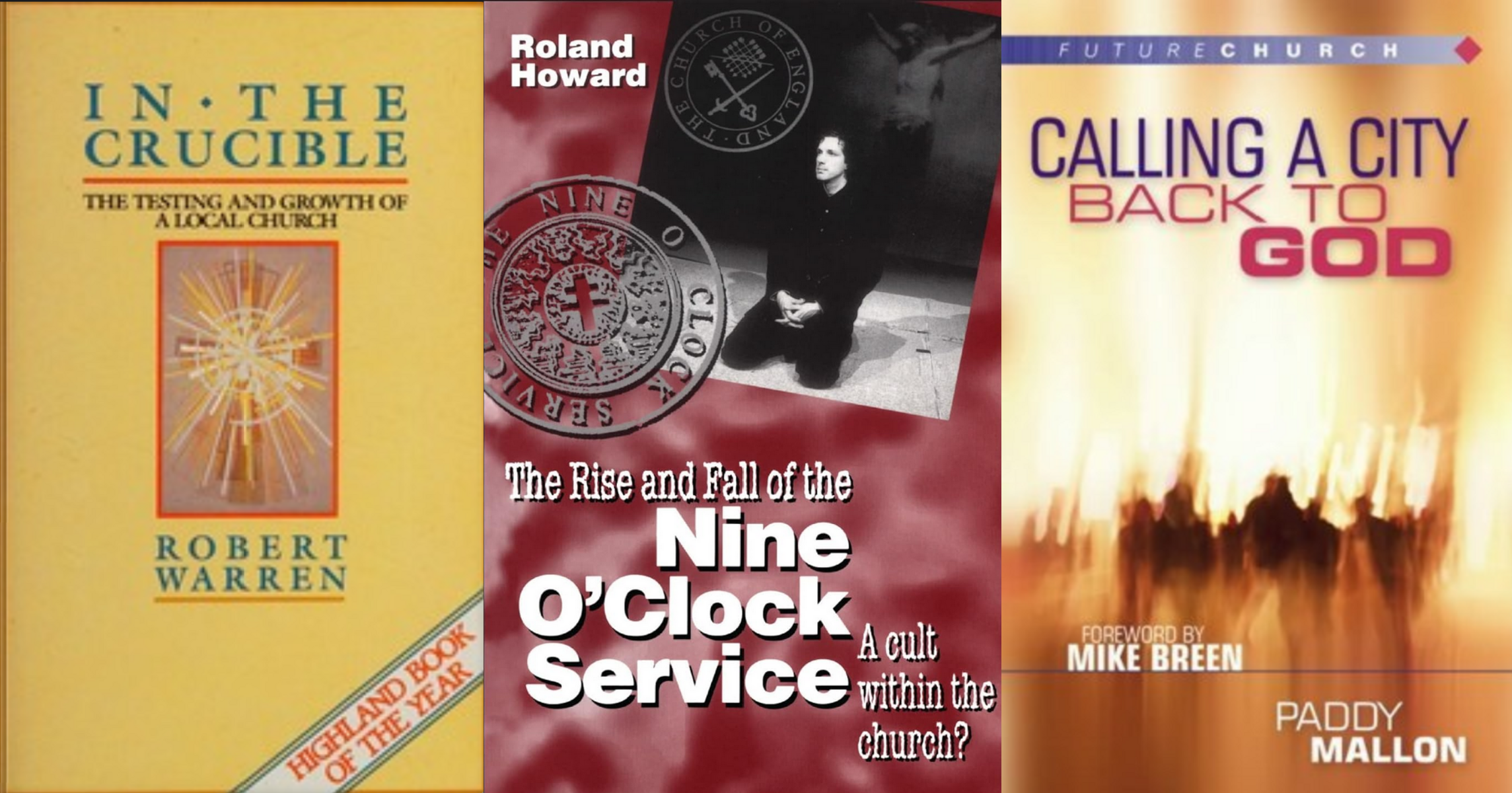
Last August, Chris Brain was convicted at Inner London Crown Court of seventeen counts of indecent assault against nine women from his congregation. Readers of this blog know the story: the Nine O’Clock Service, the homebase team, the rota of young women required to put their leader to bed. The trial confirmed in law what Roland Howard documented thirty years ago in The Rise and Fall of the Nine O’Clock Service.
The trial judged a man. I want to write about the building, and the architecture that built it.
Within a single decade, St Thomas’ Church in Sheffield produced both the most notorious scandal in modern Church of England history and, by 2003, the largest congregation in the country. The Guardian covered the second story under the headline “The sleek shall inherit the Church”. We treat these as two stories. They are one.
Three books tell it. Robert Warren led St Thomas’ from 1971 to 1993 and wrote a memoir of those years, In the Crucible. He brought John Wimber’s teaching into the church in 1985, embedding prophecy, healing and spiritual warfare in its common life, and in 1986 he commissioned an experimental service for the unchurched young, led by Chris Brain. Howard’s book records what that service became. After Warren left, Mike Breen took over in 1994; Paddy Mallon’s memoir, Calling a City Back to God, narrates the growth that followed. Breen moved to the USA in 2004 to train leaders in his methods, and his organisation, 3DM, carried those methods across the Atlantic and back through books, courses and coaching networks.
Brain and Breen are easy to confuse by surname and impossible to confuse in person. Brain: avant-garde, artistic, an obvious rebel. Breen: a gifted preacher and a builder of institutions. Attend a NOS service and a Breen-era St Thomas’ service and you would find it absurd that they came from the same church. NOS looked like rave culture; Breen’s church looked like a standard charismatic evangelical “worship, word, ministry” service. But these labels tell you what happens in the room, not what happens to a person once they are inside. For that, you have to look at the architecture: how people were let in, how belonging worked, who shaped whom, what obedience came to mean and how authority was exercised. Read Warren, Howard and Mallon side by side and the same structure stands beneath both men’s churches.
Start at the door. NOS posted gatekeepers known as “sweepers”, members whose job was to take a newcomer’s measure and steer them, either toward the inner life of the community or quietly to its edge. St Thomas’ itself ran an eight-point checklist for assessing newcomers. Howard records that the right look, the right connections or money could carry a newcomer straight past conditions others laboured for months to satisfy. Two people could walk through the same door and meet two entirely different churches. Breen kept the gate and changed the label. His huddles, the invitation-only groups at the heart of his system, admit only those the leader selects, on terms the leader sets. His “Person of Peace” teaching directs leaders to invest in the receptive and the influential, and to pass over those who question. Invest is the operative word. His Five Capitals framework teaches leaders to appraise what a person carries in spiritual, relational, physical, intellectual and financial capital. The sweeper’s instinct becomes a balance sheet. Brain extracted usefulness as wealth and clout. Breen reframes the same calculation as stewardship.
Then the family. The trial heard how Brain’s homebase team absorbed members’ lives into his household, and how he cut followers off from family and friends outside the group. Breen needs nothing so crude. His book Family on Mission creates a conditional hierarchy where true “family” are exclusively “those who surrender completely, laying down their agenda fully”. Total surrender to the vision becomes the absolute price of entry for genuine belonging. In a book that commends the dissolving of ordinary pastoral boundaries and describes life lived within them as “utterly exhausting”.
Then the temperature. Howard records NOS members enduring an affection-and-withdrawal cycle they nicknamed “Chrisnapping”: intrusive confrontation framed as “loving aggressively”, followed by sudden warmth, on no schedule a member could predict. Breen codifies the same oscillation as “invitation and challenge” and calls it “constant calibration”: the leader perpetually alternating warmth, access and affirmation with pressure, correction and withdrawal. Strip the arbitrary cruelty from Brain’s version and you have Breen’s. The same cycle, made stable, kind-faced and publishable. Defenders of the system describe challenge as ordinary leadership development, the stretch any good coach provides. I have heard from many people who sat on the receiving end of it. None of them describes goal-setting.
Publishable is one word for it. Scalable is another. Max Weber distinguished authority that rests on law or office from authority that rests on the perceived extraordinary qualities of a person: charismatic authority, power grounded in a leader’s claimed access to God. The gift itself becomes the licence to command. Brain built that kind of power, and when he fell, it fell with him. Breen’s contribution was to make portable the one kind of power that normally evaporates with the man who holds it. He reduced charismatic authority to a method: shapes, stages, huddles, vows. An ordinary leader could install it, and Breen shipped the guidebook. The leaders pouring into Sheffield in 2003 to learn from the country’s largest church took the first deliveries. That same year he founded the Order of Mission, a dispersed order launched from St Thomas’ with episcopal blessing, whose members pledge themselves for life to “accountability, simplicity and purity”: a more palatable rendering of obedience, poverty and celibacy. The Anglican scholar Jack Shepherd traces the “resource church” concept, now central to Church of England strategy, directly to Breen’s 1997 writing about St Thomas’.
Breen liked to tell a story about Monty Roberts, the famous horse whisperer, who won horses over far more gently than his father, a man who broke them by force, and got better results. He offered it as a picture of discipleship. Submission remained the goal. I have often wondered who the father was in that analogy.
I should be clear: I am not saying Brain and Breen are the same. The court record makes plain that they are not. There are more parallels in the record than I have drawn here; with a retrial on the outstanding charges listed for September, prudence says they can wait. What I am saying is that the two men came from a shared ecosystem, with a common understanding of authority, leadership and discipleship, and both placed the leader at the centre of a follower’s life. Breen’s own record is this. In 2014, his methods caused a rift in a US megachurch, an online community formed to document harm in churches that had adopted them, and he stepped down as leader of the Order of Mission. In 2024, he resigned from Apex Church in Ohio after an independent investigation found he had engaged in sexual misconduct with a vulnerable member of the congregation, later confirmed to The Roys Report as Adult Clergy Sexual Abuse, alongside findings of bullying, intimidation and a reluctance to seek reconciliation. He was offered a right of reply to my earlier investigation; he expressed confidence in the integrity of his restoration process and disputed the bullying findings. He has since returned to Yorkshire and relaunched his publishing business. The Order of Mission has expelled him and is conducting a “learning process” into his years as its leader.
And the building? Readers of this blog will remember Richard Scorer’s account of the Matt Drapper settlement. In 2014, nineteen years after NOS was wound up, the church’s own internship and prayer ministry structures delivered a young gay man to an exorcism. The final prayer was pre-written on paper, suggesting prior use.
I have found no evidence of institutional curiosity into the suitability of Breen’s methods, and the risk of harm they might represent. This is what troubles me most. The trial judged one man. Barnardo’s adjudicated one incident, and its terms of reference excluded any investigation of the methodology as a system. The Order of Mission’s learning process is, its Secretary has confirmed to me, not a review of Breen’s published methods. No diocese has examined them. Yet those methods sit, often unattributed, in huddles, discipleship years and leadership networks across the Church of England and well beyond it, run in most cases by sincere leaders who have never heard this history.
So what is the family business? The refinement, packaging and distribution of charismatic authority: made possible by Warren, used to destructive effect by Brain, and exported by Breen. Mike Breen may be the most influential charismatic leader you have never heard of. I have published a longer investigation of his methods, and a toolkit naming the techniques one by one. The Sheffield story did not end in a courtroom last August.
I knew Robert Warren. For 6 years we were in the same deanery and met up occasionally. His theology was unfamiliar to me, but I admit to being shocked at how the bishop and archdeacon waived all the rules to push Chris Brain through ordination. Why did they do it? Because he was good at getting people to turn up to his services. My fear is that too few bishops and archdeacons have learned from their mistake.
A Belfast story could be set to see a GAFCON Bishop resign or get fired. When bible thumping bigots get to work they can do a lot of damage. We can see a contempt for Anglican Church rules, and for sacrosanct Christian-derived principles of national law. Worse still, in the ultimate demonic twist, charismatic groups can blasphemously ignore the most basic biblical principles of natural justice. Bishop David McClay has allegedly sent out some kind of written note to clergy. But will he do the decent thing and just resign?
Irregular promotions yet again. It was obvious there had to be some Order plugging fake Resource Churches. How much evangelical and even pretend anti-evangelical doctrine (including in faux “independents”) is warmed-over occult?
Thank you for this. The reason you identify (bums on seats) rings true. Do you get the sense that there was a genuine effort in Sheffield to properly understand what had gone wrong?
I ask, as I’m not sure the bishops and archdeacons understood the mistake that they’d made. The culture at St Thomas’ after Brain, as far as I can reconstruct it, focussed heavily on lay leader accountability to Breen. The implied diagnosis was that Warren’s leadership had been too loose, that Brain had been able to operate as he did because nobody held him properly to account. This may well be true, but the answer – giving the leader of the church even greater centralised authority – appears to be a strange cure. Mallon wrote “initially appeared to set the tone for abuse of power and autocratic leadership”. Indeed.
Mike Breen was a regular keynote speaker at New Wine conferences of course. Being of a science-y business-ey background, I found the “logic” of his teachings and the style of his presentations compelling.
What do you feel when someone you respected turns out to have been a bad-un? My heart drops to the floor. Then over a long period as I reflect on it, once again I have to unpick what he said and I assimilated.
It takes many years to sift the wheat from the chaff, doesn’t it? To sort out what was good and we can hang on to, and what was dross that we need to throw away. And it’s hard work, but it pays off.
Agreed. Still a work-in-progress for me
I’m sorry to hear that Steve. You’ve pretty much described the reason why I set up awkward saints – completely agree. He’s a very compelling communicator.
Looking at your work, and considering his slick approach, I’m wondering how long it will be before Breen is back on the major speaker circuit, if he isn’t already.
Me too. The learning process by the Order of Mission complicates things of course. It is not a process that I have a lot of confidence in, though I hope they prove me wrong.
Robert Warren was probably the leading UK exponent of the Church Growth movement. We can see, over and over again, what happens when our primary goal is to prioritise numerical growth over spiritual depth, faithful pastoral work, and prophetic witness – and the results are not good. The promotion of charlatans, narcissists, and psychopaths; the neglect of damaged and hurting people; ethical and moral compromises in pursuit of ‘success’; and so on. I now think those who are overly concerned with numerical growth are to be treated with suspicion. What’s their motive? Do they want to look successful, be famous, gain power and influence? If you want to be great in God’s kingdom, be the servant of all.
As far as I understand the Bible, we are to preach the gospel near and far, teach faithfully, serve the poor and hurting, work for justice, encourage and build each other up, show God’s love in practical ways – and leave the results to God. One sows, another waters, but God gives the increase.
Yes, indeed, past and current headlines can have different slants, even though they share news or commentary from (or about) the same people!
Down and Dromore Diocese website ran this uplifting 23 March 2018 report: ‘Celebration as more than 80 people respond during mission’.
But it’s a very different focus in the 9.6.26 BBC1(NI) SPOTLIGHT broadcast called ‘FAITH AND FAILURES’.
TYPO! ‘FAITH AND FAILINGS’ is the broadcast title……
“Howard records NOS members enduring an affection-and-withdrawal cycle they nicknamed “Chrisnapping”: intrusive confrontation framed as “loving aggressively”, followed by sudden warmth, on no schedule a member could predict.”
It’s amazing how similar behaviour patterns recur across stories like this. This reminds me of my own experience of a spiritually abusive pastor. He could turn to angry or threatening – always backed up by a sense that he was God’s representative and some sense that the recipient was sinning – back to pleasant and warm at the drop of a hat.
That’s what I also remember about being a New Wine student. Behaviour, which was consistent with a personality disorder diagnosis, was viewed as exercising “authority” over people. Making people cry was sometimes celebrated as having a “special gift”. Even as a former GP, and a hospital doctor nearing retirement, it was possible to be deceived by the sure certainty of excessively confident people, who even boasted about the worthlessness of paper qualifications.
Yes – more recently Soul Survivor springs to mind.
Yes I have also experienced this in a large Con Evo Anglican church in a large city, from a rector who was formed in the crucible of St Thomas Crookes in Sheffield.
It’s definitely a form of abuse, of coercive control.
That experience was so like being in a cult.
Everything that happened in that church was about the rector’s feelings, opinions, likes and dislikes and his name was uttered many many more times by congregants in conversation than was the name of Jesus.
Because he was the absolute darling of the inclusive evangelical movement noone was allowed to name this – or if you did dissent in even the smallest way you immediately became a persona non grata.
Absolutely terrifying to witness what happens if he is displeased with you. And so, so damaging. To faith, as people work to please the rector, not God, and walk on eggshells lest their own desires or even just their true personalities manifest, and risk displeasing God’s anointed.
I don’t fully understand how this happens where really narcissistic priests switch from demanding constant admiration to sucking the lifeblood from their victims/ congregations, but I do know it’s something very evil.
Because the C of E UTTERLY failed in it’s responsibilities to NOS victims, to accountability within the church to victims, to understanding properly the spiritual impacts of what had happened, they left a gaping wound in the life of the church where others formed in the image of these charlatans would go on to perpetrate the same behaviours