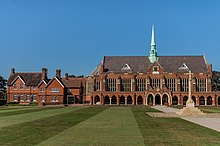
The discussion in the previous post about teenage Christianity has caused me to reflect on the experiences I went through at school and later. My boarding school took Christianity and chapel life seriously but there were no institutions like a Christian Union with links to summer camps. There was a small group called the Vivian Redlich society, named after an old boy who had died in Papua at the hands of the Japanese while serving as a missionary in WW2. This group did Bible studies and listened to talks. It did not meet frequently enough to encourage any form of over-excited enthusiasm in the participants. The school, nevertheless, allowed a steady respect for Christianity which was sufficient for me to leave to read theology at university without any expressions of surprise from masters or other boys. You could describe my school in the early 60s as an institution which provided a stable setting for emerging priestly vocations in several of its boys. It was not trying too hard to create that vocation through any form of hard sell Christianity.
My lack of any kind of hot-house Christian experiences as a teenager, was, in fact, something that served me well in later years. I arrived at university with a freedom and a keenness to explore what the faith was all about. I had at that point no strong preference for any expression of the faith which could claim my undivided loyalty. In spite of pressure from Christian Union types in my college to attend their meetings, I had enough understanding of the wider setting of Christianity to realise that Christian Unions were, in one way, just one expression of the faith among many. I wanted to experience many of these other manifestations of the faith. In this I was like a hungry person entering a room with a huge variety of foods available to sample. There were meetings of Quakers to visit, Orthodox liturgies to attend and glorious music to be heard across the city in various college chapels including my own. Those sucked immediately into the Christian Union vortex were being invited into one small room with only a single dish on offer. Though I attended such meetings a few times, I realised that to be in thrall to the notion that the meetings of the Christian Union presented the sole expression of Christian truth was not where I wanted to be. It would have been severely limiting to my early awareness of the huge cultural and theological diversity existing within Christianity. What my other discoveries of the faith were telling me was that the journey to find faith and truth was going to be complex and never totally complete. The beginning of adult life was certainly not the time to close any options down. There would always be this personal adventure of discovery, with perspectives to be explored, which would reveal the enormous variety implied in the word truth. Intellectually and aesthetically, the task of learning to be a Christian, as well as teaching others to share in it, is a life-long undertaking with many twists along the way.
Surviving Church began as a blog for individuals who, at an early age, had been ‘converted’ into a conservative form of Christianity. Subsequently they may have found it limiting for their ability to flourish as full human beings. I wrote short pieces which had a single underlying message. It was to say that the version of Christianity you follow (and this applies to me) can always be broadened and extended beyond what you have so far learnt and experienced. If any Christian leader tries to tie you to a single version of truth, theology or music style, you can be fairly certain that the narrowness they proclaim is their narrowness, not that of Christianity itself. I personally find it deeply disturbing to hear words like ‘the Bible teaches’, ‘infallible’ or the authority of the Word of God. Every time such words or expressions are used, we are witnessing a power manoeuvre. An attempt is being made to suck the hearer into the vortex I mentioned earlier. It is a place where there is no discussion or disagreement tolerated. It is a place that I dread the most – the position of being under the control of someone who is living in a place representing a sole version of truth. If he has deficits in his understanding (and that is is true of all of us), these same limits will be shared by all those under his control. Of course, authoritative statements will sometimes be uttered with the preacher’s learning and insight to back them up. Nevertheless, it will always be dangerous to root one’s entire Christian understanding on the fallible and incomplete grasp of truth held by a single individual. For me, Christianity is found, not in boldly proclaimed statements of doctrine; it is found along the journey of faith which is subtly different for each pilgrim. It does not allow any of us to say we have arrived this side of the grave. The best that a preacher can do is to explore and interpret the written truth of Scripture and share how these words have guided and inspired him/her along the path.
At the very beginning of Mark’s gospel, the text speaks of the good news, the euaggelion. What is the good news? It is not a new idea, a system of beliefs or a political system. It is the announcement of the Kingdom of God drawing close. Even Jesus was pointing his hearers beyond himself to the activity of God in the world. While he himself was the means of God drawing close, the invitation at that moment was not to believe something but to become part of something, a new reality breaking through. Over the centuries the Church has forgotten to see that the task of teaching and preaching is never about the preacher him/herself. It is about what is being revealed through the words used. The picture that comes to mind is the showman who stands up and pulls back a curtain to show some visual wonder. The thing seen is to be the centre of attention, not the puller of the curtain. The existence and creation of so-called celebrity preachers to me is a kind of blasphemous take on the task of preaching. It focusses on the person doing the preaching and not on the message being shared. The Idea of celebrity in a pulpit is also likely to cause the kind of dependency culture that is so unhealthy for the growth to maturity that each Christian should be engaged in. Although I no longer practise the ministry or preach, the question I used to have for each of my flock was not: are you sound? But are you growing in understanding and depth? Are you becoming more and more the people you are capable of being? In looking at the dynamics of a sermon, the focus should be on the relationship between the message and the would-be recipient, not between the preacher and his/her audience.
At the risk of repeating myself I want to reiterate my point about the dangers of focussing on a preacher, when the emphasis should normally be on the task of the healthy growing of Christians. Even dead preachers, like Billy Graham, John Wimber or David Watson can sometimes trap individuals in an endless cycle of dependency so that they, because of their attachment, can never grow beyond a certain point. If the people who introduce us to the ‘glorious liberty of the sons of God’ do their job properly, they leave the scene quickly after pulling back the curtain. What is then remembered is not the preacher but what was shared on a crucial life-changing occasion. I am also fortunate that in spite of the limitations of my school Christian education, I was never trapped by a system of belief and thinking which wanted me to accept or reject a system of thinking and belief in one great indigestible lump. Rather, I was allowed to take on examining the claims of the Christian faith over a lifetime. The faith has many facets, and it needs copious amounts of time to examine them. It cannot be done in one brief emotional moment by a vulnerable, possibly manipulated, teenager trying to identify his or her adult Christian identity.
Today’s blog is somewhat personal, but I sense that at least some of my readers are also ready to revisit their experiences, good and bad in their Christian pasts. I regard myself as fortunate to have had many experiences of exploring the Christian faith through travel and one-time links to universities in Switzerland and Greece. My good fortune was not just the things I learnt and places I visited but the in the fact that, even at an early age, my education had not closed me down to being able to learn and experience new things within the sheer variety of Christian culture and witness. The influence of places like Iwerne camps and the many centres of ‘sound’ conservative Christian teaching may represent where many Christians wish to be, but I sense that some may come to regret that they believed it possible to limit their experience of God to one cultural manifestation. God seems to be found in so many places and we should rejoice in that.