(Another non-virus story)
In the last blog post I explained how an encounter on a train, travelling across Europe in 1964, created significant changes in my life. It led to doors opening and enabled study opportunities which went on with some energy until the mid-80s. From around 1984 my focus for study shifted from my interests in the early Church’s art and liturgy to my current interest in healing and power and the way these dynamics are experienced within church communities.
I described in the previous blog how I received a travelling scholarship to study the Orthodox Church in Greece during the academic year 67/68. In all, I was away for ten months and the time away included visits to Israel, Bulgaria and Romania. It may sound like a long holiday but there were times of hardship and considerable stress. Part of the problem was that Greece was going through a dark period politically with the arrival of the Colonels’ regime in April 1967. The Orthodox Church was divided over whether or not it should support this ultra-right administration. The more interesting churchmen and women could see that it was rooted in a bombastic crude nationalism. The problem for the opposition was that jobs were on the line for those who spoke out. More threatening than that was the prospect of imprisonment and torture. Many people were afraid and this fear meant that meeting people was a lot harder for me than it should have been.
My main academic study was done in libraries in Salonika and Athens. These were two places of large populations and thus the political oppression was all the stronger. The arrival of spring in March 1968 allowed me the luxury of leaving the cities to travel in the provinces. After a visit to the extreme north west to visit a small town called Kavalla near the Albanian border, blessed with many painted churches, I set off for Crete. My expedition to Crete was the first time when I felt the political oppression a lot less keenly. Crete had managed to keep the Colonels at a certain distance. It was difficult for the central government to pretend that there was a potential communist conspiracy in Crete as they did in the mainland cities. Communists had never gained a foothold on the island, even during the war. Another great asset which helped me along in Crete was the memory of British involvement in the Second War. Less than twenty-five years before my visit, British officers, supported by parachute drops and gold sovereigns, encouraged an effective resistance movement. As an Englishman I could draw on the considerable goodwill which still then existed for all citizens of my country. We were, in those days, not a common sight, especially out of season in the weeks leading up to Easter.
My normal pattern of operation was to call on a local bishop and ask for recommendations for whom I should visit. I carried a formal letter of introduction from Archbishop Michael Ramsey. This worked well in Crete because no one seemed to be afraid of associating with me, a foreigner. The bishop I called on in Heraklion recommended two parish priests and a monastery in Western Crete. I consulted the map to decide on my exact route. At the extreme west of the island there are two pointed pieces of land pointing north. One promised to be a good walk so I travelled to the nearest village so that I could find somewhere to stay and attempt to walk north as far as I could along this strip of land. At some point I visited the local café and chatted with the men there. Among the locals drinking coffee there was a young man called Nikos Giannakakis, then aged 28. We talked together and I discovered that his job was as a painter of churches and icons in the neo-Cretan Byzantine style. After describing his work to me (in spite of his lack of English and my poor Greek) he promised to show me the current church he was working on in Chania. This meeting took place a few days later and I was an instant admirer of his work, both the portable icons and painted church walls.

When I got back to England, I kept up a correspondence with Nikos. I publicised his work in the magazine Eastern Churches Review, but no one seemed to be interested in commissioning anything from him. It took me five years before I was able to help him find work beyond the frontiers of Greece. The background of how I came to find myself in Calabria (the ‘foot’ of Italy), among Greek Catholics of Albanian extraction, needs a word of explanation.
In 1969 the organisation Amnesty International wanted to organise a report on house arrest in Greece under the Colonels. After some searching they found me. My command of the language was still weak but after a crash exposure to Amnesty files at their then headquarters in Farringdon, I was sent off to do this piece of field work. The whole enterprise was probably flawed from the start and I found at the airport that my name was on the card index of banned people. I had flown in from Rome on a student charter flight and so I was sent back to the same place.* At the age of 23, I possessed a considerable amount of social cheek, and so, armed with this, I set off to find the Greek College in Rome where I introduced myself (in Greek) to staff and students. (Modern Greek was compulsory for all students then studying at the college) I am not sure what I expected to happen, but they invited me to stay for a celebration of St Peter (it was June 29th). Amnesty had invited me ‘not to hurry home’ and when one of the members of staff suggested I could profitably visit their Greek Catholic diocese in Calabria, I was keen to follow it up. I visited these dioceses (there is one in Sicily) three times altogether and wrote a couple of articles to explain the peculiarities of Greek Catholicism in rural Italy. This tolerated married clergy, even in the early 70s. It was one of these villages, Santa Sofia d’Epiro that, in 1973, was looking for an artist to paint their church in the Byzantine style. I knew just the person to recommend, my friend Nikos from Chania in Crete.
Nikos visited Calabria six times in the 70s as one village after another employed his services to decorate and beautify their churches. He had, initially, considerable difficulty obtaining a passport but eventually the entire family made their home in the villages for the summer months. Nikos’ two young boys picked up grammatical Italian with great ease, something that was to help them enormously later in their education. Italian was the language that the local children used to communicate with outsiders and was learnt at school. At home they would speak a dialect of Albanian. Both Nikos’s sons ended up becoming medical doctors but trained in Italy. One now teaches medicine to Italians. Their exposure to proper Italian as children though their father’s work, had equipped them to become part of a larger world than Crete. I, unknowingly, had played a part in making this possible.
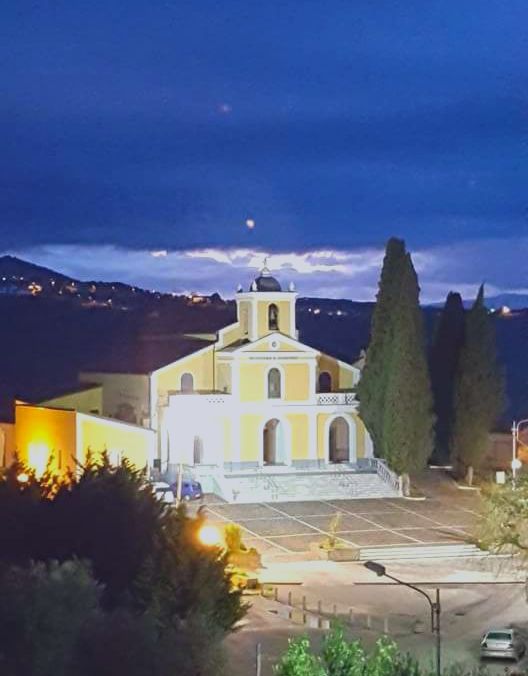
It was Nikos himself, now 80, who posted the picture of Santa Sofia d’Epiro (above) on Facebook last Sunday and this picture sent a shock through the system. It was through those two interconnected chance encounters, first with the Toynbee sisters and then with Nikos himself, that new realities were created. First we have two Italian trained doctors, a career opportunity for Nikos and a series of painted churches in Calabria. It was a shock but a happy shock to be reminded how providence had put me in situations and places that had caused something new to happen both for me and for others.
*A local Italian branch of Amnesty was set up in Rome soon after my abortive visit to Greece. I take no personal credit for this initiative but the founding of the branch was directly connected in a complicated way to my brief time in Rome. Over the decades Amnesty volunteers from Italy have played a full part in helping to promote the cause of political prisoners around the world