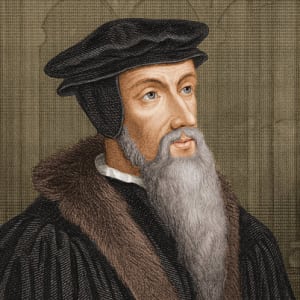
Since I was a theological student I have never been attracted to the theology of John Calvin, the 16th century Swiss Reformer. What little I knew about him and the Puritanism that he inspired, seemed always to put a damper on Christian joy and freedom. In recent weeks, in my attempts to understand the American Right and the onward march of conservative Christian ideas under Trump, I have been forced to consider the man and his doctrines as a way of getting a handle on an approach to the Christian faith for which I have had little appetite. The book that I have recently read, Blueprint for Theocracy by James C Sanford, makes it clear that ignoring Calvin is no longer an option if anyone wants to comprehend the mind-set of conservative Christians and the so-called Christian Right.
The first foundational idea of Calvin and his followers is the idea that God is all-powerful and has control over every part of his creation including humankind. Out of this grasp of the sovereignty of God comes a strong sense that he is all-knowing. In particular, he knows the future of every individual. Predestination, the doctrine that gives all, Calvinists and non-Calvinists alike, cause to shudder, is a logical working out of this idea of God’s supreme sovereignty. This states that God has already decided on those that he has determined to save and those he will condemn.
Calvinism as a system was not adopted without resistance in Protestant Europe. Among the conflicts that raged in the 16th-17th centuries was the debate with Arminius over the problem of what we call free-will. This debate was well aired at the Synod of Dort in 1618-1619. Calvinism was also later refined in the so-called Westminster Confession in 1646. Both these councils, written at times of civil conflict, were to stress the harsher and more rigorous aspects of Calvin’s thought.
The doctrine of the all-seeing sovereignty of God, as set out by Calvin, is one that is, arguably, deeply claustrophobic for those who try to live by it. The notion that a judgmental God governs every event of our life and is in control of every detail, is likely to place a Christian in a permanent state of anxiety and tension. Predestination is also a harsh doctrine and even Calvin admitted this. His response was to quote the passage in Romans 9 where the clay is denied any right to interrogate the potter.
Calvinism is, to summarise, a system which emphasises the will of God above the exercise of human reason. Questioning God is not permitted because mere creatures cannot expect explanations from their creator. Unaided human reason can never be allowed to query this supreme principle.
It does not take much imagination to see how the doctrine of God’s sovereign will being the dominating truth fits well with conservative understandings of the supremacy of Scripture. All ideas about infallibility and inerrancy of the Bible and its central authoritative place in Christian teaching sit alongside Calvin’s emphasis on the idea of the supreme sovereignty of God. Just as the faithful cannot argue with the purposes of the Creator, neither can there be discussion or disagreement with the ‘plain’ words of Scripture which reveal God’s will. The power of human reason is in any case compromised by the fact that human beings are, for Calvin, corrupted by the depravity of original sin. Here he was following the teaching of Augustine. Scholastic theology taught by the mediaeval Catholic thinkers had softened this doctrine so that the schoolmen allowed human reason to have some autonomous power in the scheme of things. Eastern Orthodox thinking also never allowed the human capacity for sin to wipe away the potential for the exercise of reason and the possibility of ‘divinisation’ or transformation by God in this life.
Calvin faced a problem in his teaching of the utter corruption of human nature. How was anyone ever to know anything about God in the first place if human nature was so depraved? He introduced into his thinking the notion of a universal ‘awareness of the divine’. Some, those who count themselves Christian, respond to this impulse. Others ignore it to their destruction. This binary distinction between the followers of God and the ‘God-haters’ is based on a passage in the first chapter of Romans (18-25). It further creates the mind-set that those who respond to God are in one camp while everyone else is somehow an enemy of faith.
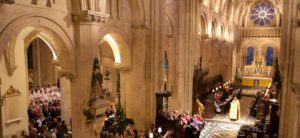
The way that Calvin’s binary thinking has been embraced by huge numbers of Christians today has, I feel, done enormous harm to the Christian Church. Calvinists and those who come after them, have got used to thinking that the only way to respond to those who do not share their belief is to convert them, thus bringing the ‘other’ into the circle of their belief system. ‘Preaching the gospel’ will always be understood to be like snatching burning twigs from a fire which would otherwise destroy them. There is no sense that God is already at work in the world or among people who think in different ways. An obsession with sin and destruction meant that Calvin and his followers had (have) little appreciation for the world of the arts and secular learning generally. The 16th-17th century wholesale destruction of paintings, books and statues in Britain was inspired by such Puritan/Calvinist ideas. The mediaeval church buildings in England survived for the most part; in Scotland, by contrast, the old worship buildings were, for the most part, deliberately destroyed in the frenzy of a more thorough-going Calvinist Reformation. In the whole of Scotland only one small section of stained glass from before 1500 survives to this day.
Calvin, to his credit, did seek to apply what he believed about God to the world of civil affairs. He gave 20 years of his life trying to work out the principles of ‘theocracy’ in the city of Geneva. For Calvin, God was concerned for the detail of civil government and the administration of justice. By modern standards Calvin’s theocracy was, however, experienced by minorities as a tyranny. Any independent thinking, including the development of the scientific method, always has a difficult time in such theocratic settings. Linking ‘truth’ only to propositions found in Scripture made it difficult for the scientific method to evolve. The contemporary hostility to Darwin and the study of Climate Change among conservative Christians in the States can be traced back to the religious hostility to secular knowledge encouraged by Calvin.
The values of contemporary Christian liberals, which include tolerance, freedom and the ability to live with difference, are principles that are sadly opposed by the elaborate systems of Christian thinking based on Calvin and his ideas. Those of us who value the principles of this liberal way need to be better informed about his system of thinking. We also need to be ready to resist it when it tries to shut down our desire to think about Christianity and share its insights from quite different perspectives.