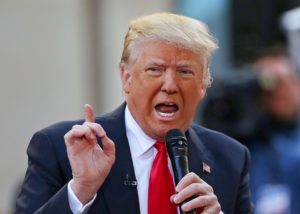
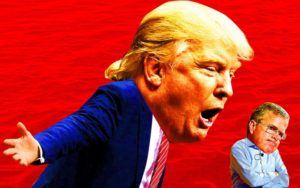
 Over recent days I have come to realise that my interest in American politics had become addictive. I have now decided that I will no longer read anything more about Donald Trump. The sheer awfulness of reading about his lying, his lack of empathy and his complete lack of at self-insight has become a distracting burden. Although it is not Lent, I find that I am giving him up anyway.
There is one thing that I take from my addictive reading about Trumpian American politics which will not be lost to me. That is a clear understanding of the way that certain individuals like Trump use power for utterly self-centred ends. The book I referred to when I last spoke about Trump, The Dangerous Case of Donald Trump, has now been published and I have downloaded a copy. It is a book that describes in layman’s terms the various psychological dynamics that the authors agree are at work in the President. The reason I can withdraw from my obsessional interests is that the book gives me all I need in my desire to understand the Trump phenomenon. The reason I had been reading all about Trump was because I recognised in him so many of the troubling and disastrous facets of certain charismatic leaders. It is not unfair to describe both Trump and the most notorious of these leaders as being both tyrants and controlling manipulators. The same dynamics are at work for these religious leaders as for power-obsessed American presidents. What has been written in this volume of essays gives me all I need to understand and describe such tyrannical and narcissistic religious leaders like Michael Reid of Peniel Brentwood.
Why the sudden determination to wean myself off American politics? A further answer also lies in this book that I have been reading. Psychotherapists describe the way that many of their clients have started to present a kind of a ‘post-election syndrome’ which has many similarities with post-traumatic stress. It would seem from what has been written that many people in the States are quite severely affected by the simple fact of having a president who is totally unpredictable and lacking either conscience or sensitivity towards anyone except himself. I decided that there was no reason for me to join these hundreds of thousands of Americans who show trauma caused by Trump’s behaviour. We have had him around for long enough to know the kind of man he is and the way he behaves. Events may move on but there is little more that is new to be learnt by being shocked and dismayed by following the detail of his antics.
I have already mentioned that the psychiatrists who have studied Trump from a distance have remarkably similar descriptions to give of his personality. Words like sociopath and narcissistic personality are to be found everywhere. It is impossible to summarise their conclusions except to say that the consensus that is achieved is remarkable. Because I detect so many parallels with some religious leaders, these simplified summaries of contemporary psychoanalytic thinking are valuable for me if ever I need to do some writing or description of the problems inherent in certain areas of religious authority. Trump of course has massive powers over the free world which makes him uniquely dangerous in his mental instabilities. Religious leaders do not of course have anything like the same power but the territory they do control is firmly theirs. No one can challenge some leaders because they claim their authority is given them by God. Now that we have in Trump the most authoritarian political leader since General Franco of Spain, the press that covers this story has had to acquaint itself with the psychological profile of tyrants. The educated public are being taught to recognise words like sociopath and antisocial personality disorder. Because these words are explained, religious leaders who possess these traits are also able to be better understood. Where there is knowledge, there is an increased power not to be controlled. When an ordinary Christian has insight into the dynamics of the church they belong to, those in power will find it harder to abuse that power.
In the past few days I responded on the blog comments to a woman who was trying to escape from a fundamentalist environment. I suggested that education is one way to begin to free oneself from the tyranny of an ideology or a religious leader. The power that a leader possesses is often afforded him because of the ignorance and consequent vulnerability of the congregation. Education and new insight will always help to undermine the power of a leader who wishes to control others. The overthrow of Trump in America would be much easier if the ill-educated among the population could be persuaded to think for themselves rather than feed on biased information coming from social media. But both in a political and a religious context we also need people to have a greater understanding of the way that other people work. In both politics and religion there are cheap psychological tricks available through which to control people. One technique practised by some religious leaders is to cultivate an air of mystery about themselves. To do this they remain above ordinary interaction with their followers. They are only seen in carefully staged settings. The Michael Reids of this world could withdraw into a place of remoteness and privilege. The followers seem to have understood this to be a form of greatness. It was of course nothing of the sort.
The ability to think logically and have a common-sense insight into the way people function, will help enormously in defusing the dysfunctional power dynamics created by narcissistic and sociopathic leaders. The American public, after their experience of post-election trauma, will perhaps gain the necessary psychological strength to challenge the president. They will then show that they are not prepared to tolerate his volatility and his version of craziness. We might also hope that congregations and the individuals within them will get better at challenging their dysfunctional leaders when necessary. President Trump has, paradoxically, made it easier for more of us to see the way that dysfunctional leaders operate. We now have the vocabulary and categories to discuss these things. We can see the problems more clearly. We are far less likely to be tolerant of these kinds of antics whether in Church or in politics. But for the time being the struggle goes on.