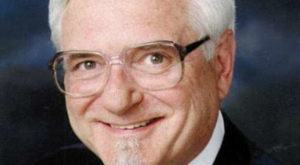
 Peter Wagner, a key figure among charismatic Christian leaders world-wide, died on October 21st. The fact that many people in the UK may have never heard of him, let alone read one of his many books, does not take anything away from the fact of his enormous importance in the charismatic as well as the wider evangelical scene. In this short piece, I am concerned neither to write a hagiography nor a critique of his thinking. Others will, no doubt, be doing both these things at some point in the future. What I wish to do is to point out how the ideas coming from one man can achieve huge influence over the way that many ordinary Christians think. At this point I think I can safely say that his legacy in the charismatic world is a mixed one. He was a man of many ideas. Whether all these ideas deserved to achieve so much influence in Christian charismatic thinking is a debatable point.
In his early days Wagner served as a missionary in Bolivia under the auspices of the South American Mission and the Andes Evangelical Mission. From 1971 up to his formal retirement in 2001 he was Professor of Church Growth at the Fuller Theological Seminary’s School of World Missions in the States. After retirement he found himself an unofficial leader in what is now known as the New Apostolic Reformation. This is a movement that has a very powerful influence among many charismatic Christians in every part of the world. Many charismatic Christians follow the ideas of this network even they may not be aware of this title. Still less will they know of the way that NAR has become politically well organised and highly influential over the past 15 or so years.
Among the new emphases that have emerged within the charismatic movement over the past few decades, Wagner seems to played a leading part in promoting and articulating many of them. In his early days at Fuller Wagner helped to promote the notion of Church Growth. I remember the first time I heard about this as a technique for increasing church membership in the 1980s. It followed the ideas of one Donald McGavran who had also taught at Fuller after a lifetime of missionary work. McGavran co-authored a book with Wagner back in 1970 which sought to promote the idea that mission was most successful when the target of missionary work was not the individual but the group or the tribe. People find it easier to accept the Christian message when it is integrated into their pre-existing cultural and social context. Translated into a Western context, it is noted how people will always find it easier to join a church when there are others just like themselves already there. Students will relate easily to other students, retired people to other retireds, and particular nationalities will more easily gravitate to people like themselves.
Church Growth principles are still taught in missionary studies but in the 70s and 80s Wagner began to develop his ideas in new directions beyond the original McGavran model. One of the most significant decisions of his career was to promote the ideas and teaching of John Wimber. In the late 70s Wimber came to teach at Fuller a course entitled ‘ Signs, Wonders and Church Growth’. This teaching eventually had a decisive impact and influence on the charismatic movement across the world. Among other things it opened people up to an awareness of evil and demonic influences at work and these needed to be countered during the process of evangelism. Also in Wimber’s teaching there was a strong emphasis on spiritual healing. Wagner identified himself totally with these new experiential teachings collectively described as signs and wonders. He was happy to describe the movements taking place around him at Fuller as being signs of a Third Wave of the Holy Spirit. Having been to a Wimber Conference in 1992 at Holy Trinity, Brompton, I am not one of those who is totally negative about Wimber’s ministry. However, I do feel much more analytical work needs to be done on his ministry and the theological and practical legacy of this teaching. Wagner’s support and endorsement of Wimber is not, for the moment, something that automatically invites criticism. However, the next stages of Wagner’s enthusiasms do give rise to some real concerns on my part.
By the year 2000 two new theological emphases had become apparent in Wagner’s thinking. Each of these were also to have far-reaching implications for the world-wide charismatic movement. The first of these seems to have begun at a Symposium in 1996 at Fuller entitled, The Post-Denominational Church. The thinking behind this title was that the New Testament church possessed no denominations. In their place there were certain offices, as taught by Ephesians 2.20, of Apostles and Prophets. Wagner was so confident about this pattern of church government that he was able to declare a little later that a second apostolic age had begun in the year 2001. We may make an observation about this confident declaration. There is here, not just a sharing of a fresh insight about biblical teaching, but a statement that Wagner believed himself to be at the epicentre of a new movement in the world-wide church. He then became involved in a confident naming of other leaders who would with him fulfil this role of Apostle. The task of these Apostles was to oversee churches and their ministries right across the world. Through these Apostles, God was going to ‘bring spiritual government to the pastors … so that the pastors can do the job that God has given them in a much more effective way.’
The second part of the new movement that Wagner was strongly identified with was what was known as spiritual mapping. I have already discussed this in a previous blog. It basically consisted of a strong sense that any missionary work would involve spiritual conflict with demons and territorial spirits. This was in part a continuation of the themes of healing taught by John Wimber that the pursuit of wholeness would often involve some form of exorcism. Space prevents me going further into this theme.
What are we to make of the legacy of Peter Wagner? He was obviously a man of enormous creativity and insight. His ideas are sometimes eccentric but always of great interest. The way that these same ideas have become uncritically adopted by so many in the charismatic world is however something that does create problems from our perspective. The concept of the Apostle as being a God-appointed role is itself a dangerous teaching. It reminds us of the ides of theocracy which seems to be the fantasy of a variety of religious leaders, both Christian and Muslim. Who oversees the overseers? In theory it is God. Peter Wagner’s legacy has not helped the wider Church give any satisfactory answer to the very basic questions about authority and where it is to be found. Simply to allow himself to become an Apostle, answerable only to God, does not resolve the wider issues. History may concur with us in concluding that top-heavy religious authority, such as that invested in Apostles, will always create enormous problems for the church. In fairness to Peter Wagner and his memory, perhaps we should not find him personally responsible for the problems of power and how it is administered in the church. In all probability, we should critique the universal longing of Christians of every tradition to search for a guru. Whether Anglo-Catholic or conservative, far too many Christians long for someone to tell them what to think and what to do. Wagner may be just one more person who found himself fulfilling the role of the guru that so many people are desperately searching for. Perhaps the culture of 21st charismatic teaching created Peter Wagner rather than the other way round.