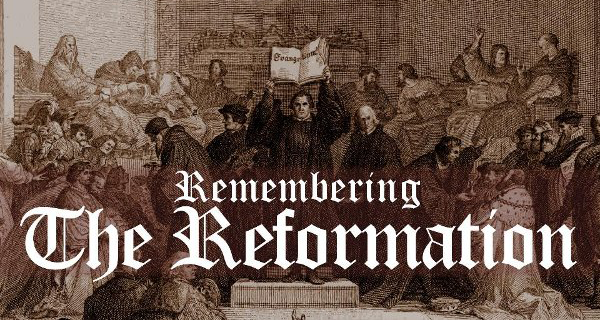
 When I speak to conservative Christians, I am often struck by the fact that many of them have very little sense of history. Few of them for example are aware of or have any interest in the events between A.D. 100 and A.D. 1500. The middle Ages are not just Dark Ages, they are a period completely to be forgotten. The typical conservative believer will be aware of the main characters of the Reformation, Calvin and Luther, but they will have little sense of the context in which their ideas were formed and the important ways in which these same ideas have been developed and refined over the centuries since the 16th century. I am also always very suspicious when I meet a so-called expert in Reformation history. What they often have imbibed is a 16th century attitude to modern problems. They have internalised so well the mind-set of that period, that they are able to interpret every modern problem from that perspective. Once again history and the way that ideas have a tendency to change and evolve over time is being ignored. Somehow the ‘truth’ which even well-educated conservatives proclaim has become detached totally from its original cultural and historical context. The words of doctrine, whether or not articulated in 16th century style, have become placed above criticism or critical scrutiny. It is difficult to discuss anything with someone who has arrived at ultimate truth! I note that the two most influential evangelical thinkers in Australia, Peter Jensen and Broughton Knox were both originally experts in the Reformation period. They have successfully encouraged an entire generation of young evangelical scholars, through Moore College Sydney, to think in a similar way as they have done. The Bible is studied and read but what is produced is a conservative understanding with a decidedly Reformation/Calvinist flavour. It is no coincidence that the Anglican diocese of Sydney embodies the most reactionary and potentially destructive strand of Anglican conservative theology in the world. GAFCON and the Jerusalem Declaration both seem to be strongly influenced by the Calvinist culture of Sydney and the failure of its leading theologians to allow any development of theological ideas to be part of the Christian thinking process. Historical process is being denied and ignored. With no sense of history, theology becomes fossilised, static and sometimes dangerous.
The failure to deal properly with history by many conservative evangelical scholars is an issue which few wish to confront. But there is another good example of a total lack of historical imagination in the way that modern evangelical culture, particularly in the States, seems to embrace, not countercultural Christian values, but the values of our contemporary culture. These observations that follow are not ones that I have discovered for myself, but I unashamedly lift them from a critique that I have found in an American book about the mainstream evangelical establishment in that country. The book claims that the values of our modern capitalist culture are found deeply embedded in the typical conservative church while their own self-understanding declares that everything they hold is based on the timeless values of Scripture. Thus their self-understanding is seen to be rooted not in ahistorical biblical values but within the same vagaries of cultural and historical change as everyone else.
The churches within the Protestant conservative orbit will always emphasise individualism. This is also very much a value that fits in with our capitalist society where the individual consumer is the target of advertisers and manufacturers in an effort to encourage mass consumption. The Christian version of individualism is clearly distinct and relates to issues of salvation and moral choice. But we still need to contrast it with more biblical ideas implied by the words ‘kingdom’ and ‘body’. A stress on individualism would help to explain the excessive fragmentation that is found in much Protestant Christianity today. There is not the space here to argue that the Bible and Jesus himself are looking to present the idea of a redeemed unified humanity, not a fragmented one. I would want further to suggest that all of us need saving from our individuality and the process is summed up in the meaning of the word ‘love’.
Materialism. We have often had reason to comment on the strong emphasis among some Christian bodies on prosperity and wealth. I need hardly say more here than to mention that Jesus is far more concerned with the poor and the disadvantaged and says little about amassing more and more in the way of things.
Innovation and free-market competition. In noting the way that congregations and churches are for ever increasing in quantity (with questionable effects on overall numbers), we note the methods through which they compete with one another. In this race each church tries to be trendier, more attractive than the one down the road. The result is that many churches do not have a clue as to how they might cooperate with other Christians. They have drunk so deeply of the wine of competition that any memory of how to work together with other different Christians has long disappeared from their thinking. I am reminded of this problem in my own area, where churches, proud of their evangelical heritage, simply do not know how to work with other congregations and other denominations. They have been competing too long to be the biggest and the best in the area now to be able to adapt to co-operation and working together.
The next way in which many ‘modern’ churches swallow modern assumptions is through their welcome of entertainment and celebrity into their midst. Each Sunday morning has to be like a gameshow or an episode of ‘Stars in their eyes’. This is a result of changing worship into a form of mass entertainment. I’m glad that I have never been part of such a church. The effort involved in keeping up an attractive level of entertainment must be frankly exhausting.
A preoccupation with sex. It is interesting to note that while the world of entertainment, film, television and literature, is much preoccupied with the sexual lives of others, Christians are also focussed on this topic. While a Christian obsession with the sexual sins of others, particularly same-sex behaviour, is not the same thing as being entertained by it, there is a curious parallel between the two. I suspect that it is as hard for some Christians to stop preaching and talking about sex in their services as it is for the world of mass entertainment to depend on sexual themes to provide material to keep people entertained.
What I am claiming in this blog is that much popular conservative Christianity is deeply enmeshed in popular culture just as it has always been subject, in spite of its denials, to the vagaries of historical and cultural change and development. Conservative Christianity does not exist in some ahistorical limbo untouched by contemporary fashions of thought and the forces of culture. The more it tries to pretend that it is above and beyond such forces, the more it finds itself dominated by these same historical and cultural trends. And yet we know from even a brief reading of the New Testament that Jesus was deeply aware of many of the cultural attitudes of his day, some of which needed a strong challenge. Space does not here allow me to set out all the ways that Jesus stood out strongly against the assumptions of the people around him. But, to give one brief example, we can look at the way he spoke to his disciples about power in John.’ If I your Lord and master have washed your feet, so you must wash one another’s feet’. We are still trying to grapple with the implications of this readiness of Jesus to abandon his power in favour of service. He lived out this humility and powerlessness in a way that all who have followed him have found it almost impossible to imitate. We do not just fail to follow Jesus in this way, we also sometimes wilfully and deliberately misunderstood and sabotage these words. But in the light of the gospel record, how can anyone even think of abusing their power when they follow ostensibly a master who surrendered all his power on the cross? This blog with its preoccupation with issues of power, has to keep asking this question and suggest possible answers. Trying to do this is perhaps what keeps me going in producing material for this blog.