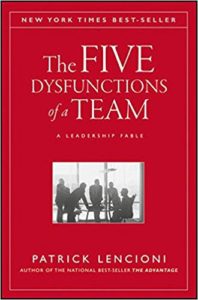
 When I was in America recently, I kept seeing a book on display whose title intrigued me. The title was The Five Dysfunctions of a Team. When I got back to the UK I tracked down a copy of the book to see if it has anything to say to the issue of teams as they operate in the Church. The short answer is that the book was not terribly helpful for church use. The context and setting of teams in business, which is what the book was describing, is such a long way from what the Church calls teams. But for all their radical differences, teams everywhere still have in common the existence of dysfunction.
Trying to read a book about teams has made me think afresh about my own love/hate relationship with the Church team idea throughout my ministry. Let me say quickly that I have never worked in a formal team situation. There have been times when I felt it would have been helpful to discuss difficult pastoral/theological issues with trusted colleagues. But, overall, I am glad that the situation never in fact arose. I witnessed what was the effect that team working had on others. I know that I would have suffered far more than I would have prospered.
Let me mention some objections to the so-called Team-Ministry idea as it is practised in the Anglican church today. In secular teams, the kind that function together to build Crossrail or motorways, there are groups of highly trained professionals who come together to make a project a reality. Each member of the team has been specially chosen and will have the needed expertise for the project and years of training. At a meeting of the management team, their expertise is listened to carefully and weighed up by the fellow team members and the person in charge. Everyone present is essential to the project and thus there is respect and dignity being offered to each person in the room. Each member of the Team may also be in charge of hundreds of workers under his/her instructions.
Church teams, such as those which come together to run a large parish, do not necessarily seek to balance complementary skills in ministry. The team is normally a group of random clergy who agree to work in this way. One of the Team is designated Team Rector who will oversee team meetings. He or she will probably have been ordained for a longer time with greater experience than the others. The members of the Team will typically be fairly junior clergy who have been ordained only two or three years. While each of them may accept some overall responsibility for an area of work across the whole, the main work will be done on their own patch. This is the part of their job-description where they are solely in charge. Team meetings, when they are expected to show enthusiasm for the large entity which constitutes the Team Ministry, will often be regarded as a chore.
One problem bedevils every Team ministry that I have ever encountered. The major handicap that I identify for successful team functioning within an Anglican parish situation is that there is now far less consensus about what a parish is for and how it should establish priorities. I have mentioned before the anecdote about the words spoken to a distressed woman linked to my church who called on an Anglican minister. He simply said to her ‘We don’t do pastoral’. By that he meant that he was only interested in swelling the numbers of ‘saved’ individuals through converting them to Christ. The bread and butter tasks of mundane caring for people, helping them through the pain and joy of everyday life in or out of church had passed him by. In vivid language, he saw his ministry as snatching branches out of the fire so that they would not be destroyed. This of course is not the only area of differing opinion about how parishes should run. The huge changes in the approach to visiting parishioners in their homes could create an enormous wedge and make me unsuitable for most Team ministries.
A second big problem for teams in the church today is the legacy of patriarchy. For centuries men have pontificated in church affairs and said what will happen and how it should happen. This tradition has never been a good foundation for team working. Entirely absent has been the idea that junior members of staff might have something valuable to offer the whole through their youth or education. I never remember any of my ‘training’ Vicars showing any interest in things I had studied in college. The patriarchal assumptions at the time of my curacies set out the pattern that the assistant curate was there to be the passive receptacle of the wisdom of the experienced priest.
I could go on to talk about the petty jealousies and rivalries that appear in team functioning in or out of the church. But that would only dovetail into what my readers would already know of their own exposure to the difficulties of working in a team. Many would summarise these issues as the ‘ego-problem’.But, in spite of difficulties, I still believe it is legitimate to sketch out the outline of what might be good team functioning. My thoughts for this come under five headings.
A team exists because of the underlying assumption that every member of the team has a vital contribution to make to the success of the whole project.
Each member of a team has the right to be properly heard with respect.
The team leader is there to ensure overall responsibility for the project but his/her views and insights do not necessarily carry greater weight than those of the team members.
The proceedings of team meetings should be carefully minuted. It should normally be assumed that these minutes are in the public domain unless there are cogent reasons for that not to be the case.
It is important that there should always be full disclosure of the source of information or ideas when external material is introduced by team members. This will ensure that team functioning is not compromised by unseen coercion from outside.
Respect, openness, tolerance and equal dignity are all hallmarks of secular teams and one feels that the same rules should apply to Church teams. But, rather than applying higher ethical standards than the secular world in teamwork, the Church seems to fall short in many respects. The word ‘team’ is quickly added to many new initiatives in the Church even when the groundwork to ensure proper team functioning has not been done.
I want to finish with a topical example from the Church of England. Five years ago the national Church started to expand its central work on Safeguarding as it became apparent that one person could not manage the work on their own. Problems have begun to surface as one person has exploded into a taskforce of thirteen and a half full time posts, collectively known as the National Safeguarding Team (NST). By calling itself a team, the Church gives out a totally false message about the way it is in fact functioning. The NST fails as a team because first it does not operate with openness and clarity. There are also serious problems of accountability to external groups, such as the House of Bishops. Where do its ultimate loyalties lie? It has no clearly defined stated aims. Survivors might expect that their interests would be properly represented by at least some of the members of this team, but this is apparently not the case. The methods of the NST operating are so opaque that many are calling for its abolition as being not fit for purpose.
The word team has been freely adopted by the Church over the years. This reflection is suggesting that the Church has in many cases debased the use of the word by simply failing to address what the meaning of the word might really involve. The NST is the latest in a long line of failures to grapple with the central question that Christians might ask. What might a team look like in a Christian context? We do not possess any models to point to at the moment.