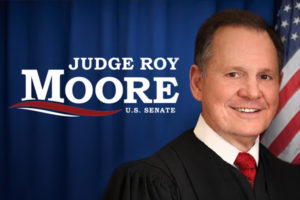
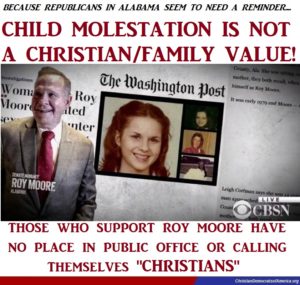
 Various commentators in America, both secular and Christian, have noticed that the word ‘evangelical’ has become damaged in recent months. Christians in the UK who still want to use this word as a self-description may need to be aware how many Americans regard this word as, at the very least, suggesting moral insensitivity. The Christian Right which represents the bulk of white evangelicals in the States has become aligned with a number of appallingly behaved individuals in American politics. No longer is a strong moral character demanded of the politicians who represent the conservative evangelical voter. Next week we may be witnessing the election to the Senate of the unrepentant paedophile Roy Moore. To vote for him involves effectively jettisoning ethics, truthfulness and straightforward honesty in favour of crude partisan politics. The Christian Right has apparently narrowed down morality to a couple of issues – the non-availability of abortion and the end of gay-rights. Every other moral principle can seemingly be discarded.
The recent recognition of Jerusalem as the capital of the State of Israel is also part of Trump’s attempt to keep faith with the Christian Right. We have to remind ourselves why this disastrous piece of American foreign policy matters to the hard-Right Christian tribe. It matters because these are the Christians who believe in the imminent Second Coming of Christ. The books they read suggest that the complete occupation of the Holy Land by Jews is part of the end time scenario. In one version of the belief in Christ’s return, the whole world is going to be catapulted into a state of disaster, war and ruin. It is only after this ‘Tribulation’ that Christ can return. A belief that our world is hurtling towards a Biblically ordained destruction helps to explain why many Christians simply do not care about nurturing the environment. There is thus an unholy alliance between right-wing Christian apocalypse thinkers and others who would rape and destroy the world’s resources for economic advantage. It is chilling.
Although I had hoped not to write about President Trump again, I find that it is difficult not to comment on the way that public discourse in America has been cheapened and coarsened in such short time. Even a year ago the evangelical voters who support Trump would not, I believe, have wanted to throw their lot in with an outrageous character such as Roy Moore. Something has drastically shifted in a very short time inside the spirit and conscience of many formerly decent people. What has happened to allow Moore even a small chance of winning? I think that the answer has to lie in the fact that conservative Christians have traditionally been required to think in terms of a strong polarisation between good and bad, truth and falsehood. Because right and truth could supposedly always be found in the Bible, discussion or debate was unnecessary. The conservative voter never learnt about the subtlety of debate. So now he has little ability to discern truth in a maelstrom of falsehoods and declining moral behaviour within political life. Because honest political discourse within the Republican party has been largely destroyed by the falsehoods and immorality at the top, the loyal base is forced to sacrifice moral conscience to continue their old loyalties. The need to defeat their political enemies has become the issue, not personal morality or decency.
I hope that this crude type of evangelical political thinking does not spread to our own country. At present we are fortunate in not having a political party closely aligned to apocalyptic right-wing Christian thinking. Although the gay issue is still important to many individuals, it has not created itself as a dominant idea in a political party. We also do not have to face individuals who want to challenge decades of scientific research in favour of a free for all, anti-ecological, model of economic development. But there are dangers and we need to be on our guard.
In the first place we need to understand and educate our children to see how dangerous polarised binary thinking is. We cannot have proper debates about anything when it is assumed that one side has all the right answers and the other has absolutely nothing to offer. That is the totalitarian pattern. Political decisions have to be made about economics and other issues of government. All of us recognise that because one course of action is being taken, it does not mean that the alternative path is without merit. It should be possible in schools to conduct debates and show this principle at work. For every decision that is made there are others that might have been made. A policy is made after other options have been considered. Few leaders, outside Trump’s America, genuinely believe that anything is black-and-white or that they can have a monopoly of truth.
Christians in many places are unfortunately encouraged to think in this highly polarised manner. They are led to believe that there are always biblical answers to complex problems. That is how the Christian faith and indeed the Bible is being presented to them. They are being failed both spiritually and intellectually. One has to say to such people as they consider truth in both politics and religion: ‘Look at the world and realise that there are precious few black and white issues in either politics or religion. The world is full of ambiguity and uncertainty. Decisions may be required from politicians and leaders of all kinds, but these will often be hard to arrive at. Even when they are made, such decisions are not infallible. A decision, the best possible we hope, is the result of an exercise of judgement and wisdom; it does not arise from some pre-existing infallible knowledge.’
Many evangelicals in America seem to be heading to a dark place. Because their teachers have been encouraging them to think in a binary way for a long time, we have this current tragic support of immoral deplorable political candidates without conscience or a proper grasp of truth. Truth, honesty and integrity seem to have slipped out of the qualities looked for in political representatives. Thus, these qualities even seem to be despised. Teaching black-and-white thinking, failing to encourage informed debate among their congregations – all this has resulted in the current moral and intellectual bankruptcy that we see today among so many American evangelicals. We never expected this to happen quite so quickly.