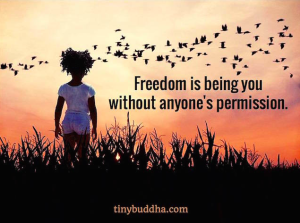
 Freedom is one of those words that everyone believes they understand. It also assumed that everyone is searching for freedom, particularly if they do not already possess it. Children, and particularly teenagers, are longing, we suppose, for the freedom of adulthood. People in a situation of slavery are also assumed to be striving for freedom above all else. The truth of the matter is in fact far more complicated. Many young adults far prefer to remain at home being fed and housed and generally looked after. Those released from slavery often find that the world of freedom is far more complex and anxiety-inducing than anything they knew before. Freedom brings about many choices and, if truth were told, people fear these choices. Some people will always prefer that life and all its complications be reduced to simply doing what other people tell them to do. The picture we have of every 18-year-old, desperately waiting to break free from family constraints, is only perhaps an idea of what we think should happen rather than the actual reality. Also the belief that every person in any kind of bondage wants to be released from their chains is also something which fits into the way that we would like them to be, rather than the way they in fact are.
From time to time I have reflected on the nature of addiction in our society. It takes many forms from cigarettes to alcohol, sex and drugs. Food is also a well-known comforter to help people cope with the choices and stresses of life. When one indulges in an addiction of choice, the addictive substance makes life seem far more under control. The highly stressed executive returning home from work may relax with alcohol. What he or she is doing is to escape from a world where they feel only partially in control. Alcohol gives them a predictable sense of well-being which helps them temporarily to blot out the choices, uncertainties and ambiguities of the working world. Most forms of addiction can also be understood to be a regression into the comfort and fantasy of being looked after and cared for by someone else. The addictive substance acts as a psychological crutch so that one can retreat from the unpredictable parts of life to something that is reliable and comforting – the child returning to the safety of a mother’s embrace.
One of the things that can be observed about the mass political movements of the 20th century is that, whether Communist or Fascist, they provided a way to relieve the stress of being a free individual, one with choices and decisions to make. The political movements, particularly as experienced in continental Europe between the wars, gave many people the experience of being in a large crowd. These crowds were all focused on a person or idea. While in the crowd the individual was relieved of having to think or feel for himself. It is no coincidence that Nazi Germany and Communist Russia appealed most especially to the young, young men in particular. This is the age group which goes through a period of anxiety as they move from the security of childhood to the time of decisions that being an adult normally involves. If there is someone or something to believe in which will resolve that anxiety, then it will be extremely popular. In short the mass ideologies of Germany and Russia in the 20 and 30s provided shortcuts to maturity for the mass of the population, albeit an utterly dysfunctional maturity. To be given a uniform by the Soviet or fascist state allowed the young man to feel adult without ever having to face up to the ambiguous and challenging freedom that such a stage would normally involve.
My reader may be wondering when I am going to reflect on the way that a fear of freedom is expressed in some aspects of Christianity. What I have to say here will not be popular with some, but I firmly believe that some presentations of Christianity have similarities to both the mass political movements of the 20th century and the current availability of many forms of addictive substance, legal or illegal. There is in fact a great deal in the New Testament about truth and freedom and the importance for the individual to take responsibility for his or her morality and choice of life. But the way the church presents itself sometimes leads us to conclude that the institution is colluding with people’s fear of freedom in the way that it peddles certainties and fixed answers that cannot be challenged. Many people see the church, not as providing a springboard for independent thinking and living, but as a place where people go to be submerged in a large group experience, not totally different from the mass political rallies of the 1930s. The music of these gatherings also helps to ‘soften’ people up to be part of a mass mind. Thinking and believing are here not the actions of individuals but this work is done on behalf of the whole by a small band of leaders. When people claim that they believe everything taught by a particular church or Christian leader, I see something profoundly regressive taking place. How is it ever possible in normal life to agree 100% with another person? And yet that is what is both claimed and believed to be possible in the context of a church. In a normal family one would expect that the 10-year-old child would begin to find areas of disagreement with his or her parents on various issues. By the age of 15 one would expect these divergences to be quite marked. Why is it that we expect everyone to agree with each other in the so-called church family? There is something quite unhealthy going on when this dynamic is at work.
Returning to our theme about the meaning of freedom, I am suggesting that this idea is far more difficult to live out and put into practice than would appear at first sight. Many people, including Christians, want to escape the demands of freedom and find a place and an ideology which makes them feel safe and included. While there is nothing wrong with wanting to belong, such ‘cosiness’ does need to be challenged from time to time. Any parent would want to tell their25-year-old offspring to find their own place rather than staying at home for ever. In the same way a church leader should want to encourage every member of his congregation to explore freedom rather than feel gratified that everyone wants to stay sitting at the foot of the pulpit in a dependent relationship. And yet the dynamic of many churches is one of creating and encouraging dependency, at the same time depriving people of the experience and challenge of finding a new freedom.
I cannot in this short piece explore fully what Christian freedom might actually look like. But I hope I have said enough to imply what the absence of this freedom appears to be. An absence of freedom in the Church can be seen in an over- dependency on particular experiences, words and individuals, This will be combined with a refusal to explore newness, paradox or the unexpected. To demand a freedom from freedom, as many Christians appear to do, is itself a kind of addiction. Somehow Christians have to own up how both in the past and in the present the church has colluded in this addiction. Living out a life of truth and freedom is hard work but this is the life in all its fullness to which Christ calls us.