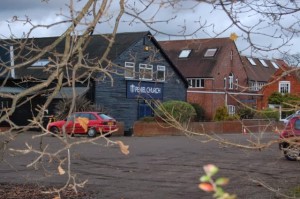
 It is sometime since I wrote about the events at Trinity Church Brentwood. Part of the problem is that other events, illness and house move, took me away from following the ongoing saga, but also I have had problems in accessing Nigel Davies’ blog. There is some bug in the system which means that I only occasionally manage to get into the discussion. But I can report that the main news at Trinity church in the post Peter Linnecar era is that the massive and devastating report by John Langlois continues officially to be ignored by the trustees. It is apparently evident that even while it does not officially exist, many people, including the trustees have read it. These same trustees have formally decided to respond to the other report from David Shearman and Phil Hills. Their response has been to set up a Reconciliation and Reparation Panel and this came into effect during March. The panel is under the chairmanship of one Peter Jordan, a minister of a local church known as Sawyers. Sawyers is one of the members of BADEF, the Brentwood and district Evangelical Fellowship. Nigel Davies has rightly been constantly critical of this group for failing ever to speak out against the abuses at Peniel/Trinity church, even though all the congregations that are part of this group were receiving a steady stream of refugees from Peniel/Trinity over the years. The stories that these refugees would have shared would have alerted any pastorally minded minister to the excesses of Reid’s ministry. Nigel points out that in fact the BADEF churches were always far too much in awe of the wealth and power of Peniel/Trinity Church ever to make any effective protest or attempt to criticise Reid’s appalling regime or the legacy he left behind him.
The individuals which has been given the task of making up the panel to attempt to reach out to the numerous victims of Peniel/Trinity church have, apart from the chairman, Peter Jordan, been left anonymous. Their qualifications have been set out but they do not inspire confidence, either in terms of their professional achievement or their potential ability to offer a true independent voice. One is a lawyer, one a consultant, and the other two apart from the chairman are a ‘psychotherapist’ and an accountant. Nigel has pointed out that an anonymous group is not one to inspire confidence from the perspective of a vulnerable victim. He is also incensed by the fact that Peter Jordan, the chairman of the panel and a local minister, is due to preach at Trinity on April 10. This acceptance of an invitation to preach hardly implies a detached independent relationship with the church. Jordan has also been active in BADEF for a number of years and is their current Chair. He is thus tainted along with all the other ministers of this organization of a wilful blindness and indifference towards the excesses of Trinity Church under its two former leaders.
As part of the exercise of reparation and reconciliation ex-members of Peniel and Trinity have been sent forms to fill in. The forms suggest that a sum of money may be made available for those who have suffered to enable them to receive some form of counselling. Meanwhile the third member of the panel who is named as a qualified psychotherapist and counsellor inspires absolutely zero confidence with regard to her professional competence and qualifications. I wrote a contribution (set out below) to Nigel’s blog to point out that many qualifications held by so-called Christian counsellors are not recognised by any professional accredited body in the UK. Nigel’s most recent blog links this member of the panel to an organisation called Deep Release.org and another known as Barnabas training. I have not yet had the opportunity to check out these two groups, but I would certainly not want to entrust myself to any ‘Christian’ group if I had been abused at the hands of Michael Reid or Peter Linnecar. My feelings about Christian counselling bodies have been severely jaundiced by some bad experiences over the years. I here insert the comment I made on Nigel’s blog.
I was somewhat alarmed to read the ‘qualifications’ of the panel member no 3 mentioned in the previous blog post. Most of us who have ever had anything to do with ‘Christian counselling’ (eg nouthetic counselling) are very cautious of the qualifications and actual content of these courses for ‘Christian training’. The only professionally accredited people are those who have done courses recognized and overseen by the British Association for Counselling and Therapists (BACP). Others who write or study courses (online etc) may be able to call themselves therapists but their standards of expertise range from the ignorant to the appallingly dangerous.
I once wrote a reference for a woman who was the least qualified person to start counselling that I had ever met. I tried tactfully to say to the Christian course organisers that the candidate totally lacked listening skills, thrust opinionated views on everyone around and was generally in my opinion unfit for the course. She was accepted and qualified!
If I go to a therapist, I want to know that they have achieved a proper professional qualification. Nothing about panel member no 3 suggests anything but a home-grown in-house type training. It reminds me of the way that MR and PL never submitted their preaching and pastoral skills to outside scrutiny. Look at the havoc they were able to achieve!
The suggestion is being made that the total amount being allocated for each survivor is around £300. Whether or not this is an ex gratia payment or a contribution towards meeting the cost of a limited number of counselling sessions is not clear. But, as someone pointed out on Nigel’s blog, this is a very small amount of money when set against the £7000 a month that was being paid to Peter Linnecar over the last eight years.
Nigel is thus extremely angry at at what he perceives as extremely half-hearted efforts to put right the wrongs of the past. His complaint in summary is as follows:
• The reconciliation panel shows no signs of true independence. This cosy relationship between the chairman of the panel and the church is symbolised by an invitation from the church to preach at their morning service on April 10th.
• An anonymous group of people will not inspire confidence from the victims of past spiritual abuse. The breakthrough of John Langlois was that, for the first time, Peniel/Trinity victims were able to see that somebody who was totally independent and without any bias was available to hear their story.
• The reparation that is being offered to past victims is derisory and half-hearted. Once again Nigel sees that the main efforts on behalf of Trinity is to preserve their assets while going through the motions of a limited gestures towards the victims of past abuse.
For all these reasons Nigel is to continue his courageous protests outside the church. This will incur the hostility of current church members who feel that their church is somehow doing the right thing for the victims of past evil. Even from the perspective of someone like myself living in the remote north of England, it would seem that Nigel is doing the right. This so-called panel inspires no confidence either for practical competence or its solutions being offered to past victims of the church.
As a final comment I am surprised that anybody would want to associate themselves with such a manifestly feeble attempt to put right such monstrous past evils. In view of the fierce outspokenness of the Langlois report we should be surprised that anybody, even a small group of ordinary church people, would want to have anything to do with this weak attempt to whitewash and try to bury the awful past of Peniel/Trinity church. It will be interesting to see if anyone in fact is prepared to fill up the reparation forms and meet a bunch of doubtfully competent people, all for the sake of a totally inadequate £300 worth of counselling. The victims of the Peniel church, as identified by the Langlois report, deserve better and we must be grateful to Nigel Davies for continuing the struggle to secure a more adequate justice for those who have been so cruelly and devastatingly abused by Christian ministry.