Category Archives: Stephen’s Blog

Investigating Trinity Brentwood

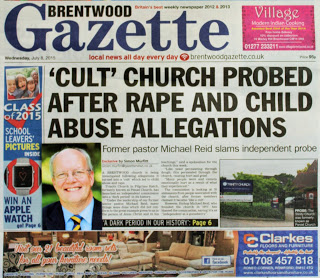
Brentwood gazette0n the day when the official enquiry into child sexual abuse begins in Britain under the chairmanship of Justice Lowell Goddard, we hear that as many as one in twenty children in Britain may have been the victims of sexual abuse at the hands of family, teachers, clergy or other adults. To judge from my own memory of the sexual abuse committed by adults among my contemporaries in the 50s, it was probably one in ten that went through this ordeal. That unpleasant memory has to be set to one side for now. What we are noting now is that the child abuse enquiry is meeting at the same time as the Commission into the past wrongs at Trinity Church Brentwood. Although the first is not due to report its findings for another seven years and the Trinity Commission is reporting in the autumn, they do share certain things in common. Both are both taking place in a totally new climate. What happened in the past is now seen to be totally and completely unacceptable. The child abuse enquiry will reveal how men who committed appalling acts against children were quietly shuffled out of jobs to take up other posts elsewhere. They were again free to abuse. Such cruelty, abuse and exploitation were somehow kept under wraps, not least because the victims were often not believed. The voice of the weak, especially the abused women and children, was given no credence. Today in 2015, thank God, the voice of those abused is being heard.

After my book, Ungodly Fear, came out in 2000, I received a number of letters, mainly from women, who echoed the stories of abuse recounted in my book. I answered them all as best I could even though the help I could suggest was very limited. At that time there seemed to be no awareness of Christian abuse in the church by those in authority. Although the book did not touch on the abuse of children, there were a number of letters resonating with my recounted story of a woman who was raped by a minister in the course of Christian counselling. That woman has now sadly died of cancer and her perpetrator was never charged. The letters that came to me recalling similar incidents, also revealed a complete failure of oversight and an unwillingness to do anything to bring the perpetrators to account. A combination of indifference and incredulity seemed to meet those women who sought help. In short, nobody wanted to know.

The situation in 2015 is a little better. The Jimmy Savile affair has opened up people to the possibility that people who perform public service like clergy, teachers as well as entertainers can abuse their positions to cause harm to those weaker than themselves. We live in a world where the stories, such as told in my book, are met with greater credence. People who tell stories of abuse long ago are now believed. For many this enables them to start a path to healing. The first thing to help them is to be heard and to be believed.

I make this lengthy introduction to the ongoing saga at Trinity Church, Brentwood because the people who suffered appalling mistreatment in the past at this church are finally being believed. The process which has started through the calling of a Commission to investigate past wrongs, may produce a document which will change the way things are done in churches for ever. Dozens of people have sent in their experiences of mistreatment at the church and school over the past 30+ years and to the Commission. John Langlois, the chairman, and his team are speaking to most of them over the summer and they hope to publish a report in the autumn. From past performance John should do a thorough job and a revealing account of the tortured history of this unhappy institution will be revealed. It will not be a perfect report as, no doubt, important aspects will not make the final report. The allegations of criminality in connection with the tortuous financial arrangements of the church will not be investigated by the Commission. No doubt, if the national press get hold of the story of the church, there may be pressure on the Charity Commissioners to compel them to open their books. The sort of things that are being investigated are the climate of fear and humiliation at the school and the experience of individuals who found themselves objects of power games perpetrated by leaders, especially Michael Reid, the disgraced Pastor who left in 2008. Sexual harassment, from lewd jokes to actual seduction, were also part of the culture of the church. The alleged criminal act that has sparked off the setting up of the Commission was the claim by one Kathryn, who wrote for this blog under the pseudonym of Sally, that she was raped by a senior church member. The context of the rape was, according to her claim, within a regime of relentless humiliation of her and all the other Bible school students when they came to Peniel in the 80s from the States to study at the church. Her readiness to stand up and be counted after this long period is a testimony to a great deal of courage and the resilience of the human spirit. It is also opportune that her story has now been able to be heard and acted upon. We can thank the climate of today which, as I have said, is far more open to making a response when accusations of such terrible crimes are made.

My hopes for the Commission report is that it will be read widely, particularly by churches that belong to the Evangelical Alliance. The Evangelical Alliance has given a sort of accreditation to a large number of conservative Christian organisations and groups over the years as long as they sign up to a statement of faith. It has never, as far as I know, expelled a church for immoral or corrupt behaviour. The only recent expulsions have been for not toeing the conservative line on the gay issue. The Commission report may well persuade the EA to insist that all Alliance members sign up to accountability measures which will protect women and children in particular. In short the Evangelical Alliance may come to demand ethical standards from its members alongside statements of doctrinal conformity. My own research in the 90s into the life of congregations normally affiliated to the EA suggested that moral standards among independent pastors were sometimes extremely low.

A hard-hitting report, such as we hope the report on Trinity Church Brentwood will be, may well open the mind of the wider public to the need to insist on high standards of accountability as well as morality in churches just like other public bodies. Safeguarding measures to protect all vulnerable people, and that means almost everyone, will come to be a priority in every congregation. The work of this blog, the constant addressing of abusive practice in church and Christian settings, would then theoretically be redundant. But perhaps that will not happen for a number of years yet. But we can hope and work for further movement towards that end.

Recovering from abusive churches – some thoughts

michael reidMy time at the Stockholm conference brought me into contact with a number of people who had been members of high-demand groups, Christian and otherwise. Some were 20 or more years into the process of recovery while others had only recently left a group. For me it was easier to interpret the narrative of those who had been part of Christian groups because the language they spoke in was a familiar one. But whatever kind of cultic group was being spoken about, the dynamics of toxic belonging seem to have many similarities. I want to think further about some of the difficult experiences suffered by those who join and leave what are known popularly as ‘cults’. I want to begin to consider how this baneful influence on people’s lives may be gradually overcome. Because this blog is dedicated to the victims and survivors of Christian abusive settings, my comments can be read as a commentary on some extreme groups within the Christian orbit. In practice, the full toxic effects of the wrong kind of charisma are generally muted in many Christian groups that we would identify as cultic. It is, however, still worth painting a picture with its darkest colours so that readers can identify cultic aspects as they pop up in many ‘normal’ religious settings.

A typical cultic group will have at its head a strong charismatic leader. By charismatic I am referring to the quality of personality that attracts others to a belief, a hope or a vision. The charismatic leader will have the ability to persuade followers to follow him (normally a male) in pursuing a vision for the future. The relationship, particularly at the beginning will often be intense so that the acolyte or follower feels a sensation similar to that of being in love. The follower will have a sense that the leader knows the path to salvation or true knowledge. He alone understands the Bible or the sacred texts of the religion. With him is safety, a sense of being at the centre of the universe where final truth is being taught and revealed.

The expression of being ‘in love’ might seem a little strong for some but it does convey the intense attraction and fascination of charisma. Charisma is particularly captivating to those who are in the first stage of adulthood where self-identity is still in a state of flux. The group encourages the adoption of what the psychologists call a ‘cult-identity’. This is a kind of faux-personality which makes the follower feel incredibly important but it only ‘works’ as long as the follower stays close to the words or the physical presence of the leader. The follower has become so entranced by the leader that he/she wants to be like him in every way. The dynamic of this ‘followship’ is that the disciple’s personality in some real sense becomes a kind of an extension of that of the leader. Somehow the personality of the follower has become enmeshed with that of the leader.

This kind of leadership/disciple dynamic can be extremely dangerous. There may be for a time a deep contentment for the follower while he/she enjoys the attention of the ‘wise’ charismatic leader. But this bliss is, in practice, short-lived. The leader, because he is human, will tire of the adoration of one group of followers and want to move on to exploit another group. The state of enmeshment, while it lasts, is enjoyable and deeply satisfying for the disciple. In the case of female followers of a male guru or leader, there may be a sexual acting out. But however the relationship is expressed, it is of such intensity that a breakdown in it will cause the follower to experience intense emotional trauma. It is the recovery from a deep emotional involvement with a religious/political charismatic leader that is a major part of the cult recovery process. In some ways it can be compared with a divorce or breakdown in an intimate relationship but in certain ways it is more difficult. The follower has surrendered not only their affection to another person in an act of love, but they have surrendered many other areas of their life to the leader, their idealism, their self-esteem and their hopes for their entire future. To have all that taken from them in a moment is indeed traumatic and indeed emotionally shattering. Without the right kind of support it can lead to a nervous breakdown or even suicide.

The emotional impact of leaving a cultic group, Christian or otherwise, is devastating but there is another facet of leaving, apart from the feeling side. In every group there are always two sides to an individual’s attachment to a group. The one side which we have already looked at is the emotional aspect. The second side is the intellectual or cognitive side of membership. To belong to the groups, which we would describe as cultic, it is necessary to have taken on board distinctive sets of ideas, beliefs and intellectual content that belong to those particular groups. For a member of a Christian cultic group, such as the Jehovah’s Witnesses or one of any number of fundamentalist churches, the cognitive side will involve some strong beliefs in the inerrancy of Scripture. Each independent church will have its own idiosyncratic way of understanding the Bible, and different leaders will require subtly different intellectual responses to the Bible from their members. Some will have, for example, a deep suspicion of women in leadership while others will always be quoting the Bible to undergird the authority of the leaders. A claim to believe in the authority of the Bible seldom produces harmony and agreement between churches with all the leaders. There are, as we have noted before, as many interpretations as there are interpreters. Historically the proclamation of ‘Sola Scriptura’ has not proved a good basis for finding unity between different Christian bodies.

Real problems exist for people who wish to leave a church or cultic Christian group. They have to cut free both emotionally and cognitively. In some cases an individual can recover fairly on the emotional front while intellectually they are still in thrall to the group. This means that they still think in the binary way, the black and way of thinking that we have discussed in earlier blogs, even though they may have made good progress in freeing themselves emotionally. Another group of people may find it easier to let go of the intellectual baggage imposed on them by the cultic group, while still being in thrall to the aftermath of emotional trauma. In talking to any survivors of cultic groups, one seldom finds that the emotional and cognitive aspects of former membership have been completely dealt with. The emotional side may need lengthy psychotherapy while the cognitive side will require a period of readjustment and possibly a readiness to enter a period of re-education. Neither process is quick or easy. It is likely that there will be a two speed process. I mentioned the incidence of tears at the conference and I detected that below the surface of many stories there were real pockets of grief and pain yet to be completely worked through.

I shall come back to this topic of recovering from abusive religious organisations. In many ways I have here merely scratched on the surface of the problem but my time in Stockholm brought me once more to consider how much has to be done in helping people move forward after being in thrall to an abusive church group or Christian leadership. Clearly there is always a lot to be done, but precious few resources in this country to help people in this process.

Taking stock

Thinking about the BibleA recent comment on this blog suggested that my approach to the issue of Christian abusive practice was ‘patronising and superior’. I have tried very hard to work out what in my writing was found to be this way. I have come to the conclusion that what may upset some people is the fact that although I try to support people who have been part of extremist groups, Christian or otherwise, I am not a party to or supporter of any of the teaching they may have absorbed. I cannot, for example, get excited about many of the details in Scripture, the accepting of which some teachers insist to be important and necessary for salvation. When, on the other hand, teachings are promoted which touch on people’s human rights, as with Christian homophobia or Christian misogyny, then I do get involved and want to debate them. When I hear debates about the details about Jonah’s fish (or was it a whale?) or the vegetation of the Garden of Eden, I find myself going into a trance-state. These types of discussion about the detail of the text of Scripture presuppose an understanding of the nature of the Bible which I find utterly fruitless and futile. Many of the issues that conservatives, past and present, believe to be important about the ‘truth’ of the Bible are not for me.

In saying that I am not going to engage with trivial details within Scripture because some Christian people believe them to be important, does not mean that I do not take Scripture seriously. Since first going to Sunday School in 1950 I have never had suggested to me that Adam and Eve were real people or that Jonah was anything but a good story. At the age of five, story and history were the same thing anyway. No one in my childhood ever tried to make me a literalist and for that I am profoundly grateful. I did not meet people who insisted on reading every single bible story as history until I got to university to study theology. They were not among my fellow theological students. After a few late-night battles over coffee I retreated from such discussions baffled and indeed puzzled that the Bible could be made even more complicated by notions of inerrancy and infallibility. Of course there was history in Scripture but equally there was myth, legend and events half-remembered through the mists of time. It was enough for me to spend two solid years learning Hebrew, New Testament Greek and wading through countless commentaries on the books of Scripture to come to something resembling a conclusion about how I was going to teach and preach Scripture over forty years of professional life as a clergyman. I was never going to pretend that ‘critical scholarship’ had reached certain conclusions about the real meaning of the Bible. I was not going to teach certainties about Christian doctrine. Rather I was going to invite members of my congregation to come on a journey of discovery to learn about Jesus, his teaching and all that he reveals to us about God. In short my ministry was going to be an invitation to faith in a man who reveals to us God and in some sense is God. That journey would always have elements of incompletion about it. There would never be tidiness. For me the Bible was and is a thoroughly untidy book, full of ambiguities and even contradictions. If I thought that the God was teaching his will clearly from beginning to end, that would be my wishful thinking and not anything I could find in the actual text.

In presenting the position of a liberally but reasonably well-trained clergyman of the 1960s I am representing a large number of clergy who had a similar education to my own. The vast majority of clergy trained at that time would have imbibed similar ideas to my own. Apart from the five years of theological study that most of us in our twenties at that time were required to do, I spent a further three years of other theological study, mainly to do with private research into Eastern Christianity. The point I want to make strongly is that even if people do not agree with what I think about the issue of Biblical interpretation, at least they should be able to recognise that my position of uncertainty over some aspects of the Bible is still a position of Christian integrity. I respect those who hold positions different from my own but I will powerfully object when their understanding of the Bible causes harm and degradation to minority groups. For example I will protest if a literal reading of the words of Paul leads a Christianity into causing women harm or injustice. The purpose of this blog is to challenge Christian teaching when it causes harm to individuals. So often, as I demonstrated in my book written fifteen years ago, the claim of biblical infallibility by a Christian leader spills over into a teaching of human infallibility. In short the teacher of an infallible book becomes an infallible person. The infallible leader is at the heart of the Christian abuse which this blog is concerned about.

To repeat the blog is concerned about Christian abuse, particularly when it occurs in conservative Christian settings. The fact that I come from a theological position quite separate from many of those I critique, should not make my approach invalid. It is not the theologies themselves that are under attack but only when they lead to harmful and abusive practice. From time to time the expression ‘the bible says’ is the prelude to bad or harmful practice, and to that extent the particular teaching must be challenged. The full weight of Biblical commentary and the insights of detailed scholarship must be used to challenge such bad or harmful teaching.

Everyone is born somewhere. Every Christian has been taught the faith in a particular setting or environment. I make no apology for mine and I stand up for a position in the liberal end of Anglicanism. I see things from that background but I hope my reading, my education and my extensive travel in the Christian world allows me to have many other perspectives. I hope that my readers, even when they do not agree with what I say will allow me to be what I am and allow me to continue my task of challenging the abuse of Christians by Christians wherever and whenever it takes place.

politics and religion

tsipras-wahlen-eu-540x304All of us have been watching the Greek crisis over the past few days. I have been giving it more attention than some as I have a special interest, having lived in the country for ten months in the 60s and witnessed some of the tumultuous times of the Greek dictatorship. I have always known that Greek politics is a bit like a cult in the sense that some Greeks indulge in the extremes of irrationalism when presented with an attractive idea. The current Prime Minister, Alexis Tsipras, has, because of his youth and practiced rhetoric, been able to persuade a large slice of the population to support him. They will be voting in a so-called referendum on the highly detailed issues of the European offer to the Greek government. If they vote ‘no’ to the offer it is likely that the country will leave the euro and descend into social and economic chaos lasting two years or more. The complexity of the arguments has been reduced to a simple yes or no. The people in fact will be voting as to whether they trust their young charismatic leader or not, rather than trying to engage with the complex arguments of the economic proposals. To be fair it takes some education and economic understanding to master what these economic proposals are, but that is why people elect governments to make responsible decisions on their behalf. The referendum is thus not about economics and the euro but about trust in their leader.

In thinking about the Greek situation, I see a number of parallels with the leadership of conservative churches. A typical worshipper, faced with a highly complex and difficult book, the Bible, decides that they want to allow someone else to read it for them and decide what it means. That relieves them of having to think for themselves about it. The important issue then becomes their ability, or not, to trust the leader. If he is perceived as totally trustworthy, then the problem of understanding Scripture and making decisions about it is solved. The whole dynamic of the group depends on this total trust between leader and led being sustained. One word that was being used at the conference last week was the word guru. It is a word that implies an abundance of trust in an individual in religious leadership. The disciple in effect hands over to the guru the decision making part of the personality in the belief that he is ‘enlightened’ and that that enlightenment will also shared with the follower. The attenders at the conference who had followed gurus were generally disillusioned people, because they discovered over a period that the guru was human like the rest of us, subject to vanity and power games, not to mention addiction to wealth. The act of having large numbers of people adulating you will give a religious leader the idea that he actually is wise, does understand the spiritual needs of his followers, does have special insights into the Scriptures. Whatever problems may arise for the follower in the guru-disciple relationship, there are also going to be problems for the leader himself. These will often not be visible at the beginning of the relationship but greed, lust and other human foibles will gradually become more and more apparent over a period of time.

At the Greek general elections in January it seems that what was being voted on was the wisdom and appeal of the Prime minister himself. People have wanted to trust him on the basis of his rhetoric and charisma. He is, by contrast, being judged by those outside Greece on his economic competence which does, from a distance, appear extremely shaky. I have to conclude that whatever domestic support he enjoys, is in fact based on the fantasy of what people would like to be true rather than what is true. The guru figure, the one trusted for his pleasing words will always be one that appeals to large numbers of people. This thrall of the guru figure is always going to be somewhat cult-like, whether it happens the context of religion or politics. There is nothing unusual about people wanting to hand over decision making. It makes life less complicated after all.

The consequence of the arrival of a charismatic figure on the scene in either politics or religion is that overall less serious thinking is being done by followers. This does ultimately bring people into the irrationality of propaganda and anti-intellectual behaviour. This is not blame-worthy behaviour but the sad result of the cultic aspects of both religion and politics the world over. It just happens but it is the task of newspapers and perhaps bloggers to protest when it occurs. Once the patterns of this sort of behaviour are discerned, then at least some people can be rescued from the result of the exuberance of charisma. At its best charisma in leaders moves people to feel and even do great things. At its worst it binds them to irrationality with a heady dose of fantasy and unrealistic promises.

Greece heads off into the unknown as I write these words. The country has been blinded by the promises of its cult-like politicians. The dynamics of trust in their political leaders have not served the country well. As I write these words I am reminded of words from Psalm 146: “Put not your trust in princes, nor in any child of man, for there is no health in them”. Many will, rightfully, conclude that we are better off putting our trust directly in God. The problem is how to do this in practice, while not being misled or even deceived by one of his representatives!

Stockholm 2015

I am writing this post very laboriously with one finger at Stockhom airport as I want to assure followers of the blog that I am still alive!

Some follwers of the blog will know that I have been attending the annual conference of ICSA (International Cultic Studies Association) at Stockholm. It has been a kaleidoscope of conversations,talks and seminars with around 200 people from different parts of the world. The typical attendee (not me) is someone who has encoutered a high-demand group and is now in the process of recovery through training as a counsellor, organising political activity or writing. As a clergyman merely interested in the issue of extreme groups, I have been in a minority at the conference. I have become aware of how much suffering most of the people at the conference have had to go through before arriving at the therapeutic place of attending a conference of this kind.

One of the highlight moments of the formal part ofthe conference presentations was a seminar on forgiveness. Three women each spoke of their understanding of the meaning of fogiveness in the context of their individual stories of recovery. The atmosphere was,as you would imagine, taut with emotion and everyone in the room was full of tears by the end. That seminar perhaps typified what ICSA is all about, providing space for people to grieve and mourn the loss of time and relationships that their involvemnt in high demand groups had caused them. So many people were speaking about forced alienation from family members which escape from the extreme groups had caused them.

The other part the conference was the study side. This was where my own reflections came in. I was addressing the issue as to what social psychologists have recently had to say on the topic of shunning or ostracism. I was noting that the scholars had not really taken into account the extensive amount of material that cultic studies has revealed. My ‘section’was alongside the well-known cult expert Steve Hassan so my presentation was boosted by his ‘fans’. A video was made of the talk which may appear on his website. I will provide link if and when it appears.

As for the future I met up with a remarkable English couple Marc and Cora,both survivors of the Witnesses. They have an active ministry to the shunned of JWs and their work of producing Youtube videos enables them to contact people all over the world. Through them I have come to see that former Witnesses may find material on thig helpful to their recovery. I shall certainly be keeping in touch with them and their networks in the future. ICSA is meeting in impossibly hot Dallas in 2016.

I come away from Stockholm with a sense that my studying, writing and interest in the topics of this blog are still important and relevant to the Chritian church and the wider spiritual landscape for the timebeing. I shall be referring back to the topics of the conference as time goes by, particularly the main theme, the suffering of children in cults. The noisy crowded setting of airport does not make deep refection very easy.

Hope to get back to my normal rhythm quite soon. I also hope that my conference adventures might help to extend our readership a little more.

Immoral God?

prosperity-gospelThe title of this reflection is deliberately provocative but it raises an area of concern that should matter to all Christians. The question that I should have asked is not whether God is immoral but whether some of our beliefs about him, our theologies, make him seem immoral.

One of the areas of concern for many people, believers and agnostics, is whether we can talk about God being active in the affairs of our world. Does God cause thunder-storms, to use a crude example? More importantly if God intervenes directly in our lives, by stopping us walking into the road when a lorry rushes past, what do we say about people who are not so protected? Are the people who were killed in Glasgow a few months back by a rubbish collector truck, somehow not worthy of God’s attention. I also have in mind the recent story of the retired GP who leapt on to the railway track in an attempt to save a woman from a train. She survived while he was killed. If we claim to believe in an interventionist God, should not that heroism have been rewarded by God?

The claim to believe in a God who directly intervenes in the detail of our day to day lives raises many problems. And yet it is the staple of the way that many people think about God. It is also the backbone of particular strands of theology that exist among conservative Christians. The particular theology I have in mind at this point is the so called ‘Health and Wealth’ gospel. In brief, as I have explained in previous posts, this teaching tells Christians that it is God’s will that everyone should have wealth and also perfect health. Such teaching raises enormous problems both on a practical level but also in what it implies about the nature of God. Everyone knows that in order for anyone to be considered rich, someone else is going to have less. Wealth is never a fixed category. We use the expression ‘wealthy’ to describe those who have more than the typical resident of a particular society. The wealthy of a society in sub-Saharan Africa are nevertheless likely to be poor when compared to the ‘poor’ of developed countries like those of Western Europe. One particular chilling statistic tells us that the wealth of a country like the States, and the levels of consumption that it engenders, is such that the resources of our planet could not cope if everyone were to be able to live like this.

It is clear that whatever else God can be said to wish for our world, he cannot want the destruction of the planet by a massive increase of consumption of resources that a substantial rise in wealth across the world might involve. And yet Western Christians are apparently proud to take the ‘biblical’ promise of material wealth to countries across African and elsewhere. People are being urged to express their faith in God by giving of their modest resources to the church so that God can ‘bless’ them and pour on them the wealth that he means them to have. In fact the only benefactors of God’s ‘blessing’ are the preachers themselves. They feel it important to drive around in large cars and live in fabulous houses so that they represent the embodiment of God’s bounty. It somehow never occurs to the wealthy preachers that there is in this flamboyance, not a sign of God’s generosity, but an obscenity directed both against his will and the poor people who make these sacrifices of money.

The ‘Health and Wealth’ preaching is not just confined to Africa but is preached by the vast majority of religious broadcasters. I have mentioned in at least two previous posts the begging for money that occurs on God TV and broadcasting in Britain and around the world. I would not able to begin to name the range of Television channels in America dedicated to this kind of broadcasting.

In declaring that God does not want all of us to be wealthy in the style of Wendy on God TV or Jimmy Swaggart in the States, I am not preaching a form of socialism. Somewhere in the future, and it may not be very far off, we are going to discover that any more growth of consumption by the inhabitants of this world is likely to destroy the world. Resources like water, trees and energy need to be conserved carefully if the human race is to survive. Somehow against this background of the depletion of the world’s resources, the pursuit of individual wealth, whether by preachers or by their followers has an obscenity about it. The God of the Health and Wealth gospel seems to care nothing at all for the good of the wider population of the world, but focuses entirely on individuals, each of whom, through their increasing wealth, is doing more than most to consume a disproportionate part of the world resources.

The God of Health and Wealth preaching is an immoral God. He is thought to do the opposite to the God of the Magnificat by exalting the rich and sending the poor empty away. In talking about an immoral God I am not attacking him; rather I am challenging a particular fringe but powerful segment of Christianity to revisit the Bible and find there a God who stands for justice, care for others and concern for the whole of nature. As a Christian individual I feel uncomfortable at the high standard of living we enjoy in Britain. Giving money away may help this discomfort but it will never solve the problem of what in practical terms I and other Christians should be doing about the poverty of so many areas of the world and the inequalities that we see around us. I suspect that were I really wealthy, which I am not, my sense of dissonance in the face of poverty would be far greater. Small things, like being extremely reluctant to throw away food and attempting to recycle as much as possible, helps to relieve conscience but it does not solve the problem of being relatively wealthy in a world of poverty and pain.

Pilgrimage – a reflection

pilgrimageLast week-end my wife and I attended a family gathering down in Kent so that we could meet up with various relatives who live in the south. Some of them we have not seen for a long time, as we moved up to live in Scotland and the North of England some 12 years ago. One of the people I met again was a nephew in his 30s and he told me of his interest. He was, with a friend, walking the old pilgrim routes of England, singing traditional music, sleeping rough and generally trying to enter the experience, both physically and spiritually of the pilgrims of long ago. He was now acting as a consultant to help an interested group who want to put pilgrimage on the map for a new generation.

Pilgrimage is something that has always interested me but my interest has focused more on the early pilgrimages to the Holy Land. I have always been intrigued by the way the early Church’s liturgy, from the fourth century onwards, has been influenced by the accounts of pilgrims who went to the Holy Places in Jerusalem. They brought back not only details of the liturgies they observed taking place in Jerusalem, but they also made sketches of the lay-out of the buildings in which these liturgies took place. There are a number of church buildings in France from the 9th century which use the layout of the churches of the Holy Land as their inspiration. This copied architecture made possible a reproduction of the distinctive Holy Week liturgies that the pilgrims had seen on their journeys to the Holy Places.

After the conversation with William, my nephew, I began to reflect on the power of pilgrimage in the way that it encourages and fosters a distinctive spirituality. Various ideas had occurred to me in the course of our conversation and subsequently. I feel that some of these are worth sharing with my readers. One thing I particularly responded to was a comment by William that pilgrimage has a resonance with younger people. One of us made the point that being a pilgrim was something that one did for oneself and this was quite different from sitting passively in a church pew. Each and every person on a pilgrimage was putting in effort and time to make the experience real, something hard to avoid when you were walking 10 -15 miles in the course of each day. This physical effort was combined with focusing of attention towards the destination. The destination, whether it be a holy well, a collection of sacred bones or the setting of a significant event in the Christian history of the nation, gave the journey its particular structure. Whatever we might now think about relics and holy wells, it is still possible to enter, through our imaginations, into the hope and expectations of the early pilgrims and the way they looked forward to entering a numinous space. Each and every pilgrimage destination had been made holy or set apart by an association with a spirit-filled individual, a martyr or saint. It might also be a place where miracles had taken place. Whatever the reason for the holiness of the destination, the mediaeval pilgrim was going to be able to participate, even for a moment, in a movement out of the ordinary into a dimension touched by the transcendent. Whether through kissing a reliquary or drinking holy water, this was a moment when each pilgrim believed him/herself to be meeting the divine. What could be taken home was a sense that God cared for each and every individual. Pilgrimage, in other words, brought the transcendent down from the control of the priests to the level of the common person. Such experiences are still enjoyed today.

The actual experience of pilgrims, past or present, I feel, is also a metaphor for a different way of being a Christian. While on the physical journey to a holy place, the pilgrim will surely become sensitised to life in ways that are not part of everyday experience. The thought of the destination, while it might not inspire constant prayer, would lead a pilgrim to a level of meditation and reflective thought. The sort of questions that might be raised internally would be ones that concerned individual purpose, direction for life and decisions for the future. Idle chit-chat would seem less appropriate when the pilgrim was trying to take the whole process seriously. I would also expect the pilgrim to pay a great deal of attention to his/her surroundings. Something of the wonder and mystery of creation would inspire a new appreciation for beauty in the natural world. Finally the pilgrim would be open to the new encounters with people that he/she might meet on the road. There would be an openness to a new relationship, a readiness to give and receive of oneself to everyone who passes by.

The feature of pilgrimage that appeals to me, in particular, is the throwing off of the trappings of role and convention while on the road. In day to day lives, as we are aware, we are forced so often to fulfil the expectations of others, be a particular kind of person so that we can earn a living. On the road there is an enforced equality. No one is taking a position of teacher or leader. ‘We are pilgrims on a journey’ are the words of a well-known hymn. Would it not be wonderful if the freedoms glimpsed by the pilgrim could be something that our churches offered? So often the membership of a church feels like a straightjacket. We are not allowed to travel onward, discovering who we are and what might be our particular role as Christians. So often we are presented with a list of correct things to believe, correct things to do and the exact formula for our financial contribution. Instead of movement forward, there is a sense of being tied down to the pews. The congregation can make no contribution to what is said or taught in church. There is no opportunity for articulating a person’s unique insight and particular journey. It is as though no one’s voice is ever valued except the one who is authorised to preach. The ‘pilgrimage model’ of church life, on the other hand, would encapsulate the vision that the abilities and insights of every single person would have a role in the onward journey of the whole. I would love to see a large sign outside every church which reads ‘Pilgrims welcomed here’. Working out what this invitation will involve will take some unpacking but it would be an exploration that would be really exciting to be part of.

Theology and Violence

1359564497_muslim-riotsIn the Times today (Tuesday) there is a leader trying to respond to the news of two young men from Britain killed in Syria and Kenya respectively in the cause of radical Islam. The crux of the article appears at the end when the writer appeals to Muslim leaders to face up to ISIS recruiters with vigour, stating what is and what is not acceptable in Islam. The leader notes that only one national leader, Egypt’s President Sisi is calling for a ‘religious revolution’ to counter the ISIS ideology. This appeal is somewhat vitiated by the fact that thousands of suspected Islamists are being jailed by his regime, only to encourage the recruiting of thousands more to the extremist cause.

The issue for Muslims is ultimately a theological one. The question for every Muslim is to face up to what they believe about truth. Does their grasp of truth require them to battle against and kill other people who differ from them in the way that truth is expressed? Is the only way that devotion to a truth can be expressed to be through militancy? Of course we recognise that differences between Sunni and Shia have become over the centuries a tribal and nationalist division, but the battles between them are still articulated in a theological language. If there were another narrative available which did not stress the theological gap between Shia and Sunni, then no doubt a political compromise might be far easier to achieve in the nations of the Middle East. Instead we have the online hate preachers corrupting young minds with their endless propaganda. They will be talking about devotion to God and the costly sacrifice that is required of all true devotees. This kind of language will be heady stuff to a young, possibly unemployed, young man. He is being offered a focus for an otherwise chaotic life, something which will give it meaning and direction.

Christianity itself has not been free of the rhetoric of extremism and violence. The preaching that preceded the Crusades in the 11th century dwelt on the importance of regaining Christian lands and killing infidels in return for divine forgiveness. It also gave the younger sons of the nobility, those who would not inherit land from their families, a chance to make a fortune from the plunder that might come their way. Historians will tell us that people went on crusades for a multitude of motives, some possibly honourable, many not. Nevertheless whatever the true reasons, the official script was that Christianity was superior to all other religions and this ideological dominance over all its rivals needed to be expressed by military conquest. Both Crusaders and members of ISIS are bound together by a conviction that they are in possession of an ultimate religious truth. Because, in each case, their faith is the best and purest form of religion, their rivals must give way to this inbuilt superiority. The fanaticism of the beliefs of the ISIS is such that they have convinced themselves that they have the right to kill, not only infidels who are not Muslims but also their fellow Muslims who do not follow their particular interpretation of the Koran.

At the heart of fanaticism, whether Muslim or Christian, is a belief that the believer possess the truth because it is contained in a holy book. A book, through the fact that it has written content, appears to have an objectivity about it, making it superior to other ways of mediating religious truth. It is obvious that an experience, orally transmitted, will change over time. A written document, on the other hand, will not change and will thus seem to preserve a fixed meaning. Since the Reformation in West, many of us have got used to the idea that the words of Scripture do not in fact have a single interpretation and the proliferation of denominations and churches bear witness to this fact. But something of the mystique of words in a book, especially the Bible or the Koran, as having a supreme authority, has remained part of the thinking of many people today. This respect for a Holy Book is such, that, to this day, some people seem reluctant to read it for themselves but leave it to the pastor/minister/iman to read and interpret it for them.

Fundamentalism, whether in Islam or Christianity, maintains in each case a highly dependent relationship with a written text. With a devotion to words that was more understandable in an illiterate society, it maintains the fantasy that the written text is a gateway to an objective expression of truth. The particular version of truth within the book is so compelling that other people must be forced into agreement. In the case of Islam that force is sometimes expressed in cruel violence. In the case of Christians physical violence is not used because the traditions of our modern democratic societies would not tolerate anyone using force against another to further religious ends. When, however, you listen to extremist groups within Christianity talking about other people who disagree with them, you wonder how close to the surface are murderous and violent thoughts. Every time I hear Christians speaking about demonic possession existing in those they disagree with, I hear the language of violence. The whole obsession with the gay issue on the part of those who campaign against it has the marks of a crusade with all its negative and cruel connotations.

My final comment in this reflection about theology and violence is to suggest that we listen carefully to the rhetoric of Christians to identify the underlying violence in the language that is sometimes used. From the beginning, Christians, like Muslims, have shown themselves capable of being able to be inflamed to the point of violence in the defence of their vision of truth. Every time a Christian wants to trash and discredit another Christian for not agreeing with their vision of truth, they are committing violence. It may not be physical but the intemperate language of Ian Paisley or many other conservative preachers can also be seen to be violent. It has as its aim the destruction of other people and their words and ideas. As I said in my piece on ostracism, people can also be destroyed by silence every bit as effectively as by weapons. It is easy to trot out at this point Jesus’ injunction to love our enemies. But perhaps we should indeed spend time reflecting on this command. Above all, it should make us sensitive to the need never, never to regard people who think differently from ourselves as people to be attacked with words of violence. Difference never justifies violence of any kind.

A quote from Jonathan Sacks which concluded the Times leader: ‘We have little choice but to reexamine the theology that leads to violent conflict…’ That would apply to Christians as well as Muslims.

Books, words and power

booksThere is a story on the BBC website recently about a teacher in Italy, Cesare Cata, who set his pupils some unusual homework for the summer break. Among other things, they were instructed to ‘wander beside the sea in the morning’ and ‘dance shamelessly when the mood strikes’. It was not these unconventional instructions from a teacher that caught my attention but what he said about reading. His recommendations struck a chord with some of the issues around words that I have been talking about over the past months. He told the pupils to read widely and use all of the new terms they learned in the last year. His comment went on to say ‘the more things you can say, the more things you can think; and the more things you can think, the freer you are’.

I immediately warmed to this idea about the use of words. We have in this blog touched on the profound social disability and disempowerment that arises from illiteracy in our society. The number of words that are used in conversation is only a fraction of those used in writing, even by ordinary people. The writing of classical authors will use far more words again. To access these major classics one has to be able to recognise the rarer words that are in use. The reason why authors who win awards and recognition for their work have such a large vocabulary is a simple one. The more words you have at your disposal, the wider and deeper can be the way you express the huge of human experiences that are explored by great literature. Cesare was aware of this in his instructions to his pupils to read. He knew that the more that they understood, the greater would be their ability to understand what we summarise as the culture of the written word.

How does this all relate to our theme? It relates to our concerns because Christians are among those who sometimes reduce deep and complex matters to formulae and even slogans. I have had reason to question an expression like ‘giving your heart to Jesus’ because it sounds like a shorthand for an experience. There is no means of knowing from the words used whether the experience is a shallow one or something profound and life-changing. Those people, like myself, who don’t like the expression, want to find out from the person using it to discover what it, in fact, means. It is not always easy to discover what lies behind such formulaic language because it has become a slogan. A limited grasp of language may here have come to involve a inability to communicate. The culture that surrounded the individual when he/she converted has failed to provide the tools of language and expression through which to reflect on it and communicate to others.

I am one of those people who has been around long enough in the church to believe that charismatic and conversion experiences are sometimes real and transformative. People do also sometimes receive profound healing. For me the problem is that the whole culture of the charismatic is also imbued with tendency to use language and expression in a somewhat banal way so that the inner reality seldom communicates itself to people outside. Banal is also a good adjective to describe the lyrics of many ‘worship songs’. People who respect the power of language cannot easily enter a culture that they feel is using language in a superficial and shallow way. It is no coincidence that there are divisions in the church that are defined, in part, by class and educational background. A preference for the ‘traditional’ in terms of hymnody and biblical translation may reflect the educational background of the individual.

The power of language to free us to understand and express ourselves as well as communicate with the ‘greats’ of the past is well understood. The opposite is also true. A limited language is one which restricts our experience and our ability to understand cultures and people different from ourselves. The problem, that I am identifying, is that church communities sometimes want to push people into a small cultural space where communication among them is conducted with a desperately restricted vocabulary. The people in that space, because the words and concepts that are allowed to them is limited, cannot experience certain things that a wider tradition would afford to them. For someone like myself, with a reasonable theological education behind me, I am filled with a frustration at my inability to communicate what I understand of both Christian spirituality but also the entire Christian tradition. I can say the words, but the words may not connect with the strictly defined boundaries of language in the audience. This has been laid down by the culture they inhabit and the teachers within that culture. As a matter of record, I frequently use visual symbols or picture in my preaching to articulate what I think Jesus was on about in his teaching. But, I fear, that my avoidance of the many Christian slogans and expressions – words like salvation and substitutionary atonement – will alienate me from many Christian audiences. It is not that the words have no value or meaning; it is rather that they need to be understood with enormous care and removed from the category of slogan and cliché, which is the place they occupy in many preacher’s armouries.

To return to the efforts of Cesare in Italy. He is seeking to help his pupils to find freedom through a greater command of language and ideas. They would then be able to think more things and break out of the tramlines of other people’s restricted vocabulary and culture. They would glimpse the uplands of being their own people, rather than individuals who can only think thoughts dictated by others. The person I meet in the New Testament was also, in a different way, encouraging us to break out of boxes of convention and custom. The particular boxes were then the Jewish law and the restrictions that that law placed on everyone. Jesus encourages each of us to meet God and, in meeting him, meet ourselves in a new way. The ‘life in all its abundance’ that is to be ours, will come gradually apparent over a whole lifetime. It is not wrapped in a box, able to be opened after a moment of ‘conversion’. No, it is revealed gradually over time as experience and, yes, new words help us to identify through people and events the fullness that is God. Each person will travel the journey in their own way, but they will be the sort of people that will be open to receive assistance in making the journey in many ways. Let no one ever say to you, here you have arrived because you belong to this or that church. That will be a kind of prison every bit as limiting as only having a vocabulary of 2,000 words.

Why do people join cultic churches?

why do people join cultic churchesAs my readers will know I am a fairly regular reader and contributor to another blog about Trinity Church, Brentwood, http://victimsofbishopmichaelreid.blogspot.co.uk. I do this for various reasons. The first is that I am learning an enormous amount about the dynamics of this one particular church, past and present. I did once visit the church in the late 90s while researching my book, but the accounts of people, who have been involved recently, are fascinating. A second thing is that by making a blog comment from time to time, I am able to get a sounding board for some of my own ideas and insights. Some of my comments are also an attempt to reach out to the victims of this frightening cultic church, while other comments are aimed at encouraging the blog master, Nigel Davies.

In the past week I made a comment in response to someone who was describing the endless use of certain tell-tale words and phrases which have become commonplace in Trinity Church. There was one particular word that was mentioned, ‘tirelessly’. This was used to describe the efforts of the present senior pastor, Peter Linnecar. But it was also pointed out that the same word was used to describe the work of the former discredited leader, Michael Reid. I began my comment by saying how this kind of repetition of words was a form of sloganising. This suggested a lack of originality in the thinking of a church which practised it. Were I to be a member, I would find such a church, which repeated words like this, utterly boring and lacking any sense of vision for its future. I then went on to wonder out loud why people remained in churches that went in for this kind of sloganised thinking. I suggested that one reason was that they had invested so heavily into the church over the years, through their time and money, that they could not now leave it behind. All that now remained of their ‘investment’ were familiar faces on Sundays and, what I described as ‘jolly music’ provided by the choir. Leaving would be a final abandoning of their investment

I would not normally comment on my remarks on this other blog but it was the response to my comment that struck me. It came from a member of the church who has recently left and who had some pertinent things to say. He began his reply with these words: ‘ The other motivation (for being a member) is the drug of superiority, pride, arrogance and all that Trinity entices the flesh with, because by joining, or by staying, you can buy into aspiration, more status and instant acceptance or belonging.’ I realised instantly that this was a very helpful insight as to why people join not only a church like Peniel/Trinity but many other churches as well. I also realised that ‘superiority’ applies not just to a social reality that a church seems to promise, but it is also a theological category.

A person observing small children will notice how, from a very early age, the child develops a strong competitive spirit. Much of the time the competition with other children will be over fairly trivial things. Which child has the highest pile of bricks or whose is the better painting? There will also be competition to be the ‘favourite’ of the parent or the carer. All this competiveness will ultimately be about feeling superior. It is from a place of superiority that an individual feels safer because other children have to look up them as the winner, even if only for a brief time.

As part of growing up, most people discover that the value of cooperation over competition. But the competitive spirit never completely leaves people. You see it in the lining up of cars outside peoples’ homes. In buying a car that is bigger and grander than the others in the street, the competitive adult feels that he/she is gaining an edge over the neighbours. Looked at in a detached way, it seems as trivial and unhealthy as when a toddler fights to get on to the top of the climbing frame first so that he/she can taunt the ones who are left behind. Cooperation, on the other hand, delivers many advantages, but even when these are experienced, the need to win seems to be a very powerful urge for many, particularly the members of the male sex.

It is not surprising that churches that feed into the competitive addiction shown by so many, do well in the world. ‘Come to our church and you will mix with and associate with successful people. We guarantee that they will befriend you, thus making you a person of significance.’ That seems to the subliminal message picked up by the former member of Trinity, Brentwood. But it is not just a feature of churches of a conservative bent. I can imagine people being attracted to churches of all kinds which, because, when they do things well in some area or another, they help to exalt the status of those who attend. There is a process of osmosis. ‘Our church has the best choir’, or ‘our church is run by the best leader in the area’, or ‘we do the liturgy properly in our church’, might be the cry. It is hard to keep out a competitive spirit from the church, and in this respect conservative churches are no worse and no better than others.

The claim to exalt people socially on the part of this particular church, Trinity Brentwood, is not the only claim implicitly made. There is what I would describe as theological one upmanship. Although some of the churches I have belonged to have subtly played the ‘social card’, none have claimed superiority over the matter of truth. As I have said before, truth is something to which we aspire, not something we own. A typical claim of many conservative churches, like Trinity, is that they preach the ‘pure’ gospel, unlike any other church. If members of the congregation buy into such an arrogant claim, it is not surprising that they are doubly addicted to a desire to belong to that particular church. They believe themselves, not only to be part of an upwardly mobile social group, but also the owners, through their leader, of a unique access to God and his truth. This is an intoxicating as well as toxic combination. It is not hard to see, the other blog contributor does, how hard it is to let go of such claims. It needs a massive dose of humility to come down from the place of arrogant superiority to a more realistic place. Realism and humility are, in fact, both in short supply in many churches, not only the conservative variety.

I have now exceeded my word allowance, so I need to conclude with a final remark. Is not the cure for our addiction to feeling superior in our Christian life, a proper and thorough understanding of the word ‘repentance’? That word, when it is understood in the context of Mark’s gospel, enables a Christian to eschew artificial superiority of any kind and come humbly into the presence of God and be one who knows that we ‘have no power of ourselves to help ourselves.’