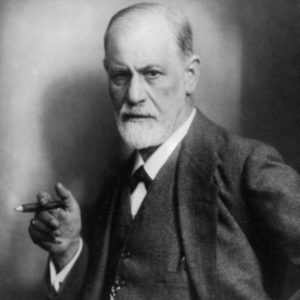
 “A group is extraordinarily credulous and open to influence … anyone who wishes to produce an effect upon it needs no logical arguments; he must paint in forcible colours, must exaggerate, and he must repeat the same thing again and again. … (The group) wants to be ruled and impressed, and to fear its masters. … And, finally, groups have never thirst after truth. … They are almost as influenced by what is not true as by what is true. … A group is an obedient herd, which could never live without a master.”
—Sigmund Freud
In my attempt to educate myself in subjects beyond my original training, I have sometimes dipped into Freud’s writing. I find that my relationship with him goes in one of two directions. On the one hand I have never enjoyed his theories of the unconscious or found them especially congenial. On the other side his prose, even in translation, flows well and is normally comprehensible. This quotation came my way recently and I thought it resonated with many of our contemporary problems, both in and out of the church.
Absence of logic, exaggeration and failure to pursue the truth mark many of our current discourses today. But it is Freud’s mention of the group that I find especially interesting. I do not know exactly when Freud penned these words but, in the period up to the date of his death in 1939, it could be claimed that many thinking people allowed political groups, right or left, to do their thinking for them. The group-mind was arguably even more powerful then than it is today. If problems came up that were too difficult to resolve on one’s own, then the individual defaulted to a group of like-minded individuals. This group might be friends or ‘mates’ down at the pub. Independent thinking was too hard for most people even to attempt.
I could go on to speak about the influence of ‘opinion-forming’ newspapers like the Daily Mail on current political discourse in the UK. Clearly much of the Press in the UK and in the States has no interest in helping people to think for themselves. They offer instead instantly attractive opinions which pander to prejudice and deep unconscious bias. The chief technique of manipulation which has been used for hundreds of years is the identification of a common enemy. We can all feel smug and safe when we agree on the individual or group that we hate in common. I don’t need to enumerate all the enemies chosen by the right-wing press. Clearly foreigners of some description would form one of the categories of hate-object.
Having identified a few of the unhealthy dynamics of groups that Freud spoke about, it is painful to realise that many churches all too easily fall into the category of the mindless associations that he was describing. A contemporary worship service has a lot of ‘forcible colours’ in the form of loud, addictive and endlessly repeating music. As I have suggested many times before, repetitive music has the effect to drowning out coherent thought. Sadly, as with any addictive substance, that is precisely the point of engaging in it. People seem to long to go to a place where they can forget and where thinking and having coherent opinions is done for them by others. Possibly this is a regression to the place they occupied as a small child. Mother and father cared for them totally and they long to return to the place where they can enjoy the same dependence.
The second part of Freud’s description of the group or church is in the way that a relationship is sustained with a ‘master’. The church group often wants to be ‘ruled and impressed’. How often do we see this kind of link being established with a pastor whose word is equivalent to that of God himself? A failure to critique what is being said in church leads to a passivity about truth which Freud also identified. It has always been striking how many congregations only read the bible when selected passages are being preached about. It is never read independently by many in the congregation. This is perhaps because they fear what they might find there in the form of questions and insoluble problems that the text raises.
Group and mindless behaviour sadly seems to be endemic in our churches. Church shares with political parties the attractiveness of being a place where often opinions come ready-made. They are also spaces where individuals can feel strong as part of a group. This is what ‘we’ think about moral issues. Someone, not me, has decided what I think on the gay issue, abortion and countless other topical matters. If I were to think about them for myself that would be dangerous. I might find that I did not really agree with others. So, I will return to the mindless and safe state of being ‘credulous and open to influence’.
It is easy for church members to feel intimidated by their dependent role within a church congregation. Centuries of custom and practice has created an unhealthy deference to authority in all the churches. As part of the revolution being created at this very moment in the Church of England, that deference is beginning to be confronted and challenged. If the church is to survive and flourish it has to escape being an ‘obedient herd’. It needs to find a new role as a communion of thinking, inquiring and searching individuals. It needs to embrace the fact that in searching there may be differences of opinion. Those differences are no threat to our ‘salvation’ but are part of being human beings who are blessed with an infinite variety of personalities and ways of seeing
Freud was a thinker, but thinking is about as unfashionable as quoting Freud.
Transparency, however, is more of today. It is becoming harder and harder to conceal anything, let alone wrongdoing, with the advent of online exposure and instant news.
Our leaders come in for intense scrutiny and rarely seem to emerge unscathed. We can no longer glibly accept everything, nor rely on group-think, but must carefully weigh what we say and do. And think.
Perhaps, after all, Freud had something important to say?
Did Freud define what he meant by ‘group’? How permanent, for instance, does the group have to be? Does it apply to a group convened for one meeting at a conference, or only to groups who meet regularly over a period of time?
And what of us poor souls who have both a need to belong, and a fatal habit of thinking for ourselves?
Boom boom!😀
Was it Temple who said that the church existed for the benefit of its non members?
I imagine the early church groups were short-lived due to persecution, but left a lasting legacy.
Wilfred Bion noticed weird behaviour in groups getting “off task”. E.g. he saw inappropriate dependency, and exulting “pairs” of leaders, as a way of the group protecting itself from anxiety. He saw this in the army and church and other groups.
It takes courage to face these anxieties. Paradoxically, It’s easier when shared with other people.
Comfy as it may be to belong, we all get complacent when the task is nearly done. It’s nice as it is. We become exclusive. We don’t need non members.
And sometimes then we turn a blind eye to the weird and sometimes positivity wrong stuff going on in our midst.
Has persecution returned to this particular group? And for good reason? Perhaps it’s better not to belong for a while; or start something better?
First and foremost we should be searching for the Kingdom and surely each of us search as individuals. This doesn’t work well if we belong to a group where we are confined to certain ‘acceptable’ books, texts, doctrines etc. But we do so much want to be liked and approved of by members of our group. What a dilemma!
Not for me though or any self respecting individual.