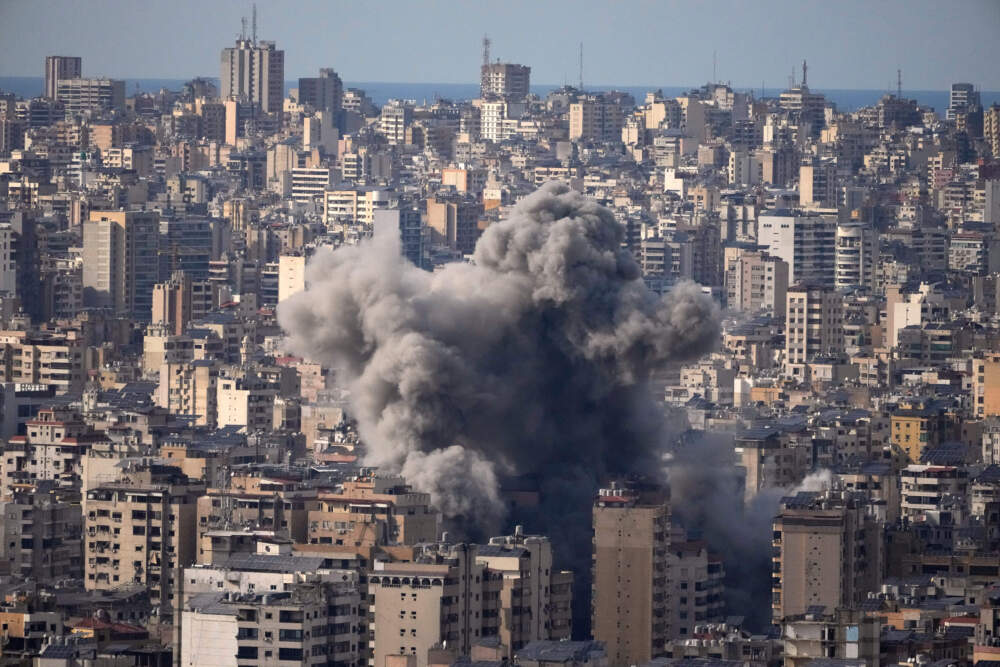
Every so often an event in the news triggers a strong memory which may have retreated from our awareness. The recent reports of thousands of British people stuck in Middle Eastern airports recalled a moment when I found myself in Beirut in 1975 at the very beginning of one terrifying phase of the civil war. It was an extremely unsafe place to be, but I was following up on a very successful journey three years before. I was engaging in what I described to myself as ‘ecumenical fieldwork’, making links with Christian leaders from both the Syrian Orthodox and Orthodox members from the Patriarchate of Antioch. It was an entirely personal journey of discovery. I wanted, in particular, to learn about an Orthodox youth movement that appeared in the war years in this part of the world. Having begun to flourish in around 1942, by the time of my visit it was a fully mature expression of Orthodoxy, affecting people of all ages from student members to the elderly. It was a fascinating story, and I did manage to write up my discoveries for Eastern Churches Review.
The expedition was not without its moments of drama. Within three days of my arrival, I found that there was massive crisis in the supply of petrol for the whole country of Lebanon. There are no railways into Syria out of Lebanon and the only form of overland travel was by shared taxi. My Lebanese friend took me to a central taxi depot which normally would have had a plethora of taxis competing to transport me across the Syrian border to Latakia, where I was to meet one of my Youth Movement contacts. On this particular day all the taxis signalled they were out of petrol, and they certainly did not have enough to take me to Latakia. Eventually we found what was possibly the last taxi out of the capital and we set off, calling at every petrol station along the way. Fortunately, the last petrol station before the Syrian frontier still had some petrol and we soon reached the comparative safety of Latakia. If I had not travelled on that day, I would not have been able to reach Syria. Beirut itself became, in a matter of hours, a place of terrifying danger and mayhem, with uncollected bodies left lying in the street.
The anecdote which I tell is not only explaining how the current Middle Eastern wars have stirred memories of what might have been traumatic experiences for me, but also how the same journey was the setting of a conversation which has resonated in my memory for years afterward. The conversation was about how the Bible is understood, especially among those who teach and preach every Sunday. Should congregations and their leaders ever be faced with the difficult problems that arise when looking at ‘critical’ questions of language and interpretation. My Lebanese host, Nadim, had been my roommate for four months at the Ecumenical Institute at Bossey in Switzerland. He was involved in the college for the Orthodox in a place called Balamand in Lebanon. By 1975, he was a senior member of staff, teaching ordinands the basics of bible study in preparation for ministry. The particular conversation I recall, centred round, not politics, but my discovery in his flat of an OT one volume commentary published by the Intervarsity Press and obviously well used. This was a book which gave the ‘sound’ interpretation of various OT problems that students of theology have everywhere to deal with. This particular volume, true to its conservative evangelical origins , was presenting what I felt to be a thoroughly confusing and misleading view of what the broad consensus view of OT scholarship had to say about critical questions of authorship and historical fact. This commentary, to take three examples, supported the view that the book of Isaiah was the work of a single author, Moses wrote most of the Pentateuch and that Daniel was a product of the exile period. I went through the commentary noting how, what I thought to be the consensus academic positions of Old Testament agreement were all routinely rejected. I observed how the author consistently argued for a conservative and literalistic explanation on every occasion. These explanations were political in the sense that every critical conclusion conformed to what the author had predetermined to preserve the ‘correct’ interpretation every time, one which supported the inerrant point of view. Up to that point I was aware that such conservative ideas were taught in Christian Union circles, but I naively did not believe that ordinands of other denominations such as the Orthodox, were being fed this approach and, consequently, having to argue for the conservative inerrant position in their essays. The conversation went on for over an hour, and I passionately made the case for allowing every student, not only to know the many critical issues thrown up by Old Testament studies, but also to have a choice in whether to identify with this scholarly consensus. These were the interpretations that sided with the main-stream ‘liberal’ ideas taught by the non-fundamentalist critical approach the world over.
To summarise this conversation with Nadim, I was given that day a crash course in the politics of conservative biblical interpretation. There is a lot more I could say about why I believe that there is something profoundly wrong about teaching a single version of truth in biblical studies. The so-called liberal position over the understanding of Scripture is often decried as being unfaithful to God’s truth and God’s word. What in fact is the position of the so-called liberals is their plea to be allowed to argue and debate with the tools of criticism for another position than the one laid down by denominational or institutional authority. The position presented as ‘sound’ or correct can never be the only one allowed in debate.
My own position is to allow myself a freedom to be hesitant or even sceptical when there is a claim to provide certainty. Sometimes the conservative interpretation for a passage raises more problems than it solves. The discrepancy over the numbers of animals going into the Ark has a disarmingly simple explanation when one accepts the thought that Genesis is not the work of a single author but a compilation of sources. To take another claim of ‘liberal’ scholars that there are the hands of three distinct writers in the book known as Isaiah, we have a revealing insight into the work which makes it far more manageable than if we argue for a single author. Giving a late date for Book of Daniel (i.e. 160 BC) also helps to understand the thinking of the Jewish nation in the face of their Greek attackers who sought to destroy the Jewish Maccabean princes. Daniel’s visions may conform to a modern popular understanding of the nature of prophecy – namely it is about what is going to happen in the future. By contrast the classical prophets in the Old Testament, Jeremiah, Amos, Hosea and Isaiah etc are far more interested is declaring God’s will to the present. ‘Thus says the Lord’ normally introduces a passage where the judgement of God is declared over the people for their immorality, their dishonesty or misuse of their power over the stranger or the poor. Prophecy is the insight to understand what God wants, even demands, from his people in their pursuit of the life he wants them to have.
A near disastrous trip to Beirut and a significant discussion/argument about the teaching of Scripture came together in my mind for this week’s reflection. The juxtaposition of these two events may make no sense to the reader but for me, they come together in a strange way. If President Trump had not started a war in the Middle East, perhaps this important discussion about Scripture might never have been evoked and vividly recalled to my memory. In thinking out loud about the events that took place over 50 years ago, perhaps I am able to share something helpful with my readers. There is of course a lot more say of these topics, but at least I have been able to share something of my understanding of Scripture.
Another interesting reflection-as always! The ‘OT literalism’ vs ‘open perspective’ on OT interpretation is a fascinating topic. I have come across conservatives who believe in every line from the Genesis opening to the last words of Revelation being equally inspired. The converse of this is a clipped liberal Protestantism, where Gospel-Acts-Pauline Epistles almost suffice, and are certainly given an absolute primacy. The believer in YEC may well struggle with standard Astronomy-Evolution-Geology and the mainstream archaeology or palaentology domains. But should the ‘open-evangelical’ believer, and a great mass of liberals, draw a breath when we hear Our Lord affirm ‘The Days of Noah’? I have started to find the Mind-Brain area fascinating. Incredible how the fat-protein-water of half a dozen kippers arranges itself into the amazing human brain. TV food critics wax lyrical on how to fix a perfect pizza, or where to find the best Italian food. But is the human brain is the greatest mystery within the cosmos, and one of the strongest evidences of a designer being present?
Thank you Stephen for sharing this significant episode in your life.
Its depth and meaning has value for us all.
An interesting reflection, Stephen – you must have been intrepid in your younger days!
May I enquire in what sense you are using the term ‘critical’ in the above essay? Do you mean ‘vitally important’, ‘analytical,’ or are you referring to the ‘literary critical’ approach to Bible study? Or, none of the above, or all three?
The word critical is being used in the distinctive sense that the Bible is being studied using all the tools of modern post-enlightenment analysis (history, linguistics, archaeology etc). Such analysis has, over the past 250 years, revealed an enormous amount of insight and understanding of the text of the Bible and this critical adventure is shared the world over by theological colleges and faculties and their students. Resistance to the findings of ‘criticism’ is found among conservative Christians, as some threat to its truth. There are many Christians, including myself, who can read the Bible as in some sense as the Word of God while honouring the ‘critical ‘ insights of modern scholarship.
G K Chesterton famously said: “It is absurd for the Evolutionist to complain that it is unthinkable for an admittedly unthinkable God to make everything out of nothing, and then pretend that it is more thinkable that nothing should turn itself into everything.”
Modern scholarship in Astronomy perhaps tallies rather neatly with Genesis 1:1. While the media look closely at how-‘Young Earth Creationism’-appears to be incompatible with scientific discoveries, it is also interesting to note how-‘The Steady State’-and infinite universe, as favoured in the past by distinguished atheists, now looks obsolete.
To have visited the Middle East must be a grounding experience, and bring added poignancy to the current war in the region.
Normally I think it’s lazy to take sides in a dispute, but in the present situation you have to, not least because we’re sending our grandchildren out there to defend our people.
As to who is on our side, is a challenging question, with once firm allies flip-flopping with their allegiances, tactics and even values, almost on a daily basis.
Our distance from the fighting normally tends to insulate us from the blood being shed. However, in a globally linked economy, the price rises are already being felt particularly in our rural oil-heated homes.
Distance is also being eliminated (hopefully solely theoretically) by the range of truly intercontinental ballistic missiles.
One thing the warring parties have in common, is their certainty that God is on their side. It’s a common tendency throughout history to conflate what we decide God wants, with what we want.
In the U.K. we live in a society where we benefit potentially (and sometimes obliquely) from the ruling hegemony. We derive some virtue from challenging its approach and methods, but as Christians I believe we are right to do so, not forgetting the comforts we derive from our shared systems, and having the humility to admit this.
There is evidence (Ed Conway, Sky News yesterday) that the financial markets are being gamed by the use of inside and advance knowledge of announcements, to the tune of hundreds of millions of dollars. In the U.K. this could potentially amount to misconduct in public office, with prison. Obviously it’s very hard to prove, but as nations if we suspect war is behind done for profit (if that’s not a naive statement) we can at least debate it politically and vote accordingly.