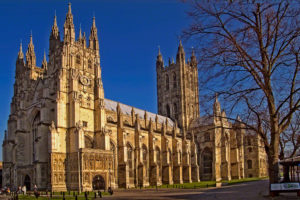
 Around 60 years ago in Canterbury Cathedral a notice greeted visitors as they entered the building. A request was made for them to make a generous contribution to Cathedral funds. The notice pointed out that Canterbury Cathedral needed £1500 annually to cover the shortfall in its income. This worked out at around five pounds a day. Even allowing for inflation this seems to us a tiny sum of money. Visitors were in fact fairly few in number in those days as continental tourists could not then afford to visit Canterbury. I have no doubt, nevertheless, that the generosity of the visitors easily able made up this modest deficit
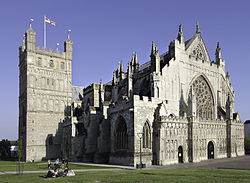
Moving back to today it is quite clear that all cathedrals in England are currently encountering massive financial burdens. These, sometimes running into millions, are crippling for those who have responsibility for caring for these buildings. Some cathedrals, like Canterbury, have successfully implemented a visitors’ charge for all who come to see the building. Visitors to Canterbury Cathedral today number well in excess of a million in a single year. Thus, even the huge capital projects for restoration can be managed with a reasonable hope of success. Other cathedrals which lie well off the tourist circuit, like Peterborough and Exeter, struggle to raise necessary funds. In recent months, we have heard of the difficulties of governance in both these establishments. Both deans have had to resign. Financial problems have played a major part in the crises that these cathedrals were going through. Clearly there were also personality clashes. It is perhaps inevitable that people will fall out when difficult decisions have to be taken. Making individuals redundant or selling off assets are clearly paths to be taken only after a great deal of possibly acrimonious discussion.
In the past two weeks, the Archbishops have set up a Cathedrals Working Group (CWG) to look into all the issues around governance and organisation of cathedrals. In the background is the often criticised Cathedrals Measure (1999) which attempted to put onto a new footing the way cathedrals are run. The main change brought about through this Measure was to require all cathedrals to employ lay people to manage many aspects of cathedral life. In particular, it was recognised that expertise in financial matters was required. A Chief Executive figure had to be appointed for every cathedral. Cathedral Councils were also set up with the Bishop of the Diocese present in a non-voting role. The Cathedral Chapter, the Dean and the Canons, would be left to be responsible for the worship and the pastoral care of the congregation. Clearly the divisions of responsibility within cathedrals has not been without potential tension and friction. In a previous blog post I pointed out that requiring cathedrals to have these multiple foci of power would result in problems. I have only indirect knowledge of how the divisions of responsibility in cathedrals works out in practice; clearly human relationships will be a key issue and this will involve a need for constant diplomacy by all concerned.
The published reports on Exeter and Peterborough Cathedrals both raised many issues of governance and personal relationships in these institutions. In a set-up where there can be up to four competing centres of authority, I find myself asking why no one talks about this issue of power at a very early stage? Power is like many unspoken topics; it is there but no one wants to describe and analyse it. No one, as far as I know, has ever examined the way authority works in a cathedral from a psychodynamic point of view. When people accept positions of responsibility and power, they will inevitably bring to the table their own personal foibles. These may well become exaggerated by the exercise of the authority role. From my own reading, it seems that in many leaders there is a chance that some will go on over time to develop increasing narcissistic tendencies. Such characteristics will make life for those below them utterly miserable. It would appear that most commercial organisations are alert to this possibility of bullying and obnoxious behaviour and have procedures to deal with it. In the church and other voluntary organisations, the culture of niceness prevents many people calling bad behaviour by its proper name. When an individual with a frustrated ego accepts the role of a manager, it may be a recipe for disaster in that organisation. Why do not people talk about the psychological issues among leaders in places like the church and which commonly cause so much unhappiness?
Looking back over my career in the church, I would many times have welcomed an open discussion about personal and psychological issues connected with my work. In particular I would have welcomed a free exchange over the issue of relating to a Vicar when I was a curate. If the Vicar had said to me, for example, that there will be some issues where I have full authority because of my greater experience. There will be other matters where I welcome your opinions and insights. That will allow us to have an open and free discussion so that we can make a decision jointly. That would have been a path to liberation. If there had also been an open recognition of the fears and tensions that were unspoken and existed on both sides, that also would have been tremendously helpful. But neither thing happened. The Vicar curate relationship for me was very much the parent-child relationship with little recognition that I had anything to offer in spite of five years training. I suspect that many of the tensions which occur within cathedrals, whether between Bishop and Dean or within the Chapter are like this. Individual egos, some of them badly corrupted by over-rapid access to power and authority, are normally unprepared to examine the power dynamics that will always exist in institutions. Would that people could really speak freely about what they feel and think about personal interactions within an institution. Everyone should be able to speak openly when they are expected to work together in harmony.
The expression ‘speaking to power’ is one that is now being much discussed in the context of politics. What I would wish for the Cathedrals Working Group is that they began a serious discussion about the way that power dynamics operate within large and somewhat unwieldy institutions like cathedrals. I would also like the emphasis on training of senior figures in the church to include a much greater understanding of how power dynamics in institutions function. Relationships can so easily breakdown when power games are in operation. Many people do not know how to separate their sense of personal self-esteem from the responsibilities they hold. Defining the ‘self’ by the position of power that is held is neither healthy nor conducive to good relationships. On a slightly separate point, I cannot understand how the Archbishops in England can expect a working group to produce an adequate report with a time-limit set for the end of the year. The issues, the evidence and the stories that they will hear will take them considerable amount of time. I fail to see how they can digest so much material and bring it into a coherent form.
2018 will see the published report. It will be interesting to see whether the group is able to do justice to anything of this issue of power within institutions. They may of course leave it as the unacknowledged reality which no one wishes to unpack properly for full analysis and understanding.