by Janet Fife
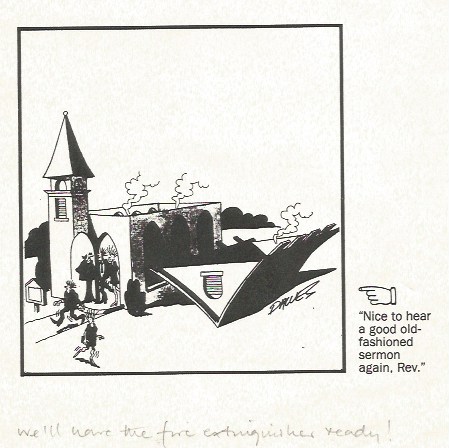
I arrived at my office in the church to find a cartoon taped to my door. It depicted a smoking church, with shaken and singed members of the congregation departing. One of them says to the minister on his way out, ‘Nice to hear a good old-fashioned sermon again, Rev.’ Someone had pencilled in underneath, ‘We’ll have the fire extinguishers ready!’ I can’t remember what text I’d been assigned to preach on that Sunday – I was still a curate – but clearly I’d gained a reputation for preaching some pretty judgmental sermons.
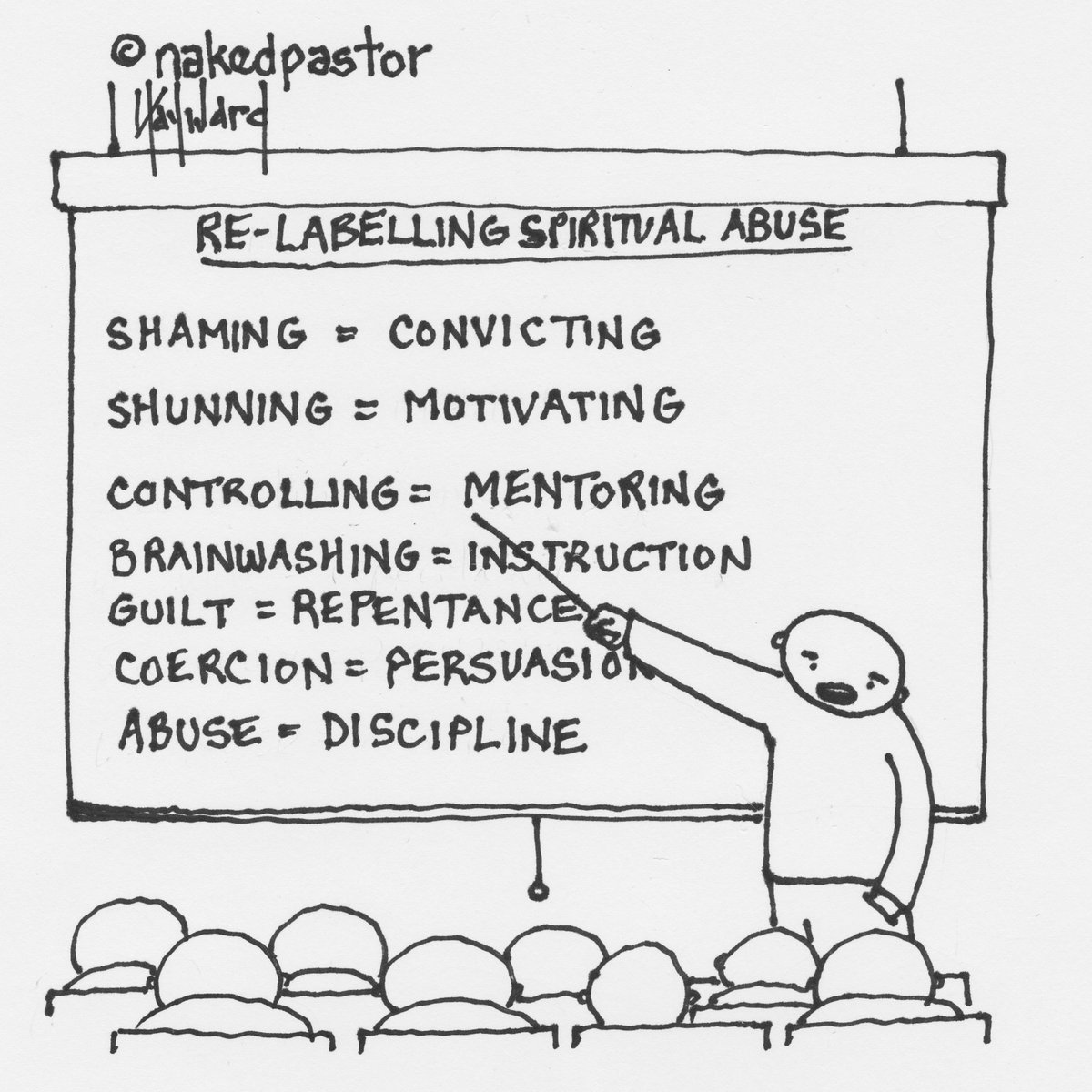
That was part of the tradition I’d grown up in, where preachers ‘dangled sinners over hell’, like the 18th C preacher Jonathan Edwards, or ‘challenged’ their hearers ‘to within an inch of their lives’. It was all done in love, of course: people had to be ‘convicted of their sin’ before they would turn to God. So in all earnestness I would declare that ‘God is not impressed’ by this or that aspect of human behaviour. I knew very definitely what was right and would please God, and what was wrong and would make God angry. Certainty is so reassuring.
It was at some point after that cartoon was left on my door that I sat in that same office preparing a sermon. And an inner voice said to me, very clearly, ‘It isn’t your job to convince people that they’re sinners. That’s the job of the Holy Spirit.’ (See John 16:8.) I saw then that my role was not to convince (‘convict’, in evangelical parlance) people that they were sinners, but to attend to those who were already worried about their sin. To those people I might minister forgiveness, healing, restoration. Or, as often happened, I might reassure them that they had done nothing wrong. I recall one woman, who came to see me who was tormented by guilt and could find no peace. Her offence? On her first ever visit to church she had taken communion, not knowing she ought to have been confirmed before taking part.
Many of us will, at one time or another, have taken part in a social media conversation among Christians where some of the participants refuse to accept that there is more than one valid point of view on a contentious topic. Not content with merely stating their own views, they imply that anyone holding a different opinion is wilfully disobedient to God. ‘The Bible clearly says, x, y, or z, and everyone who wants to obey God agrees with me.’ There is no recognition that faithful Christians might differ as to the interpretation of the Bible or the will of God; no nuance. If others in the discussion quote Bible verses that appear to contradict their stance, they ignore them or explain them away. If opposing arguments are backed up by citing Bible scholars, those authorities are dismissed as unsound or second rate. Nothing can shake their apparently impenetrable assurance that there is only one version of the truth, and it is theirs.
This is not a new phenomenon. St. Paul, writing to the Romans, said: ‘Accept the one whose faith is weak, without quarrelling over disputable matters. One person’s faith allows them to eat anything, but another, whose faith is weak, eats only vegetables. The one who eats everything must not treat with contempt the one who does not, and the one who does not eat everything must not judge the one who does, for God has accepted them. Who are you to judge someone else’s servant? To their own master, servants stand or fall. And they will stand, for the Lord is able to make them stand.’ (Rom. 14:1-4 NIV).
The question of whether or not to eat meat may not sound too serious to us, but to first-century Christians living in Gentile cities it posed a serious dilemma. Much of the meat sold in the market came from animals which had been sacrificed in a pagan temple. Therefore, the meat on a Christian’s plate might well have been sacrificed to an idol. To some, knowing the idols had no real existence, this didn’t pose much of an issue. Others felt strongly that it was a risk no Christian should take. This might be that they believed the idols had demonic power, or because the believers had converted from the other religion and were afraid of being lured into slipping back, or for some other reason. For whatever reason, they contended that true Christians ought to make their devotion to Christ alone clear by abstaining from meat. Real Christians were veggies.
I was born in 1953, and in my lifetime the defining issues of ‘soundness’ for evangelicals have included the following: not wearing make-up (for women); not having long hair or beards (for men); not dancing, drinking, smoking, playing cards, listening to rock music, or seeing films; the right beliefs about the Second Coming of Christ, the Tribulation, Rapture, and Millennium; predestination vs. free will; the authority and infallibility of Scripture; eschewing vestments, candles and incense in church; wearing a cross rather than a crucifix; opposing the ordination of women; and believing homosexuality to be sinful.
Some of these are still contentious issues, but the heat went out of others long ago. And while British evangelicals have never been much exercised over dispensationalism and the details of the Rapture, their American equivalents never had a problem with cosmetics. My mother, speaking to a church ladies’ group in the Chicago suburbs in the 1960s, recounted how shocked British evangelicals had been when the Billy Graham team arrived in England in 1956, and the wives were wearing make-up. Unfortunately, it turned out there were several of those same wives in her audience, and they were affronted. That was the last time my mother ever spoke in public.
Anglo-Catholics will have their own shibboleths, as will traditionalists. Observing Ascension Day on a Sunday; the position a priest takes when celebrating; whether ‘virtual’ Communion is valid: almost anything can be loaded with immense and eternal significance. I have known charismatics maintain that everything from paisley fabrics to Body Shop products are demonic and must be eschewed by truly devoted Christians.
Which all reminds me of the therapists’ axiom: ‘The presenting problem is never the real problem.’ The real issue is not eating meat, the infallibility of Scripture, or LGBT people. The real issue is a deep, unspoken fear that God cannot possibly love us enough to accept us despite all our sins and mistakes. It’s a dread of what happens when we die. It’s a (probably unacknowledged) rage that has to find an acceptable outlet when Christians are expected to instantly forgive and forget even the most terrible wrongs committed against them. Or it’s the preacher’s own guilt projected onto others, as with my abusive father or my colleague Geoff, who was outed by the News of the World as ‘the dirty dean of Salford’ after advertising ‘Happily married man seeks sex with no strings attached’.
It took me years, even after I stopped preaching judgment on people, to realise that the eagerness to do so sprang from my buried anger at my father and other abusers. I had grown up among evangelicals who believed that the ‘abundant life’ Christ brought meant we should always be smiling and full of joy. And two vicars had counselled me that I must forgive my father for the abuse; one even told me that if I was still angry after a single session of prayer I must be ‘demonised’. So what acceptable outlet could I find for my rage, other than to condemn those who could safely be regarded as sinners? One of my greatest regrets, looking back over my life, is the people I damaged by doing so.
I wonder if Paul had similar regrets. At any rate he, the ‘Pharisee of the ‘Pharisees’, the absolute stickler for the letter of the Jewish law, writes to the Romans that it is the punctilious Christians who have the weaker faith. This is of course the opposite of what I was brought up to believe. It seems also to be the reverse of what many contemporary conservative evangelicals still believe. The CEEC (Church of England Evangelical Council) has this week issued a video which includes the following statements:
‘If you and I disagree about what the Bible says is good, and what can receive the affirmation of God…we have a fundamental problem.’
‘We can’t agree to disagree on these foundational issues of sexuality and Christian living because Jesus says they’re issues of eternal significance.’
‘This particular issue goes to the heart of what we believe, not particularly because of what people do in their bedrooms, but because of what it says about God.’
The video is, as you will have guessed, about whether the Church of England should be accepting of same sex relationships: but over the years and the centuries the same things might have been said about many another issue which is now not an issue. The speakers will all have been absolutely sincere in their belief that LGBT+ is the most important and defining topic for the Church of our day, but it’s not clear to many of us that they are right. If Jesus said anything at all about homosexuality the gospel writers didn’t record it; and how can affirming gay Christians say anything bad about God?
However, I don’t intend to get into a discussion here about homosexuality; my theme is our tendency to judge each other about decisions which are really between the individual believer and God. We rightly condemn those activities which harm others: slavery, theft, adultery, violence, sexual abuse, slander, and so on. We are right, too, to be truthful about corruption and injustice where we find it. But I now believe that we should be very slow to call sinful those activities that don’t harm anyone else. We don’t know what God is doing in someone else’s life, but we do know that it’s the Holy Spirit’s job to nudge them if what they are doing is displeasing to God. I end by parapharasing Paul’s wise advice to the Romans:
‘The one who is liberal must not treat with contempt the one who is conservative, and the one who is conservative must not judge the liberal, for God has accepted them. Who are you to judge someone else’s servant? To their own master, servants stand or fall. And they will stand, for the Lord is able to make them stand.’