These days I do not have many face-to-face conversations about God. In my local parish I keep very much in the background. An application that I did make over a year ago for a PTO seems to have been lost in the bureaucratic in-tray of my diocese. It did not help that the mission-community leader, then overseeing our parish and my application, left the area two weeks after signing my form. This diocese seems to have ample supplies of retired clergy so that my potential contribution is not missed The sermons that I don’t preach in a real pulpit have to appear from time to time on this blog.
The short conversation that took place after church followed a sermon from our new Vicar which was a commentary on the first section of the Alpha Course. This is being used during Lent. I am not attending these sessions, but I gather that one question in the first session concerns the historical reality of Jesus. There is a real effort made to convince the Alpha attendees that Jesus can be believed in because both the historical evidence for his existence and his claims to be the Son of God are strong. There is the usual apologetic mention of Josephus and Suetonius which I believe are frequently appealed to in this context. The argument seems to be that if Jesus existed and the evidence for believing the claims made about him are strong, we have solid grounds for following suit. Everyone is faced with a choice – to believe or not to believe. If we do believe, we have solid reliable historical evidence to back our choice.
My quiet conversation after the service was with a man who has, like us, only moved into the area in the past few years. His wife is an enthusiastic Christian in a way that he is not. He comes along apparently to support her. His words to me were few but they communicated his difficulty in ‘believing’ what had been said in the sermon. There was no opportunity to go into the detail of the Alpha reasoning or what I might describe as black-white theology. I simply said there is a third way to approach the question of belief. We can, in the words of a course that I used in my church some years ago, be ‘living the questions’. I explained that the place of living inside a question was to allow that question to be alive and active inside us. The alternative positions, total acceptance or total rejection both seemed problematic. Each of these options did not appear really to engage with the discussion. One side was walking away from even considering the question. The other was claiming to have certainty over the question of belief without having necessarily engaged with it at depth. To claim to have certainty in respect of a religious topic may not necessarily be a healthy position. It implies that you feel you have arrived at a point beyond questions and doubt. You cease to be a position to learn anything further. Your stance appears to be sterile and implies that you have reached the end of your journey.
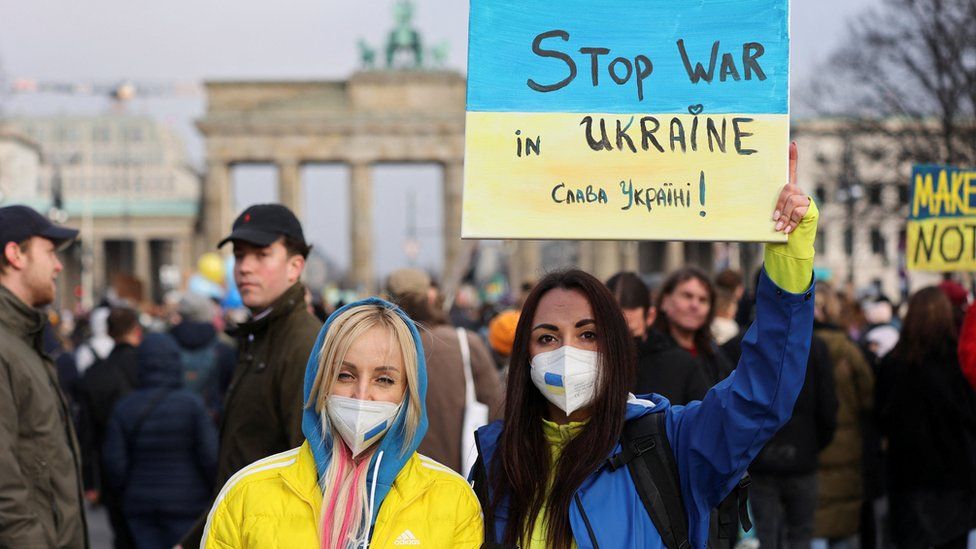
The conversation lasted only a minute or two and I did not develop it beyond the point of encouraging the man to think through the meaning of the phrase to live the questions. But it got me thinking about how I would have, in the past, preached a sermon to encourage people who found difficulties with aspects of belief and faith. To offer people certainty in religious or political situations is seldom the best option. The current crisis in Ukraine reminds us that certainty can be a lethal and dangerous commodity. Putin is an example of the way that one man’s certainty can lead others into a dark place where questioning and doubt are erased. Such a place can have terrifying results. Should not Christian believing always have an element of uncertainty about it? There are, I believe, reasons for us to hold strongly to a position where ‘living the questions’ is the right and healthy reaction to both the way we learn, and the way we practise our Christian faith.
The first good reason for some provisionality, even uncertainty, to exist in our Christian faith is that it allows an individual always to be open to something new. Scientific discovery, we are told, depends on a readiness to discard old theories when these cease to work. Truth for the scientist represents something tentative and provisional. If certainty were to be the goal of scientific enquiry, then scientists might believe that it was right to hope for a point where they no longer had to experiment or question their theories. While I am no scientist, I note the huge adjustments that have had to be made when a scientist probes the sub-atomic world. Common sense physics simply ceases to work at this level. The scientist has to operate in the mysterious language of mathematical formulae which are a closed book to the majority of us. Is it not reasonable to suppose that the Christian faith might be expressed in ways that transcend the limitations of our human languages?
One of the things I am grateful for in my life is the privilege of having studied theology at university level for eight years. The chief reward for this study is not some prestigious job in the Church but a wider sympathy for the infinite variety of ‘languages’ in which theology can be expressed. I am not talking about the actual languages of Hebrew and Greek in which the Bible was first written, but the way Christianity has adapted itself to the variety of cultures that are found in the world. Culture does involve languages, but it is also operates beyond words and concepts. To say that we truly understand any culture fully, even our own, is probably a dangerous claim. It is even more doubtful to lay claim to a culture that is not our own or expressed in languages which we have to work at studying. My theological journey has taken me across a variety of cultural and linguistic boundaries. 18 months of the eight years studying were spent attached to institutions abroad where English was not a first language. This privileged exposure has not provided me with superior knowledge of theology but has made me aware of the limitations of what I do know. Wisdom comes from recognising how much my background of being a middle-class English male have shut off huge areas of wisdom that are given to those who think and speak using totally different words and ideas. In short, my privileged theological education has allowed me to realise how much I do not know rather than what I do know.
Grasping that one does not know much in an area of knowledge, allows one to be extremely allergic to the language of certainty. A lot of my theological opinions are a work in progress. I shrink from settled opinions that are set in stone for fear of being suffocated by these opinions, when I want to take a new look at what I really mean in expressing them. Many of my readers will be sympathetic to the analogy of the journey or pilgrimage as describing the Christian faith. Because journeys involve movement there is always variety and newness built into what we can see. We can never see the totality of the journey, but we can describe episodes that occur along the way. The pilgrimage analogy is a good way of helping people, like the man in church, to realise that they can belong, even when they are uncertain about what they believe. The same humility could be asked of the militant atheist. How can anyone possessing the limitations of a single brain and living inside one culture feel able to pontificate what is ultimately real and true? Humility is required of the atheist dogmatist as much as it is of the religious believer.
The task of learning to be a Christian does not fit a textbook pattern. We do not learn something as children and then cling to it for the rest of lives. In practice all of us struggle with doubt, uncertainty and sometimes despair. The alternative to struggle and untidiness would seem to be something far worse. Coasting along, afloat on a raft of certainties and settled opinions, may sound all right, but it seems to offer a life devoid of texture, colour and meaning.
Christianity suggests that one day we shall face our maker to face some process of judgement. The idea of this judgement is often presented as a way of discovering whether we have lived good moral lives. If that is true, I also believe that we will be questioned about whether we have been living lives involving adventure and courage. Have we intellectually and physically pursued all our opportunities for learning and experience? Have we, in other words, lived life to the full, exploring the options given to us and opening ourselves the infinite variety of life? Have we, as well, pursued the many questions that life throws at us concerned with meaning and the nature of reality?