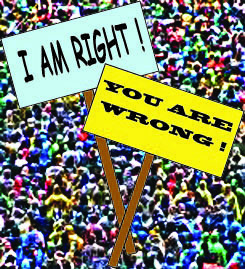
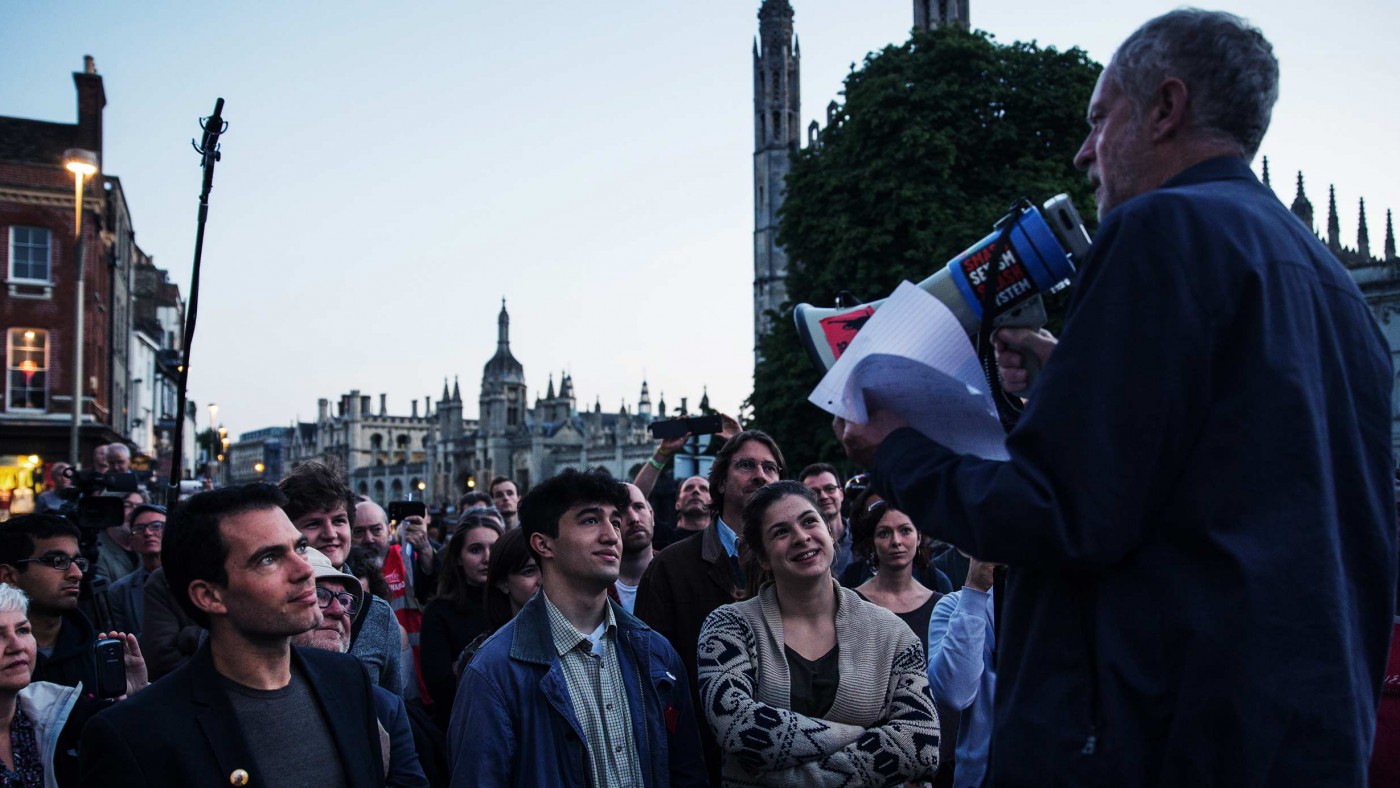
 I have been reflecting recently about the vulnerability of individuals who think that there is only a single truth, whether in such things as politics or religion. I write this the day after the bitter debate in the House of Commons over the bombing of Syria. The idea that one day we may arrive at a place where we can know the ultimate truth in politics or other areas of life suggests that we are people who think in a binary way. People who have the ‘truth’ will see nothing wrong in attacking and harassing those who do not agree with them. The 70 or so Labour MPs who voted with the government, needed to be people of considerable courage to face up to the mob-like behaviour of the ‘Corbynistas’. These latter individuals do not easily tolerate ambiguity or paradox and it would be true to say that their personality type is one that is vulnerable to cults and authoritarian leaders. Cults or high demand groups can be understood to be places where ‘truth’ is found and there is also an emphasis on the banishment of all forms of ‘error’.
In thinking about the way that some people gravitate to places where truth and ultimate meaning is promised, I am reminded of the fact that certain individuals are conned and cheated out of their money. Someone makes them an offer, apparently too good to pass up, and then the salesman puts pressure on to make a decision instantly. It is obvious in the cool light of day that any sensible person should refuse to make a decision on the spot. They will know that it is possible to do research on the internet or speak to other people. In fact the internet has done more to help people discover the scams and frauds that are around us above anything else. But people, sadly, continue to be cheated by plausible con artists and scammers. The better protected among us are those who have the capacity, not always a very attractive one, to be cynical about claims as to how wonderful a particular service or consumer article is. Being cynical about what someone else is telling us, is a form of self-protection. But the cynicism at work here is based on our intellectual ability to see that there will nearly always be two or more sides to a question. In other words our cynicism is the polar opposite to those who have been conditioned to think exclusively in black and white terms. The ‘binary’ person will see the salesman and think what a nice man or woman they are. Because they are pleasant, their motivation for trying to sell us something can be assumed to be honourable. The cynical among us on the other hand, will immediately be asking the question – what is in it for them?
Many Christians carry in their minds the undergirding belief that anything written in the Bible is a direct revelation of God’s will. Such a belief is not based on the internal evidence of Scripture as most readers are completely confused when they try to read it without guidance. They nevertheless collude with this conservative teaching because they trust the church and its leaders where such an idea is taught. A conservative Christian will thus lean heavily on their teachers to make this idea of God speaking in every word of Scripture, work. While there is nothing wrong in looking to a teacher for guidance over issues we know we cannot understand, we can see that a conservative believer is starting from a place of utter dependence on another person. In other words the conservative believer does not even attempt to work out for himself the implications of his inherited belief system. To call such people vulnerable is not meant to be any kind of put-down. What it is saying is that a person who cannot or will not take responsibility for their understanding of the faith is in a situation of weakness. In short they are vulnerable to a Christian leader who may want to take advantage of them in some way. They are like the naive but trusting individual who takes every word on the salesman at face value. Such people are sometimes deeply betrayed.
As a liberal Christian who has also had the benefit of a theological education, I have learnt to be highly suspicious of any Christian leader who claims to have discovered the ultimate expression of the faith. Because I see strengths in a variety of Christian traditions, I find myself not totally able to identify with a single Christian denomination. This is sometimes lonely place to be. In many ways the Church appears to be favouring those Christian ‘tribes’ which follow a clearly identifiable and unambiguous path. I mentioned this tendency a few blogs back when I talked about the difficulty of a parish attracting a new vicar because the old Vicar had resisted all attempts at making his church a tribal expression of evangelicalism. In short to have a clear label with which to identify what one believes is the way that many ‘successful’ groups of Christians are going. The problem of Christians living within such tribal groups is that the individual finds their ability to grow spiritually and intellectually severely compromised. The ideal member of such a tribe will be a clone of whoever is in charge. This suppression of the individual spirit is not something I feel is a mark of the full humanity that Jesus came to bring.
Having a single and ultimate truth as well as fitting in with a single identity is not a path that I wish to follow. Truth is not something, as I have said many times before, that can be contained in certain written formulae. It has a habit of slipping through our fingers as we try to ‘possess’ it and then popping up in different and unexpected places. The main historical expressions of the Christian faith each make claims to have the final expression of the Christian message. I for one am deeply suspicious of any Christian community that claims a unique grasp of truth, whether it be Catholic, Orthodox or Protestant. Historically each of these groups has been very good at trying to claim a monopoly on Christian truth. It is also far too simplistic to say that the truth of Christianity is contained in the Bible. A claim like this should solve the problem of Christian identity but the sheer numbers of churches claiming to be ‘bible-based’ but disagreeing with each other, suggests that Scriptural ‘truth’ is never going to be easy to discern. As a preacher of Scripture in the past, I was always far more interested in helping people to read the Bible for themselves. Then they could face up to the fact that in some ways it is an inconsistent and quite confusing document. When we admit these difficulties, we begin to engage with it as it is. Slowly, slowly we begin to catch a glimpse of God as he reveals them in the pages of Scripture and history. That kind of faith does not satisfy a need for certainty but it allows us to be open to the journey, the pilgrimage of life under God as many have done before us.