by Hatty Calbus
The British are known to be mad. But in the maiming of their privileged young, they are criminally insane. So observed Etonian John le Carré. There is finally more awareness of boarding schools’ insane maiming, particularly of now middle aged and elderly men, my focus here. Another Etonian, Alex Renton, reviewing Robert Verkaik’s Posh Boys: How the English Public Schools Ruin Britain refers to “the toxification of British public life by the private school system.” That toxification, particularly by boarding schools, very much affects the Church of England. In his BBC radio series, Nicky Campbell included, among former boarders wielding power, religious leaders. In Sex, Power, Control: Responding to Abuse in the Institutional Church, Fiona Gardner emphasises “the embedded cultural ethos of the public school and boarding school which permeates the church hierarchy.” It is necessary to admit the maiming and find help to heal. Most never try and, therefore, should not be spiritual leaders. I want to show that, among the Church hierarchy, over-representation of untreated boarding school survivors, or untreated boarders – which I’ll abbreviate to UBs – has caused immense harm. I am focusing on men because they continue to do the most damage, although such women, often identifiable by their brittleness, can also devastate in positions of power. The network I wrote about previously, with Iwerne-imbued HTB having connections to four big recent abuse scandals in the Church of England, yet chosen as a standard-bearer, comes almost entirely from this world. It is not yet clear whether HTB’s Revitalise Trust will continue to play such a central role under Archbishop Sarah Mullally. Even if she reduces it, its effects will not disappear quickly.
Charles Spencer, in his painful memoir, A Very Private School (whose compelling account of his abusive prep school shouldn’t need justification as a resource) asks, “Why were parents blithely sending us away, to live with adults and children who were total strangers, in a clear rejection of family?” Children are meant to live with their parents, not be abandoned by them, yet boarding school means childhood in what former vicar Mark Stibbe called “orphanages for the privileged.” The actor Dominic West said being left as a small child “… had a major effect on me – it was the worst feeling I ever had, very similar to the grief when my parents died. It’s the same thing really; you think you’ve lost your parents.” Psychotherapist Joy Schaverien, identified an ABCD of ‘Boarding School Syndrome’: abandonment, bereavement, captivity and dissociation. Penny Pickles and Helen OdellMiller, in her obituary, elaborated: “‘A’ stood for the abandonment and rupture children felt when they were taken to school and left there with strangers. ‘B’ was for bereavement and the sudden loss of all that was familiar: family surroundings, friends, toys, routine, even food … ‘C’ indicated captivity, the realisation that there was no way out from rigid and often punishing routines, no escape, even though some tried to run away. This could lead to ‘D’, dissociation and the development of a false self that they felt helped them to be brave and cut them off from their true feelings
Those at less dangerous schools still experienced significant distorting, including when school was safer than home. Schaverien’s colleague Nick Duffell, drawing on neuroscience research, says “the case has been proven that forging early bonds and developing relational abilities foster brain matter development.” So rupturing children’s most crucial relational bonds must mean impairment. Stibbe, whose subsequent relational damage led to the breakup of his marriage and end of his ministry, lists boarders’ deprivations: love, home, safety, childhood, siblings, innocence and freedom. Even the thicker-skinned cannot be unaffected – which those around them tend to know all too well.
Piers Cross, part of a group, including Duffell, who made the documentary Boarding on Insanity was quoted in a Guardian article: “Take David Cameron. He described being sent to boarding school at seven as ‘brutal and bizarre’ and recalled ‘frequent beatings’. He lost a stone in weight during a single term (my italics). Tony Blair tried to run away aged 14, making his way to Newcastle airport in a bid to escape. There are so many of these stories
Spencer says, “I’d regularly consider shooting myself in the foot with one of my father’s shotguns: physical agony seemed preferable to the psychological torture of being sent away to that place again.” However much former pupils might want to minimise it afterwards, these schools inflicted appalling suffering on children.
As well as the beating and bullying, with constant access to prey, boarding schools have, of course, also been paedophiles’ perfect hunting grounds. Teachers are the obvious perpetrators, but there is the less well-known cycle of older boys abusing younger. Boys not abused themselves saw their peers abused. A further aspect Spencer shows is the meeting of physical and sexual abuse in paedophile sadism – it is obvious where Smyth and Fletcher came from.
Dr Elly Hanson is the clinical psychologist consulted for the Makin Review, which observes, “Of note in Dr Hanson’s analysis is reference to boarding school culture and practices, in which she describes how often very young children are separated from their families for long periods of time and therefore ‘come to lack strong, secure attachments and an understanding of healthy relationships. This can make them more vulnerable’ to exploitation and abuse, ‘especially when perpetrated by someone in the guise of a ‘father figure’. Dr Hanson goes on to explain the vulnerability and needs of those that were targeted by John Smyth ‘… needs are especially acute during adolescence, and become more so when children are placed in boarding school – and furthermore it appears that John [sic] targeted those that he perceived as having deeper unmet needs (in other words particular vulnerabilities)’ . This explanation correlates to the experiences of several victims who described describe vulnerability because of family relationship breakdown and/or boarding school attendance.”
Makin also points out that “the [Iwerne] movement pursued an explicit strategy of trying to convert to it boys that were deemed of high rank (educated at elite private schools, athletic, attractive and so forth), because such individuals were seen as having more potential to influence society (that such an unjust and inequitable society exists was embraced rather than challenged).” These schools perpetuate what Gardner calls “the complacent culture and tradition of elite masculine power.” Iwerne was born again as the Titus Trust, whose homepage still invites only those from private schools on its holidays. Why, if not to perpetuate that elite power in the Church?
I’ll counter here the defence of UBs who send their own children to boarding schools that they have completely changed. There is still the separation from family and shall note that Dr Hanson writes of pupils’ vulnerability in the present, not just historically. Penelope Brown, in the interviews cited above said, “Generally, the schools are safer than they used to be [a low bar] and the majority of staff are doing their best. But the inconvenient truth that none will confront is this: in the vast majority of cases, children simply aren’t better growing up away from their family. If it’s safe for a child to be at home, that’s where they should be.”
Safeguarding children in private schools has finally caught up with state schools (only fully in 2020), reducing the risk from teachers and removing the impunity abusers enjoyed for so long. But the movement Everyone’s Invited is an online platform where girls, initially primarily from boarding and private schools, shared anonymous testimonies about sexual harassment, assault and rape culture perpetrated at their schools by boys with psyches pornified online. One imagines older boys still abuse younger ones too. https://www.bbc.co.uk/news/uk-56558487 What makes the experience at boarding schools still so terrible is that, as happened to those old boys who now run – these days not everything, but still an awful lot of it, especially in the Church of England – there is no escape: victims are trapped with their predators in well-appointed prisons.
A significant reason parents still send their children to boarding schools is to ensure they acquire the prestige, social markers and social connections of the British elite. Some people will think that obviously only an envious Trotskyite would object to this and want to highlight connections between untreated boarding school survivors and indifference to abuse, but the saying “The foundation of every state is the education of its youth” also applies to the Church. Yes, abuse happens in all sorts of spiritual traditions and at different social levels. My point, to repeat, is that the involvement of UBs almost guarantees a terribly inadequate response, which has been evident in the network in which HTB sits, most notably with John Smyth and Jonathan Fletcher.
I shall attempt to show first harmful traits of people who have not dealt with their maiming; then, if they have not become perpetrators themselves, how their defences engage when they are confronted with others’ abuse; and finally I shall suggest counter actions.
The ABCD described here is exactly what affected me most in my boarding school. After World War 2 a great many marriages were unsuitable, with parents unable or unwilling to bring up their own children. And, in addition, the desire to get their children into a ‘good’ school where they would ‘get on’.
When parents send their children away to privileged boarding environments (incl. cathedral schools), the child often internalises this separation as a profound form of rejection. In that deeply vulnerable state, some who have faith are taught to lean on that faith – and the institution as a surrogate sanctuary for comfort.
When that very environment is permitted (as has often been the case with the CofE) to operate as an unchecked den of predators, the psychological breach is absolute. It doesn’t just shatter a childhood; it weaponizes the child’s search for spiritual comfort against them, routinely decimating their faith entirely.
The abhorrent abuse inflicted by men like Terence Banks and John Smyth (courageously exposed by survivors like Graham) is a devastating example of this betrayal.
Yet the institutional cruelty extends far beyond that initial, catastrophic abuse. Historically, the Church of England’s solution was to quietly “repurpose” implicated clergy, moving predators from one setting to another to protect the institution while abandoning the children left in their wake.
Today, that same instinct for self-preservation has merely evolved into a weaponised bureaucracy.
As psychoanalyst Fiona Gardner explores in her work on institutional betrayal – insights we feature on House of Survivors – the Church’s default reaction remains defense and deception.
Under the stewardship of administrators like William Nye, the machinery operates on ruthless reputation management rather than any pastoral imperative. Survivors are treated as institutional adversaries, PR threats to be mitigated rather than wounded human beings seeking healing. The devastating human toll of this secondary abuse is a moral weight these administrators should rightly carry, and one for which they must face uncompromising accountability.
This is a *profound* psychological violence. To possess the devastating truth of what survivors endured, yet consciously choose bureaucratic stonewalling, requires a chilling detachment.
When those at the very apex of moral authority use their power to protect the institution at the expense of the abused, it ceases to be mere mismanagement. It is the active, deliberate perpetuation of harm – driven by an unyielding need for control – that entirely destroys their – and everyone else’s foundation of the faith they claim to represent.
Your description of search for spiritual comfort being used against victims and decimating their faith is so painfully true
Two worthwhile things some boarding schools could teach: the first is academic excellence. Obviously not all, not even most, could do this, but some could, and I think that was worth a great deal. The second is the discovery that suffering ends, and is almost always endurable. This is not a pleasant lesson, but it comes in useful in later life. But they only really made sense as vocational training for infantry officers. Without an army they serve no wider social purpose.
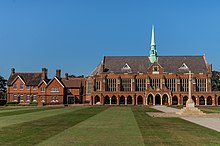
What is the connection between the article and the school portrayed in the picture?
None, I suspect, other than doubtless chosen as an illustration of a typical public school campus. It’s a Christian foundation, both boarding and day, and now co-ed.
The idea of elite boarding schooling, is to be “the making of them”. It is to force a small vulnerable child into a world leader. Many are thus made.
Many of them were broken too, they just didn’t know it yet. Often this is discovered late in life after a series of broken relationships or a disastrous mistake in Office, as we know.
Much has been written about this, by Schaverien, Duffell, Renton, Gardner, Spencer etc, and as mentioned, and Isobel Ross (re girls) Despite this and many other accounts online and mainstream TV/radio we are seeing little progress in learning from this disastrous practice of “making of people”.
One reason for this is a wider support network of parents and grandparents who want to emulate the elite boarding schools, by sending their children to a much larger second tier of independent private fee paying schools. The one I attended compensated by being loaded with academic high achievers, with tight entrance requirements to get in, with (at the time) a lower financial burden. For others, it’s higher fees to exclude anyone other than the very wealthy. The equal intention of all this schooling is also to buy connections, to open doors that others don’t think they can go through, and to hoodwink the kid into thinking she’s not only better, but must step up and lead. And then to pass on the next generation.
Entitlement is endemic. Feeble attempts have been made by society to tackle it, such as VAT on fees, which eliminates the poorest, and probably the least “entitled”. But really it’s because much of society actually wants to be special, and will seek these educational step-ups regardless of the morality or wisdom of it.
The strongest alumni are the least likely to be able to discern their own suffering in this wider system, and continue to promote and replicate it. Wider society continues to search for “strategic survival personalities” and deliberately promote them to high Office. As has been pointed out, the Church is no exception. Moreover, as it lags behind wider society by several decades, it will take a great deal longer to change, if it ever can.
The Church has its own history of elite promotion, which I might divide arbitrarily along theological axes: conservative evangelical – Iwerne Smyth, Fletcher inner circles; Anglo-catholic -“Give a year to Christ” with the infamous Peter Ball; charismatic evangelical – the cult internships and wider network of Pilavachi, Soul Survivor and their vast network.
Central to all these (and the others) is the lure of getting ahead, matched with abuse, often very severe. Elitism replicated, with a heavy price to pay.
That idea-‘of winning at all costs’-extended far beyond boarding schools. Did the old Eleven Plus exam send masses of small children to grammar schools which could be single sex, single language, single race, single religion? Boys schools could be places of militaristic hardness for juniors, where a great mass of people did not flourish, or felt undervalued if they did not excel at sport or academically.
Our current era is not without gigantic national problems. But it’s now odd to remember how British Imperial success was once taught in history lessons, even relatively recently, with Clive of India being a hero, and the exploitation of other people and/or territories not being highlighted. It’s a very sad observation, but the Anglican Church seems to blend Woke and Waco.
There are some ultra-leftist driven decisions, as well as some fundamentalist cultist stuff. Project Spire feels like the worst of every world. ‘Woke’ waste of money on Project Spire is plain nuts. But it is orchestrated by the few dictating to the many, with a confident elite being in control and answerable only to God, if anyone at all.
That bears a resemblance to darker aspects of past British Grammar School education, where student autonomy was glibly sacrificed. Is there a darker organisation than Anglicanism on this topic? Savage bullying and abuse has been hidden in plain sight, and even when confronted with it our elite leaders have often failed to address glaring scandals.
I used to do individual Maths coaching and had several “quiet” students from a local comprehensive school where they had been bullied as first years and then kept quiet in lessons so as not to draw attention to themselves, consequently slipping down the ability sets. The coaching that I did was, in no small part, to help them with self esteem and confidence and it was a joy to me, as well as to them, when they passed their GCE Maths! In fact one went on to become an accountant!
My point is that the type of school (independent/public/grammar/direct grant/secondary modern/comprehensive ) does not necessarily dictate the behaviour of teachers or students. A child can have bad experiences in a large comprehensive school and not communicate that to their parents just as they can in a boarding school. It is a difficult job and a great responsibility, as a parent, to keep those channels of communication open with your teen. As Christians we need to be praying regularly for our schools and all who work and study in them.
This article would have had more appeal to me, a woman, a survivor, left school at 15, dragged through institutions, if it was in some way contrasted with the Guarding the Flock article, ‘A Seat at the Table Provided you Know your Place,’
https://www.guardingtheflock.com/post/a-seat-at-the-table-provided-you-know-your-place
No one would disagree that boarding schools are dysfunctional in pulling apart family bonds and that they often hide a predatory and abusive landscape but at least kids can leave with the name of a prestigious school to throw around, handshakes that can open doors and a chance of academic success. At least they can consider they might have a shot at becoming ‘someone.’
Contrast that with kids growing up in care, institutions that were often overseen by the church, prey to grooming gangs, sexual and drug exploitation and state schools that had no expectation that they would achieve anything apart from ending up pregnant or in prison.
We don’t know how those kids would shape the church because they simply don’t get to that point.
I feel immense sympathy for those damaged in the boarding school system but to write only on the subject of how their alumni shape the church without reflecting on why the many that suffered worse or equal deprivations in the care system or hellish familially abusive homes are allowed to achieve nothing in the church hierarchy provides a one dimensional article.
I thought Michelle’s article was spot on.
There’s a limit to how many topics can be covered in 2,000 words, and Hatty Calbus’ closing paragraph suggests she will be rioting some follow-up articles. Patricia, maybe you’d like to compare this blog with the one in Guarding the Flock? You could do that in a comment.
Back to boarding schools, I used to know the matron of a house at a public school, and she had charges as young as 4. Poor little boys.
I think I did contrast it quite adequately Janet thank you when I said that it is not known how kids from tough backgrounds would shape the church because they are never given the opportunity.
I think an article on a blog aimed at abuse survivors is rather tunnel visioned not to mention this fact as many survivors come from that background and not the financially privileged one the author describes.
I’m not sure that I agree with you that a comparison with Michelle Burns’ article would be helpful. It’s clear that, generally speaking, many working class children have far more to contend with than boarding school children. But the point of this article is that here we have a group of people with a smooth and easy path to power, who have suffered a particular kind of emotional deprivation. Sending children away to board early in what were often brutal conditions was a strategy in the days of Empire; the children were prepared to move far away from home and manage large populations of subject peoples without suffering too many emotional scruples about the way they were treated. By separating children from what was considered the cosseting and sheltering of the maternal influence, boarding school, especially early boarding, prepared them very well for this. As the author points out, although boarding schools have changed in many ways, the foundational belief that there’s something good about sending children away from home for their education remains. It is a peculiarly British belief. It does explain a good deal about many of those who get into power in the British establishment, including the church.
Authoritarian certainty-of an ancient imperial British type-gets coupled with ‘wokery’. Is that what we see in the Church of England? Southwell Minster could close for want of £20M repairs. Yet the Church seeks to present a large scale plan to gift £100M in slavery reparations.
John le carre only taught at Eton though was a pupil of Sherborne, it seems.
Excellent article which I completely agree with John Le Carre went to Sherborne not Eton.
I was recently discussing my experience of living with other men from my university CU and it’s attendant difficulties with my counsellor. She, my counsellor, commented that it was very “boarding school-like”.
Does age impinge on what people are ready to tolerate? Older people, when faced with contempt for personal autonomy or civilised standards of behaviour, tend to run away as far as they can go. Are younger men (or vulnerable teenage boys) far more likely to tolerate a coercive, manipulative or bullying culture? 2 out of 5 students, in my New Wine training year group, were advised to leave the local Anglican Diocese by a senior minister. The minister was alarmed when the students felt unfairly accused of sexual misconduct in crude language, and the diocese had little appetite to address a clear crisis. I wonder if a militaristic type culture dominates certain fundamentalist factions of the Anglican Church. Are there people who preach an uncompromising message of purity from the pulpit, but who tolerate all sorts of sleaze provided it can be safely hidden away from the public or from church members? Could an avalanche of sleaze arise, if victims-witnesses-whisleblowers were freed from existing NDA terms. BBC Radio was has a series of excellent podcast by India Pollock (DARK ISLAND). The end of the series poses this question.
The article perhaps helps project the ‘calm confidence’ which highly disciplined schools sought to give pupils. Has ‘calm, confidence’ been at work for a long time when we see the breaking Southwell Minster story: £20M repairs not done, other deficits not addressed?
Also, do a lot of media stories-about major abuse crisis exposures-catch headlines, but is the bullying-abuse-harassment issue undergirded by chronic immorality and incompetence getting confidently and calmly hidden by senior Anglican leaders?
There was shock when BBC broke FAITH AND FAILINGS 9 June 2026. But the 40 mins documentary’s content caused me zero major surprise at all. The ‘calm, confident’ leadership facade has a lot to answer for across Anglicanism………………..
I have no connection with, nor knowledge of, Southwell Minister. Interesting though to note from the Charity Commission website that the 2024 accounts were submitted six months late, with the 2025 accounts outstanding although due on October 31st.
Yes, indeed, that’s exactly what thrust the Southwell Minster issue into my mind, while currently reflecting on the topic of this blog piece above. The delay time at Southwell for accounts is interesting. Can poor financial oversight be a huge problem is some parishes or dioceses? Down and Dromore Diocese is strongly connected to the GAFCON group. ‘Premier Christian News’ (17-10-26) reported ‘Church treasurer appears in court on £750,000 fraud charges’. It refers to Lurgan’s huge Shankill parish in the Down and Dromore Diocese. How did such a vast quantity of money ever vanish? My point is how acute stories-like the breaking Southwell Minster one-often have chronic roots, where serious issues have perhaps been allowed to quietly fester. Old fashioned ‘stiff-upper lip’ (and British public school ‘confidence’) can possibly sometimes mask over issues which desperately need to see the light of day-and get addressed by community members and leaders. FAITH AND FAILINGS 9 June 2026 illustrates this point. Even after 4 months there is no unreserved apology, or a detailed public response from any bishop or archbishop.
There sadly still seems reluctance amongst some of the UBs in the hierarchy of the church to develop enough emotional literacy to move from a place of ‘destructive entitlement’ to ‘constructive entitlement’.
In other words, moving from what is often an unconscious justification of responses and reactions based on ‘it didn’t do me any harm’, to something more compassionate: ‘yes I suffered and I’m going to work to make changes so others don’t have to’.
And now we have this shocking report: https://www.bbc.co.uk/news/articles/cqr7y7pjpy7do. Boarding ceased in 2008.
Similarities with my own school experience, although worse at EA by the sound of it. And in the face of abuse stories like these, we must not lose sight of the product of this style of education which is to produce “types” of people who can dominate and claim status. These qualities are largely conditioned into the brutalised pupils and usually completely unconscious. It can take a great deal of psychotherapy and support even to begin to glimpse how we were conditioned. It’s also painful to appreciate how we may have then passed on the pain to others, for example by leading them over the top, like those of earlier generations. My folk went to similar schools and laughed when I explained the menu of corporal punishments we were subjected to. They were committed evangelical Christians
My kids went to State schools. In cases these were far from perfect, but I see better qualities in my children, than I believe I achieved, certainly at their age.
Recent posts and comments have been very thought-provoking. Stephen’s blog is indeed doing a good job, not least regarding bishops and ‘privilege’ – harsh boarding schools etc. That said, Nina (3 Nov) is right – good and bad can exist in any kind of school. Then Fiona (9 Nov) has a powerful point – if we learn ‘emotional literacy’ we can use our experiences in ‘constructive’ ways (and if we don’t, we can’t). During 20 years’ teaching (mainly Music in State schools) I met dedicated older teachers who, like me, remembered brutality (emotional or even physical) in their own schooldays. They really have worked to make good changes – and modern musicians have an interest in this. We believe in ordinary people, especially young people.
Forty years ago, women who wanted ordination criticized so-called ‘male’ faults in the Church – and especially ‘Oxbridge Chaps’ or ‘Public School Chaps’ (the two groups aren’t quite the same, though related). Those faults (they said) came from taking young boys away from their families, conditioning them for 20 years in all-male institutions, then letting them loose in a modern world to which they couldn’t intelligently relate.
That may seem true as far as it goes, but other dysfunctions were (and still are) available. I’m not sure that women have really challenged those faults as they said they would – Hatty’s point about female ‘brittleness’ (30 Oct) is relevant. So is Steve’s (31 Oct) about males or females passing ‘entitlement’ on to a new generation. Be that as it may, many of us have had run-ins at various levels – not just bishops – with the ‘public school and upper-middle-class hierarchical male culture’ (Stephen, 8 August). I’ll give examples if anyone’s interested.
Every coin has two sides; there are good people out there. Teachers have to be dedicated – the job is much more demanding than it was. There are priests of faith, kindness, and integrity – also facing demands and problems. Not all bishops are bad – though the William Temples and Ian Ramseys always seem very rare. We must affirm what’s good, and pray for it. We must also call out what’s bad (and pray against it) – persistently, as James comments more than once. Some Church officials still demand unconditional deference, and sweep inconvenient facts under the carpet – misguided at best, and perhaps just cynical. Stephen’s steadfastness, bringing important subjects ‘into the light’, can only help. Thank you, Stephen, Fiona, and the other thoughtful commentators.