
Category Archives: Stephen’s Blog

28 Hierarchy – the link with Stress

???????????????????????????????????????????????????The blog post about hierarchy and the responses to it have made me realise that this is an important topic to which we need to return.  As always I am drawn to thinking about the groups for whom Chris is an advocate, the poorly paid, the mentally ill and those working in low status and demeaning jobs.  In any hierarchy, in any society there are always going to be people who for various reasons are at the bottom of the pile.  However we describe such people who do not succeed, we need to be aware of them, the large number of people who occupy a place of disempowerment.  These disadvantaged may suffer in various ways, poor education, indifferent health and an upbringing that may have been inadequate in some way.

It is the issue of poor health and low life expectancy that I want to focus on today.  In some reading I did in the past year or two, I came across some fascinating research by one Sir Michael Marmot, an epidemiologist (one who researches issues of public health).  He had a commission from the Government to study ill-health and life expectancy among civil servants.  A Google search will provide further details of this research so I will limit my comments to the broad outlines.  Marmot had the health histories of some eighty thousand civil servants to study, what illnesses they contracted and the age at which they died.  None of the subjects for study was poor in a material sense and their medical histories were carefully screened to take out of the calculation any genetic factors leading to ill-health.  His conclusions were startling and alarming.  The lower down the civil service hierarchy an individual worked, the more they were susceptible to ill health and relatively early death.  The ones who lived the longest and who enjoyed the highest standards of health were those who had reached the top levels of the Civil Service.  The ones below the top did not achieve the same levels of health and this pattern was repeated right down the pay grades to the least paid and those with the lowest status.   Marmot and his fellow researchers tried to test this observation again and again but it seemed every time that high rank in the Civil Service predicted good health.  It was far more important than diet, exercise and other healthy life-styles.  Only smoking seemed to be a greater hazard than low rank.

The reader is invited to look at the research for themselves to check that I have represented the findings accurately.  But it is the speculation about the reasons for this imbalance in health between those of high and low status that is the intriguing part of the research.  Marmot surmised that the one factor that could account for the mismatch of health between the different levels within the Civil Service was stress.  It would appear that he identified a particular type of stress associated with looking over your shoulder at your boss.  In short having your work priorities determined by someone else and also having to work following other people’s orders is deemed to be stressful in a way that is different from simply working hard.  It is only when you are the boss that you escape this particular threat to your health.

Giving and receiving orders is no doubt  a normal working out of the dynamics of a hierarchical organisation.     Marmot’s research in a nutshell suggested that the stress caused by a constant need to obey orders and to please those set over you is not only unpleasant but is also a physical threat to your health.  We can surmise that when the ordinary giving of orders has added to it actual abusing of power, we have a very stressful and toxic mix.

The word ‘stress’ is a slippery word but we all have experience of it.  It is one of the privileges of retirement that for the first time in my life I can control the external stressors on my life as I have the power to use the word ‘no’ if something comes up and I do not want to do it.  Speaking personally I also find that opportunities for taking extra exercise also help to counter any residual stress in my life.

But to return to Marmot’s research.  It confirms how serious is a situation when power manipulation and even the simple giving of orders can be experienced by the vulnerable, those at or near the bottom of the hierarchy, whether in a church, the workplace or as a member of a despised social group.  The conclusion of the research indicates that those at the bottom do not just suffer indignity, they also suffer severe threats to their long-term physical health.  That observation should compound our concern for any group that lies at the bottom of a social hierarchy.

One of the ‘good news’ stories of 2013 was Pope Francis’ decision to speak up for the poor.  By the poor, no doubt, he meant not only those who have little money, but also all those who come at the bottom of the hierarchies in societies across the world.  His example may help in identifying those who suffer, emotionally and physically, from the experience of disempowerment and bring them properly to the attention of the ‘powerful’.  Those of us who follow this blog, although we are only a tiny number of people, can play our part in firstly becoming aware of the powerless people around us but also by helping in small ways to help lift them up.  The words of the Magnificat come to mind.  ‘He hath put down the mighty from their seat and hath exalted the humble and meek’.  Would that the church became a place where exalting the humble and meek was a reality.
26 Hierarchy behaving badly

‘aloof complacency’

In today’s Times there is an intriguing story about the efforts of Mr Xi, the Chinese President, to curb extravagance on the part of those who work for the State and occupy important posts within it.  A decree has gone out that this elite is no longer going to be allowed to drive foreign imported cars, particularly those from Germany, such as Audis and Mercedes.  They will be required to drive Chinese made models instead.  The problem for the Chinese officials is that Chinese cars are not known for their reliability.  But there is also a problem for their perceived status in the eyes of their fellow citizens.  ‘How,’ remarked one tweeter, ‘can a senior PLA officer possibly maintain his usual expression of aloof complacency at the wheel of a Geely? (local car)’  It is these two words ‘aloof complacency’ that seems to capture aspects of hierarchical behaviour the world over.  My younger daughter, who spent a year in China, tells me that for a country who is wedded to Communism, the Chinese have developed a remarkable variety of marks of status, including the size and shape of their spectacles!

What do these two words, ‘aloof complacency’ imply?  They imply that people who occupy a high position within a hierarchical structure often develop a body language and pose that proclaims their position at all times.  Aloof is a word that describes a self-important pose, an expression around the mouth accompanied by a straight back.  It says two things.  Look at me and be impressed and simultaneously keep out of my way because I am too important to be bothered with the likes of you.  It is not difficult to convey that message from the driving seat of a large imported foreign car.

The other word, complacency, picks the part of the attitude that wants nothing to do with lower forms of life.  In any hierarchy one way of asserting your position and keeping your status is by disregarding or dominating those below you.  They are simply not worth your attention.  People below you in the hierarchy do not just get ignored, they do not engage your compassion or what Christians would call love.  Complacency thus involves detachment and such detachment seems part of the pose adopted by many who occupy high places within hierarchies the world over.

Another story parallel to the Chinese report leapt at me from the pages of this week’s Tablet, the Catholic weekly.  This is the news that Catholic clergy, with a few exceptions, may no longer expect to achieve the honorary title of monsignor.  This title was given to clergy by the bishops for such things as long service or loyalty to the bishop.  Pope Francis has spotted no doubt a kind of careerism and ambition for titles among the clergy which involved a certain preening themselves as somehow more important than their fellows who were doing identical jobs.  The Church of England has a similar system which rewards clergy who have stayed loyal to the system for a long time in one place, by awarding them the honorary title of Canon.  The title has virtually no duties or extra responsibilities but allows some of these clergy concerned to make minor alterations to their robes as well as inviting his parishioners to alter their term of address to him from ‘Vicar’ to ‘Canon’.

These examples from China and from the Catholic and Anglican churches can probably be paralleled by the reader through countless other examples from a variety of walks of life.  In my school days I can remember the way that promotion to becoming a prefect meant that one instantly stopped speaking to boys who were not prefects.  In short, hierarchy, whether political or religious, has a horrible capacity to corrupt people and make them less human, compassionate and loving.  There are some telling words in the gospels when Jesus comes in on a conversation among his disciples about who was the most important.  He said and I paraphrase, ‘Kings and Lords exercise authority and lord it over others, but it shall not be so among you.  Whoever wants to be great must be the servant of all’.  There is a long sermon that could be preached on these few words.   We may comment that the undergirding message of this passage seems to have been completely lost over the centuries.  Few people criticise constructively the malign effect of hierarchy on some individuals.  They do not see that although it is necessary to have different levels of responsibility in government and church as well as in every other form of human organisation, it does not necessitate the ‘aloof complacency’ that quite often accompanies it.  Christians follow a master who saw right through power games in society and so should we.  Jesus spoke some memorable words in Matthew 23. 5 when talking about the teachers of the law and the Pharisees.  ‘Everything they do is done for men to see.  They make their phylacteries wide and the tassels on their garments long; they love the place of honour at banquets …..’  How little things have changed!

To return to the theme of this blog overall and the relevance of these news stories, we can finish by simply noting that ‘aloof complacency’ is a temptation always inherent in hierarchical organisations and this will increase the likelihood that power over others will be abused.  An increase of responsibility within a hierarchical structure is not sufficient reward for some.  They have to gild the lily by behaving in self-important ways that ultimately seem to be pointless and self-defeating.  It is particularly disappointing to find church organisations sometimes drawn into the same vanity power games as others.  The abuse of power wherever it is found is also often going to be rooted in this kind of vanity and superior attitude.  That is a good reason for us to be alert to notice it and resist it.  Although ‘aloof complacency’ is not easy to withstand when we are pushed down by it, we can at least recognise its ultimate futility and even see in this futility aspects of humour.    Perhaps ultimately pomposity and vanity are best defeated by humour and ridicule.  No doubt the Chinese tweeter raised a few wry smiles when describing the behaviour of the Government officials in his country!

25 The Historical Institutional Abuse Inquiry (Northern Ireland)

Reflections on power abuse

instituional abuse
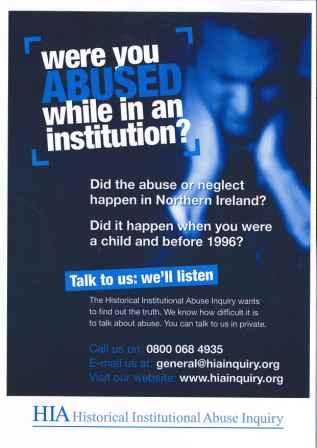
Today marks the beginning of an inquiry in Northern Ireland of abuse against children over a seventy three year period between 1922 – 1995 in public and religious institutions.  The type of abuse being investigated covers not only sexual abuse but also gratuitous physical and mental cruelty.  The BBC news today reported children being scalded in their bath as well as other kinds of physical torments.  Worst of all was the statement that no affection of any kind was ever offered to some of the young children sent to these institutions.

The sexual abuse of children, which has been in the news for a number of years, has no doubt been studied at depth and involves a pathology that experts would understand and be able to some extent to explain.  Gratuitous violence towards children and the withholding of any kind of affection takes us, in some ways, into a still darker place.  The normal healthy instinctive response to a child, whether one’s own or that of a stranger, is a desire to protect and cherish as appropriate.  The human race has been hard-wired to see children as the vulnerable part of the species and also the custodians of the future of the race.  If they are not cared for, then the genes, whether our own or those of the group, do not flourish.  Without children doing well in our families and in our society, our own well-being is compromised.  We all know this at a gut level and to act against it in any way is deeply perverse.

The question why nuns or children’s homes workers should act cruelly against their charges is a deeply troubling one.  The same question could be asked of those who abuse the elderly or those sent to special hospitals for the mentally and physically handicapped.  The easiest answer to come up with is to point to a desire, even need, on the part of some to exercise total control over other human beings.  Looking at it from another direction, the abusing individual is unable to deal with others as a subject only as an object.  We may speculate that this kind of relating was the only one that the abuser had ever known.  All relationships had been ones where he or she had been used.  Any idea of mutuality in relationships is unknown to them.  Finally the chance is given them to exercise power over others weaker than themselves and treat them as objects for power gratification.  They have no other internal model for relating except as someone abused or as an abuser.

It is hard to imagine the family and church dynamics that caused ordinary Irish women to become nuns and then child abusers.  Clearly there was something profoundly unhealthy at work in both home and church that created individuals who could only treat others as objects for perverse gratification.  Speculations can be made but I would offer only one thought.    A domestic or religious culture where obedience is put very high on the agenda will work against the flourishing of mind and spirit.  Obedience to parents must always be balanced alongside the need of every child to find their own personality and creativity.  Conforming to the will of another at every point does little to allow the flowering of spirit or the nurturing of altruistic love and compassion.

What is the relevance of this discussion of the Northern Ireland Inquiry to our blog?  The relevance is that the Inquiry touches on something deeper than sex or even cruelty towards children, however horrific these may be.  At the heart of the Inquiry is an investigation of an epidemic of abuse of power, manifesting itself a variety of terrible ways.  The manifestation of the abuse of power is particularly horrible when directed against children, but we would claim that abuse of power is rampant in society at large.  To reflect on the Northern Irish situation helps us become a little more sensitised to abuses of power in our own situation.  We will not normally encounter such dramatic examples as child sexual abuse, but if we look carefully at the power abuse around us we will find the same fundamental ingredients at work.  Person A pulls rank over Person B and treats them badly.  The reason that Person A behaves in this way is because he or she has herself been treated badly by person G.  This may be a dramatic over-simplification of the causes of power-abuse in our society but it has enough truth about it to be useful to state.

When we come back to the church we find that it too is invaded by these same power dynamics.  People routinely work out their past humiliations by seeking to dominate others in petty power games.  If their position in a church is one of authority the temptation to abuse their power is greater and potentially more damaging.  The leader may subconsciously have sought this position of power precisely because their past traumas needed to be afforded some sort of palliative relief, that afforded by a gratuitous exercise of power.  I will be speaking further about this pattern of behaviour as it is covered in some reading I have recently done into what is known as ‘traumatic narcissism’.    Meanwhile I am asking my readers to reflect on power games, not only insofar as they are the victims of them, but also as they may contribute to them so that other people are affected.  While these are less severe by far than those revealed at work in Northern Ireland, let us at least recognise a functioning of similar human weaknesses and foibles.   All of us fit somewhere into the webs of power dynamics that go on around us.  Sometimes our participation is benign, sometimes less helpful.  Our conscience and capacity for self-reflection should guide us in the way we deal with these.  An imaginative identification with the victims in Northern Ireland may help to understand, albeit in an extreme form, the dynamics of power abuse.   In a lesser way these are manifested in the people and situations around us day by day.   Understanding and identifying them is the key to dealing with them successfully.

24 What the Bible really says – Noah’s Ark

Noah

Recently there has been a news story about a Bible theme park in Kentucky which is to have as its center a large reproduction of Noah’s Ark built to accord with the Biblical measurements.  The Bible talks about God’s detailed instructions to Noah in the sixth chapter of Genesis.  The measurements are given in cubits but my NIV has helpfully translated these measurements into feet and inches.  The story that is breaking, as I write, is whether the Kentucky project will ever be finished.  Clearly they are in need of  more ‘bond holders’, people who believe in the literal truth of the story to dig deep into their pockets so that the project can continue.

The great problem about all those who want to make a case for the literal truth of this story is that they never appear to have faced up to some of the problems inherent in the Genesis text.  Those who preach on the Ark story presumably have read the text and they will have noticed that the story changes direction when we go from chapter 6 into chapter 7.  In chapter 6 the account declares that God tells Noah to ‘bring into the ark two of all living creatures’.  The chapter rounds off with the statement that ‘Noah did everything just as God had commanded him’.    The account changes direction in chapter 7.  Suddenly the word for God changes to the word  ‘the Lord’ and the number of each of the animals to be taken into the ark also changes.  Instead of pairs of animals to be allowed access to the ark, suddenly the Lord commands Noah to take ‘seven of every kind of clean animal, a male and its mate and two of every kind of unclean animal, a male and its mate’.  What is going on here?  The student of Genesis who is not committed to the literal truth of the story will have no problem explaining this enormous discrepancy with the resources of critical scholarship.  I will reveal all in a moment.  But the literalist is going to have enormous problems reconciling this change of gear within the story.  The shift in style is more apparent when the original Hebrew is consulted.  The word Elohim translated as God is found in chapter 6 while in chapter 7 the more familiar word Yahweh (translated as the Lord) starts to be used.

I do not possess any conservative commentaries on this passage so I do not know how the discrepancies are explained for a fundamentalist audience.  Perhaps there were eight pairs of certain animals in the ark but I have never heard this offered as an explanation!  But I think I would be right to guess that most conservative preachers would not own up to there being any problem.  It is easier simply to leave out the ‘difficult’ section in chapter 7 and carry on with the story after the offending passage.

For those unfamiliar with the critical interpretation of the book of Genesis let me explain what main-stream scholarship has had to say about the discrepancies in the Genesis story of the Ark for the past 150 years.  My summary, while new to some, will be a massive over-simplification to others.  The discrepancies in the story can be accounted for by recognising that there is more than one source for the story.  Two different versions are given, one after the other. The first version in chapter 6 is from a early source known a E on account of the word used for God, Elohim.  The second version comes from a source known as P on account of the sensitivity over the presence of unclean animals being given equal status with the clean ones in the earlier version.  The account is called P because there is evidence that the interests of the writer reflect the concerns of priests and those devoted to the maintenance of purity laws.  The P account was probably written many centuries after the E version.  The name Yahweh for God had become normative by the 4th – 3rd century BC when the P account was written.

Liberal scholarship allows itself the privilege of reading the Old Testament as ancient literature as well as a revelation of a story of God’s self revelation to a nation.  As ancient literature, contradictions in the text can be faced and to a considerable extent explained and understood.  Without these scholarly insights we are often left with impossible conundrums and contradictions.  The conservative preacher on the other hand may have had to deceive his people and pretend that problems are solved when in reality all that has happened is that they have been censored out of sight.

If I am right that problems inherent in this Biblical text are ignored by many fundamentalist preachers, then that implies a readiness by some Christian leaders to short-change their members.  At worst it can be described as dishonesty.  Either way it arises out of the fundamentalist fantasy that sees the Bible, in spite of any contradictory evidence, as infallible and able be taken as authoritative on matters of history and fact.   This examination of the story of the Ark is given as an example of just one passage where people in the pew are not being given the full picture of what the Bible actually says.

The Kentucky theme park is no doubt the vision of people who believe they are taking the story of Noah literally and thus they have given energy, money and time to its completion.  The question has to be asked.  Did the sponsors of this massive project ever sit down and actually read the account of the story of Noah as it is set out in the Bible?  Was their understanding based on that reading or had they simply picked up a tidied-up version such as that put in a children’s version of the Bible?  It would be an interesting question to ask but I rather suspect that for the sponsors and their supporters the Bible has been read not in its original form but in a version pre-packaged  for easy consumption.   It is only in that form that a doctrine of ‘infallibility’ can be sustained and promoted with any possibility of success.


23 Substitutionary atonement – is this what Christians have to believe?

A few weeks ago I attended a funeral in the south of England.  The deceased was a faithful Christian lady who had planned her own funeral with great care.   For me the service jarred in one place where the congregation were required to sing the controversial hymn ‘In Christ alone’.  This hymn is missing from many hymn books because of the words ‘Till on that cross as Jesus died , the wrath of God was satisfied.’  Many people have found these words upsetting and even offensive, as it implies that God could forgive humankind only through an event of supreme violence – the death of Jesus on the cross.

To understand the theology being put forward in this hymn, we have to recognise that Paul does in fact use the word that is translated as ‘anger’ or ‘wrath’ referring to God as well as another Greek word translated as ‘propitiate’.  This use of these words might imply support for the words of the hymn but as we shall see there is far more to be found in the New Testament on the sacrifice and the death of Christ than just these ideas of Paul.   Even if we take Paul’s thoughts as normative, scholars have indicated that these word ‘anger’ does not imply, as the English translations do, any suggestion of passion or feeling on the part of God.  Also as we shall see below, the word ‘propitiate’ does not imply an averting of anger of a vengeful God.

To go a bit deeper into this question of how Christ’s death can be spoken of as a sacrifice, we need first of all to look at what the early Christians thought about sacrifice and how we can understanding the connections they made between the sacrificial system and the death of Christ.  To have this understanding  we also have to go back further to see what they inherited from Judaism.

In the Old Testament we find three main types of sacrifice.  These are all set out in the Book of Leviticus.  In the first place we have what are known as communion sacrifices, eating and drinking in the context of a religious rite of sacrifice.  These are not prominent in New Testament times.  The second type is the whole burnt offering, an expensive type of offering which seems to have had its origins in the idea of feeding a god.  The third type of sacrifice is the one that dominates in the Book of Leviticus – the rite of expiation.  Expiation was predominantly about dealing the effects of sin by the use of blood rituals.  Blood with its associations with the life-force was believed to be particularly effective in cleansing and purifying human sin.  There was here no sense of offering anything to God.  The sacrifice was simply complying with an ordinance given by God himself to deal with sin, whether moral or to do with cultic impurity.  It is argued by scholars that the word for ‘propitiation’ has a meaning very close to that of expiation.

Alongside these three types of sacrifice were two Jewish feasts of particular importance to early Christian thought  and which involved sacrifice – the Passover and the Day of Atonement.  The feast of Passover was of course originally associated with the Exodus from Egypt and at its heart involved the use of blood smeared on doorposts to avert the Angel of Destruction.  Later the feast became one that had to be celebrated in Jerusalem and thus was the occasion of pilgrimage.  By the time of the New Testament the most important part of the ceremony was the celebration of thanksgiving for the Exodus and an occasion for the family to come together.

The Day of Atonement is, according to scholars, a very late festival.  The book of Leviticus, where it is described, only came into its present form in the 3rd century BC.  The best known part of the ceremony involved the ‘scapegoat’ ceremony, the confessing the sins of the whole community and transferring them onto a goat which was sent off into the desert.  The other part of the ceremony takes the High Priest into the Holy of Holies to pray for the entire nation.  Once again the efficacy of these rituals arises from the fact that they are rites given to the community by Yahweh for this purpose of removing sin.

What are we to make of the idea that the death of Jesus was in some way a ‘substitute’ for human-kind, a sacrifice that God needed in order to forgive sin?   For the ‘substitution’ idea to work, it would have to be shown that there was an understanding that Jesus was like the scapegoat carrying the sins of the world on his shoulders.  But the only author to use the imagery of the Day of Atonement is the Epistle to the Hebrews (not written by Paul) and mention of the scapegoat is entirely absent.   Hebrews 9.22 reinforces the idea that the shedding of blood and the forgiveness of sins are linked together in this God-given rite and there is no suggestion of ‘satisfying the wrath of God’.

The passages in the Old Testament that best illuminate a link between sacrifice and forgiveness are those describing the Suffering Servant in Isaiah.  Here the life of an innocent man (who may represent the whole nation) is described and his life and innocent death are seen as having the power to expiate or wash away sin.  God lays the iniquity of all on him so that he becomes a sin offering, which will cleanse the people.  The dynamic at work seems to be that an innocent good man can in some way allow his innocent suffering to effect a washing away (expiation) of sin on behalf of others.  All through their history the Jews had noticed that sin separated them from God and in these chapters of Isaiah they caught a glimpse of a new way that the suffering of the Exile might be used in some way to effect a washing away of sin.  This they linked to the old blood sacrifices of the Temple.  Although God allows this suffering, there is nothing to suggest that the Servant is ‘satisfying God’s wrath’ in any sense.

In my first attempt at this blog post I went on in more detail to discuss the Epistle to the Hebrews and the way that he understands the death of Christ to fulfil the Day of Atonement ceremony .   But neither the language of Hebrews nor the allusions to Suffering Servant narratives that are picked up in the Gospel accounts of the Last Supper point to the ‘substitutionary sacrifice’ ideas that can be read out of Paul.  The conclusion of this blog post is to say that there is not one idea in the New Testament to explain the death of Christ in the language of sacrifice but several.  To say that there is one Biblical view on this topic does violence to the Biblical  text.  For myself I far prefer the Hebrews image of Christ entering heaven with humankind in his train to Paul’s language of anger and propitiation.  We have those glorious words that used to be in the Anglican ASB.  ‘Since we have a Great High Priest who has passed into the heavens …. let us draw near with confidence with boldness to approach the throne of grace’.

Let us rejoice in the diversity of ideas and images that a close reading of the New Testament gives us to have an insight into the deeper meaning of Christ’s death.  The Bible, as I shall never tire of saying, is a far more complex and diverse document than sloganised (ignorant!) preaching would indicate.  Let us celebrate this nuance and not be trapped by a preaching that wants to trap us into believing that there is only one way of talking about any particular doctrine.  The Bible in fact gives us a glorious diversity of ways of expressing truth.

To return to the theology of the death of Christ, we have, I believe, in the theology of Hebrews a well rounded and coherent symbolic account of its significance.   For all its complexity, the book has little truck with the idea that God ‘needs’ a death in order to forgive sin.  The idea is also alien to the gospel of St John.   Jesus’ words, according to John, sum up a vision close to that set forth in Hebrews.  ‘But I, when I am lifted up from the earth, will draw all men to myself.’   The risen ascended Jesus represents humanity and embodies it in himself.  Thus he can lift it up to God to be ‘ransomed, healed, restored, forgiven’.  That sentiment is a deeply resonant message and could be said to be normative for the whole of the New Testament.

Note:  I am taking it as read that Paul is not the author of Hebrews.  With 99% of scholars I understand this book to be a theological treatise, probably written in Alexandria in Egypt in around 65 AD.  The mention of Paul’s name in the beginning is not of itself evidence of anything, unless you hold on to a theory that all versions of scripture are protected from being corrupted by later editors.  I do not hold this view!

22 Further thoughts on vulnerability and leadership

I have already used the word ‘vulnerability’ in one of my blog posts and no doubt I shall return to it again.  The big question that hangs over cult studies and studies of abusive groups is the question: How did the individual get drawn into the group to be abused in the first place?  It is a question that will continue to puzzle some of those reading this blog post as they have been there themselves and are still unable to work how they became victims of power games by religious leaders.

The short answer to the question as to how they were drawn into the group in the first place is to say that the group or its leader were able to exploit their vulnerabilities.  They provided an answer to what was then perceived to be an acute need.  What are these vulnerabilities and needs that religious (and political) groups are able to exploit?  The first thing to be said about them is that they are very ordinary and common for the most part.  In the first place everyone alive has a need to know their value as a person.  The common expression is self-esteem.  Few people escape attacks to their self-esteem during the process of growing up and the journey into adulthood.  These attacks may come from parents who may for deeply complicated reasons resent their children and want to put them down.  Undermining of self-esteem may come from failures in the deeply competitive of world of exams, earning power and success in relationships.  For young women self-esteem may depend on success in achieving some unrealistic body shape or standard of good looks.   For any number of reasons an individual may arrive in early adulthood with a self-esteem which is less than complete.

The second area of potential vulnerability is in their success or failure in the task of belonging.  The need to belong is hard-wired into the infant and although the nature of belonging changes over the years, it is still part of everyone alive.  For many people the transition between membership of the birth-family and a wider belonging to groups in society is messy.  In the first place the birth-family may be unwilling to let the individual go and so there is a period of conflict and possibly estrangement before equilibrium is restored.  This may be a healthy rebellion of a teenager wanting to establish his or her identity.  More complicated and potentially tragic is the young person who never experienced a core experience of belonging in the birth-family.  They may have stumbled through childhood with a series of attachments which may have been violent or abusive.  The need to belong was still there but all they have to model their desire for adult belonging is a memory of being used by other people whether sexually or emotionally.

This piece would claim that everyone needs to be affirmed, to have self-esteem and to belong.  Few people alive achieve a perfect balance in these marks of identity and most people, when you scratch below the surface can be said to be wounded or vulnerable in one or both of these areas.  Of all the groups in society the most vulnerable group of all is the cohort of young people, newly making their way in the world after leaving the family home.  Many of these young people find their way to colleges and universities where the usual props of support are no longer there.  Such young people are vulnerable to the groups that promise them a solution to the pain that is caused by the cracks to their self-esteem and their lack of rootedness in this new strange world of adulthood.

The religious and political groups that recruit new members among university students are by no means all malign in their purposes.  But one does worry about any group that effectively ‘swallows-up’ an individual by offering total solutions to any areas of pain that are experienced.   Christian evangelical groups pounce on lonely disoriented students and thrust them into the totality of a social life where they no longer have to work to meet new people but are presented with an instant group of friends.  The teaching of the Fellowship may be very controlling and strict so that the student begins not only to feel ‘safe’ among the group but also to begin to share a paranoia about those outside the group, the ‘unsaved’.  Apart from anything else the full rich exploratory experience of university is snatched away from that individual almost from the first day, in favour of a group of people who think and feel alike in ways that are not healthy.   Eventually the individuals may find themselves becoming first engaged and then married to someone from within that close-knit group.  In my limited enquiries into this area of university life, I found myself questioning more than once whether these marriages could be said to have been arranged by the group rather than freely chosen.

I have given the example of students at university to illustrate what I believe to be a process whereby a religious group uses the vulnerability of individuals to draw them into a ‘total’ group.  Chris has spoken to me about the way he was drawn into his group.  In his case the group latched on to the idealism of youth and fairly swiftly exploited it to become a means of control.  I have more to say on the subject of the historical context of Chris’ conversion.  Here but also especially in America idealistic flower children were transformed into the victims of cults and hardline Christian groups.  This has been studied in an American context and is a fascinating story.

I want to finish by saying that perhaps everyone who has become a Christian as an adult has probably passed through a point of need and vulnerability.  Christian faith has been part of the answer to a problem, whether intellectual or emotional.  It is not this fact which creates a problem.  The problem is in the fact leaders of religious groups and cults are gathering groups of people together to weld them into fellowships etc without appearing to have any understanding of the vulnerabilities that are being played with and manipulated.  Of course there are times when the Christian faith has a positive part to play in helping an individual move forward spiritually and emotionally.  I will have more to say about the way that Christianity is an agent for wholeness and healing.  But equally the experience of some is that far from moving them forward, the religious leader or group has in fact caused them to regress.  They have been encouraged, effectively, to return to the safety of their birth family, a place without conflict.  This has been chosen above the realistic demands of growing up, a process that involves facing up to and dealing with conflict, uncertainty and ambiguity.  It is only by growing through uncertainty and experiment that one can reach eventually the place of maturity.  In this case it is a maturity of spirit and emotion.  That is a place well worth fighting for.  Christianity should be helping and supporting this process not getting in its way.

21 Misunderstanding the Old Testament prophets – unravelling the muddle

Of all the failures of teaching by fundamentalist preachers, perhaps the most striking is when a congregation is encouraged to believe that the Book of Daniel in the Old Testament is an example of biblical prophecy.  There are two massive misunderstandings at work in such teaching.  One is to perpetuate the belief that the word ‘prophecy’ in the Bible is all about the future and being able to foretell it.  The second misunderstanding is to believe that the Jews themselves believed the book of Daniel to be a prophet.

To take the second point first.  The Old Testament in its Hebrew version is divided into three sections – the Law, the Prophets and the Writings.  The book of Daniel is firmly placed in the third section – the Writings.  In ancient times it was understood to be a mysterious collection of oracles and stories with little relation to the classical prophets like Isaiah and Jeremiah.  Modern scholars agree that the book was written in around 160 BC at the time of the Maccabean revolt against the Syrian kings.  The story of this revolt is set out in the Books of Maccabees in the Apocrypha.  More serious than an ignorance of what the Jews themselves thought about Daniel is a refusal to engage with what the Old Testament understood as the nature of prophecy.  When we actually read the early prophets, writing in period from 725 – 530 BC, we find a genre of literature that is quite distinctive in type.  What it does not possess in general is an obsession about the remote future.  Whatever the use of the prophets made by Matthew in his gospel, the prophets were far more interested in what was going on in their present as well as a concern for the immediate future.

How can we typify the extensive writings of Amos, Hosea, Isaiah etc?  These writings are not easy and relatively few Christians are familiar with more than selected passages which appear of relevance to sermons heard in church.  Thus we have all heard countless times the passage about a young woman bearing a child, which is read at Christmas, but we know little about the original context of the utterance.  I find that the best and simplest way to describe prophecy is to say that it is a perspective on the events of the time in the context of an understanding of the will and mind of God.  When we use the word prophecy today in relation to the Church, we also understand it like this.  We expect that Church to interpret what is going in our society and political life and offer a critique and perspective that comes out of faith and spiritual reflection.  This is what the classical prophets in the Old Testament were about.  For many people the social comments of the prophet Amos about the behaviour of the rich in Israel towards the poor are some of the most powerful verses in the Bible.  ‘Hear this, you that trample on the needy, and bring to ruin the poor of the land  … buying the poor for silver and the needy for a pair of sandals.’  Amos 8.4ff.  The whole of the book of Amos is unremitting in its condemnation of an unjust society as demonstrated by the people of the northern Kingdom of Israel in the years leading up to the Assyrian invasion in 721 BC.  Amos as well as the other prophets were talking about the future but it was a future firmly rooted in the present.  Israel and Judah were both failing to live according the laws of their God.  Because of this failure the message delivered was much of the time pessimistic – society as they knew it was to be utterly destroyed.  While hope was not entirely absent (2 Isaiah), more typical is an unrelenting announcing of doom and destruction.

When we grasp that the prophets were about announcing the consequences of injustice, idolatry and greed to their own contemporaries, we begin to get a glimpse of how incredible the achievement of these individuals was.  They had stumbled across an understanding of what we today would call ‘ethics’, the secret of good behaviour grounded and rooted in their faith in Yahweh their God.  The earlier followers had been given the Ten Commandments but these rules did not reach deep into a person’s conscience but rather represent a rule for a relatively ordered society.  The prophets began to articulate something new, a way of behaviour which drew people to reflect in their personal behaviour something of the holiness of the God they sought to worship.

The ethical genius, if we can call it that, of the classical Old Testament prophets helps us to understand more clearly that Daniel is not to be counted among them.  The book is a tale of the events of the exile, told 400 years later by an author who was keen to bolster up flagging morale in the midst of a terrifying war.  It attempts to indicate that history is in the hands of God by pretending to give an accurate foretelling of the future.  No prophet from the previous period had ever attempted to set out the future history of the world in this way.  The fact that the book of Daniel does indulge in this kind of writing has meant, tragically, that many Christian apologists have assumed that all the prophets think in this way.  There are no grounds for such an assumption.  But wait, I hear someone say, does not the evangelist Matthew also see the prophets foretelling the future in his gospel?  It is true that we do of course read in Matthew’s gospel several times the phrase ‘in order that the prophet ….. might be fulfilled’.  It is thus apparent that Matthew was following a particular tradition within early Christianity that wanted to find Christ in particular passages of the Old Testament.  But just because there was this tradition does not make it wrong for us to study the Old Testament prophets in their original historical and social context.  This combining of historical and literary scholarship when applied to the prophets has given to them an amazing vitality to modern students and readers.  The prophets are seen to be what they are – living breathing witnesses of a powerful transforming religious tradition, one which is of tremendous relevance and applicability today.

The prophets, the central swathe of the Old Testament, are read by scholars and all who study them properly as revealing a genius for religious experience as well as ethical thinking.  Let us celebrate them in this way and learn from them.  It may be that the message of Jesus should also be heard today through the prism of his readiness to be a continuity of Old Testament prophecy.  Perhaps if we have the eyes to see, we will find that he does not just fulfil the Law but he is also a living embodiment of the will of God first revealed in the writing of the classical prophets of the Old Testament.

20 Life in all its fullness – or is it?

I was talking to someone about Christians – the impression that many of them give to the outside world.  According to the person I was talking to, ‘Christians’ often come over as judgemental, defensive and deeply suspicious.   There is a hesitancy about them and a complete lack of humour.  They appear to live on an alien planet and appear resentful in having to visit another world where they are not in control of the topics under discussion.  This may touch on things which cause embarrassment or even a sense of shame.  Above all, this person told me, if you look into their eyes, there is a kind of emptiness there.  It is as though the original personality has fled and they have been taken over by a kind of phantom identity, marked by an anxiety to please and be ‘right’ and ‘good’ like a nervous child seeking the approval of their teachers and parents.

This description of a Christian is not of course fair to all Christians by any means but I imagine my reader can bring to mind an encounter which fits this description more or less.  In my psychological commentary on fundamentalism I commented on the way that social identity theory indicates how certain people hand over their personal identity to the group identity.  Such individuals existing in and through the group will have virtually nothing of their own personality left to them.  They find their aliveness only when they are part of the group, the ‘we’.

In the English language we speak about individuals having a powerful presence.  By that we mean that when they are around people are all aware of them.  Their presence somehow exudes itself outwards even without any words being spoken or any actions done.  This word ‘presence’ should be balanced by the opposite which is ‘absence’.  Sometimes we find ourselves with someone about whom all that can be said is that they display a complete ‘absence’.  There is nothing about their posture or facial expression that shows any engagement with what is going on, the words being spoken or the dynamics of the encounter.  The ability to be in a place and yet absent from all that is going on seems to be a sad extreme manifestation of what happens to some individuals who sacrifice vivacity, humour, personality and a general aliveness in exchange for the doubtful privilege of being part of a tight knit group who have been ‘saved’.  Such individuals, it could be argued, have gone in the opposite direction to the path indicated by Jesus when he said, ‘I have come that they may have life, life in all its abundance.’

Way back in the Middle Ages in the 1330s, the Franciscans arrived in England and set up a house in the part of Oxford now known as St Ebbes.  They lived very austere lives with little in the way of creature comforts.  And yet these young men were known for their radiant joy and happiness.  This was expressed by their unending capacity for laughter.  We don’t know exactly the source of their laughter, whether it was because they saw the absurdities of life or whether it was simply an overflowing of inner joy.  But whatever the cause of this laughter it indicated a closeness, I believe, to the ‘fullness of life’ that Jesus had commended.  Humour does indeed play a part in the Christian life.  For us too it indicates an ability not to take ourselves too seriously and also to see through the pomposities of hypocrisy and power.  Laughter is also deeply social and binds us with other people in a way that few other things can.  I would like to think of heaven as a place of unending joy and humour and I am sure that when we speak about everlasting joy, we are also referring to everlasting laughter.

One aim for the Christian life whether for ourselves or for others is to find all that promotes abundant life.  We speak of helping life to flourish and this must always be our aim.  Simultaneously we must work to prevent all that narrows life and that takes from it zest, energy and light.  That will mean that we are not content to allow or promote life-denying forms of belief and practice within the Christian life.  This blog is perhaps playing a small part in communicating what ‘fullness of life’ might mean.  It is a way of life that encourages joy, humour, happiness and mutuality.  It is also a way of life that wars against narrowness, meanness, suppression of spirit and all that denies human flourishing.  May that deadness of spirit never be seen in us as we try to follow the example of Christ who calls us to experience life in all its  fullness.

19 Making sense of Christmas – a reflection

nativity reflectionLike many of my readers I have attended Christmas services and listened once again to the narratives of stables, shepherds and wise men.  Sometimes the preacher will have side-stepped the historical problems of the Christmas stories by focusing on peace in the world or the latest social issue such as the proliferation of food-banks.  Few preachers want to go very deeply into the actual stories that are told to accompany the birth of Jesus.  This blog post is not meant to start a deconstruction of these nativity stories but we may note that few scholars regard them as straight historical records.  Taking the four gospel records together we can see that two of the gospels, John and Mark, have no narratives about the birth while Luke and Matthew have one main story each.   Luke records the shepherds tradition and Matthew introduces the wise men.  At the very least we can say that there was no single early narrative tradition about what happened when Jesus was born.  Even if Luke ‘s account may possibly give us recollections from Jesus’ mother, those particular traditions were not thought important enough to be remembered in  the churches that Mark, Matthew and John represented towards the end of the 1st century.

So what part of the Christmas narrative can we value as capturing what the whole thing is about? For me the Christmas event is summed up in the words ‘the Word became flesh’ in the first chapter of John.   To grasp the significance of these apparently simple words, we have to ponder a moment to see what John means by the Greek word ‘Logos’ which is translated as Word.  This translation is, it has to be said, a very weak rendering of the Greek original.  The English word simply refers to a something written or spoken.  The Greek word and the Hebrew one behind it is a word that can be said to be brimming with energy and content.  Hebrew words seldom have but one meaning and the Hebrew word for ‘word’, Dabar, is no exception.  To begin to understand the English use of ‘word’ and the Hebrew use, we have to think for the moment of the difference between a statement of fact and an oath.  In the first, words are used descriptively and in the second they are used to make a point with force.  An even more powerful use of the power of a word is when it is used in the context of a creative act.  We can give many examples of this in the Old Testament, particularly in the Psalms.   ‘God spake and it was done, he commanded and it was created’.  The quote ‘By the word of the Lord were the heavens made’,  also reflects an understanding of the way the Word of God operates.   A scrutiny of a bible concordance will throw up numerous other examples.

When we return to John’s first chapter and ask ourselves what John might be referring to when talks about the Word becoming flesh, we can begin to see that he is saying something fairly massive in its importance.  The ‘Word’, the creative and effective outpouring of God, the efficient instrument of his purpose and will, has become visible and effective in the world.   In short when God speaks through his Word, he is not just communicating ideas and concepts, he is communicating his very creative power-giving self.   To receive the Word in Jesus is to receive this same outpouring, the very being of God communicated through his self-expressing Word.

A few years I stood up after a Carol Concert to speak a very few words.  I found myself saying that the essence of Christmas is not in the story of shepherds and Wise Men but a grasping of one single truth, God is for us, God is on our side.  Perhaps that is all we need to understand this Christmas time.  Reality in all  its mystery, its incomprehensibility is ultimately friendly and is working for our good. ‘ Do not be afraid’ said the angels, ‘I bring you good news of great joy..’  May this Christmas be a time to capture a little of that joy, the joy of knowing that God is both with us and for us.  If that is true, even in a small way, then we need never again be afraid.

18 God has spoken – the power of the interpreter of God’s word

In a recent conversation with an individual who was telling me that fundamentalism has no real place in the Anglican Church, I wanted to tell him about this statement put out on a web-site by a church a few miles away.  This Church of England parish is or was, till the present Vicar arrived, a middle of the road parish but its atmosphere has changed considerably under the new regime.  I pick up only snippets of information about what goes on, so really all I have to go on is their web-site.  I want to do a critique of this extracted statement because it needs to be answered, not only on behalf of the souls who attend this church but on behalf of all Christian people who have Vicars who believe that they are offering coherent and life saving teaching.  The is the statement about the Bible which appears as part of the section ‘What we believe’..

 The Bible is true

We have a ‘high’ view of the Bible.  Jesus’ scripture was the Old Testament.  For him, whatever scripture says, God says (Mathew 15:4).  He lived under their authority (Matthew 4:4).   So, we believe if we are faithful to Christ, our church must hold a very ‘high’ view of the Bible.  Jesus calls us to believe and obey what it says – even when it is not to our liking.  We can’t pick and choose what we will accept or reject from the Bible – otherwise we place ourselves above God’s word rather than under it.

 The first statement that needs to be queried is the one that says that the Old Testament was Jesus’ Scripture.   Yes, this is a true statement up to a point but it in no way stopped Jesus questioning it and changing the teaching.  The formula that is used by Matthew goes as follows ‘You have heard that it was said by those of ancient times …. but I say to you’.  Even Matthew, the most Jewish of the Gospel writers, accepted that Jesus was like a new Moses giving a new law.  It is no coincidence that he records Jesus going ‘up the mountain’, as Moses had, to deliver his teaching.  The whole tenor of the Sermon on the Mount is that a new revelation, a new teaching is being given comparable to that delivered by Moses.  Christians do not accept the old Law as the word of God without qualification.  I suspect that very few Christians have read, let alone want to follow some of the supposed divine injunctions as set in the first books of the Bible.  We do not regard as binding the commands connected with the uncleanness of women during their menstrual cycle (Leviticus 15.19ff).  This is not because Jesus delivered some new teaching about it, but because we read it as reflecting cultural values from a long dead civilisation which have long since ceased to apply for those who do not live in such a culture.  In the same chapter of Leviticus there are no less than 15 verses instructing the male reader how to deal with nocturnal emissions!  And so we could go on to describe countless other customs in  Jewish culture which touch us hardly at all even if we took the trouble to know about them.

Two things come out of this.  One is that Jesus and the contemporary society in which he lived sat lightly of quite large swathes of Scripture.  The Jubilee idea, when debts were to be forgiven and all slaves released, had long since become only a expression of idealism rather than a course of practical action at the time Jesus appeared on the scene.  Even the strictest practitioners of the law, the Pharisees, avoided selling their daughters into slavery or stoning their blaspheming neighbour!  The parts of the Law that Jesus did discuss, he rarely commended without qualification.  His teaching was new and his ministry, though rooted in the Old Testament was also new.  We call the second Testament ‘New’ and that implies a critique as well as qualification of the Old.

The parish statement that states baldly ‘whatever Scripture says, God says’ is a highly confusing and misleading statement.  If we are to talk about the authority of Scripture we need a far more nuanced approach to our understanding and use of the words and ideas that are set down within the pages of the Bible.

Most people faced by the conundrum of believing divine authorship of a series of texts which reflect the customs (sometimes unsavoury) of a people long ago, will feel utter confusion.  They will look around to find someone who will help reassure of possible answers to this conundrum.  Of course there will always be handy guides to explain it all!  But subtly and imperceptibly the seekers will find themselves beholden, not to the text itself but to these interpreters and guides.  In short the more global the claims for Scriptural ‘truth’, and the consequent increased difficulty for understanding, the more power the leaders of these churches will acquire over those who come to them seeking a way out of this impossible predicament.

What is going on at this village church?  To put it simply, the doctrine of scripture has become a instrument for establishing power over the congregation.  The Vicar, the writer of the statement, has become the sole interpreter of the infallible text of Scripture.  He would claim to be able to provide a way through for those who are utterly confused by these claims for the Bible.  Secondly if there are any who want to remain content to sit on the periphery of this confusing teaching, a second bombshell is brought in.  If you do not accept this interpretation you ‘are placing yourself above God’s law rather than under it’.  The implication is clear.  Unless you accept my teaching and my understanding of scripture, you have no part in this congregation.  Outside the church community you are not part of the elect and so by implication you are beyond God’s salvation.

These words in a village church web-site show me that the worst kinds of fundamentalism are alive and well in the heart of the Anglican church.  The teaching about the Bible has become a weapon with which to threaten and intimidate those who would practise their faith in a different way.  No dialogue is offered or to be expected.

Let us hope that some at least of the church members have not actually read this statement and so for the time being are able to avoid being confronted with this potentially abusive manifesto.  I would like to think that at least some of them are resisting the hidden power manipulation that is going on in these words.

I will update this blog with anything that I hear in the future!