by Janet Fife
Have you ever been told by a Christian leader that all your problems –
depression, mental illness, addiction – were due to your own sin? Have you
ever told a pastor of your abusive childhood or marriage, only to be told you
need to repent? Have you gone to a vicar for counselling, only to have a
Bible passage read to you, and informed that the solution is for you to put
those verses into practice in your own life? If so, chances are your leader has
been influenced by Jay E. Adams and what he termed nouthetic counselling
(from the Greek noutheteo, to admonish).
Adams (30 January, 1929 – 14 November 2020) was an American Reformed
theologian and pastor. His PhD was in effective communication and
preaching and he taught homiletics (the study of preaching) part-time at the
reputable conservative Westminster Theological Seminary. Eventually,
however, he was asked to teach pastoral counselling – although he seems to
have had little or no background in psychology or psychiatry. Adams was a
biblical theologian, so he developed his own method of counselling based on
expounding the Bible: if your only tool is a hammer, everything looks like a
nail. The prophet Jeremiah wrote, ‘Is not my word like fire, says the Lord, and
like a hammer that breaks a rock in pieces?’ (Jer .23:29). When the Bible is
used as a hammer on the vulnerable, the results can be further damage.
Adams was convinced that secular psychology and psychiatry undermined
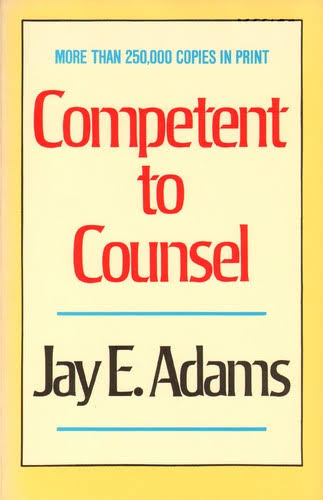
Christianity. In 1970 Adams’ book Competent to Counsel was published, in
which he propounded a counselling method based on confrontation and
rebuke employing Bible passages. The book became enduringly popular and
has been used in theological training; generations of clergy and church
leaders have based their pastoral practice on it. Dozens of other books
followed, but Competent to Counsel is the one for which Adams is best
known. It might be thought that a book published in 1970 would be no
longer relevant, but Adams also founded the National Association of
Nouthetic Counselors (now the Association of Certified Biblical Counselors),
which still trains pastors in Adams’ techniques. It is a global operation,
based on the convictions that ‘God’s Word is sufficient, and that all believers
can be equipped to counsel one another’ (https://biblicalcounseling.com/).
There are a further three organisations based on the same theories and
practice. They offer certification in biblical counselling, but these counsellors
need not have any clinical training or awareness at all. They are not licensed
or certified to offer any kind of psychotherapy, and are not qualified to
diagnose or treat mental illness or trauma.
Adams questioned the very concept of mental illness; alcoholism,
depression, neurosis, psychosis, and homosexuality were all classed as sin.
The people he met in psychiatric hospitals ‘were there because of their
unforgiven and unaltered sinful behavior’. For him the purpose of counselling
was not to help the counsellee attain self-realisation, but to change their
personality. This was achieved by confronting the person with their sin: ‘the
more directive I became…the more people were helped. Spelling out and
getting commitments to biblical patterns of behavior after an
acknowledgement of and repentance for sin seemed to bring relief and
results.’
Larry Crabb, another proponent of ‘biblical counselling’, wrote in the
foreword to a book for sexual abuse survivors that a biblical approach to
counselling
‘must insist that our sinfulness, not how we’ve been sinned against,
is our biggest problem; that forgiveness, not wholeness, is our
greatest need; that repentance, not insight, is the dynamic in all real
change.’
As a sexual abuse survivor I’ve been on the receiving end of this approach
and it definitely did not bring either relief or results. In fact, it increased my
sense of unworthiness and shame and of my distance from God and other
people. Worse, it left me vulnerable to exploitation and abuse from others,
since it was hard to believe I deserved any better.
Rosemary Green, wife of the late Anglican evangelist Michael Green, was a
proponent of what she called ‘prayer counselling’ – nouthetic counselling
combined with ‘inner healing’ and deliverance ministry. In her 1991 book
God’s Catalyst Green describes her technique:
‘It is sometimes good to ask [the client] whether he knows any part
of Scripture he thinks is relevant. More often you will choose it, find
it while he is still talking, and pass the Bible to him…Then ask him
to read it aloud…One day [a client] read aloud some verses I
suggested from Hebrews chapter 12, then promptly slammed the
Bible shut. I asked her to open it again. She refused. I told her that
if she was not willing to see what God might be wanting to say to
her, there was nothing I could do to help her. I then left the room,
telling her she could find me in the kitchen if she wanted.’
The Greens spent years teaching this technique to ordinands and clergy in
the UK and Canada.
What exactly is wrong with this counselling approach?
Firstly, it assumes that the same answer will solve all human problems:
repent of your sin. This is like an A&E doctor treating every patient, no matter
what their injury or illness, by telling them their diet is to blame and ordering
them to change it, without offering further treatment. Or a police detective
telling every crime victim their driving is at fault. Most of us could improve
our diet and most have committed a traffic violation at some time, but that is
not necessarily at the root of our present dilemma. Many charismatic
practitioners, such as Green, will also assume that if the client doesn’t
respond ‘well’, in the counsellor’s terms, they must need deliverance
ministry. This shows a remarkable ignorance of psychological processes,
and is potentially dangerous in the case of people who are traumatised or
mentally unstable.
Second, biblical counselling is wrong because it fails pay attention to the
person who is seeking help. A pastor who has made up his/her mind at the
outset that the root problem must be sin isn’t listening. A counsellor who
riffles through the Bible while their client is still speaking isn’t listening.
Worse, they are making it very clear they aren’t listening. And it is the
listening itself which is healing. When we engage in deep listening to another
person we are making space for them – and that space is where God works
and they can begin to become whole. It is not for nothing that the name
Jesus can be translated ‘the one who makes space for’. Abuse of all kinds
overrides our personal boundaries and stunts the growth of our psyche.
Growth can only be resumed when those boundaries are restored and
maintained, and the person is free to explore who they really are when they
are not being limited or dictated to. A counsellor who imposes their own
choice of scripture on the counsellee, together with its interpretation and
application, is merely compounding the harm done by previous abuses.
Third, biblical counselling removes agency from the client and locates all the
power with the counsellor. I suspect this is a large part of the appeal for
many practitioners; it makes the pastor feel powerful and avoids the
vulnerability of opening up to someone else’s pain and sitting with them in
the darkness. It’s much easier to riffle through your Bible looking for a
favourite passage of your own, than to set your own agenda aside and really
hear someone else’s dilemma or anguish. Listening may raise questions that
challenge the counsellor’s own faith, and it will certainly entail sharing the
burden of the one who has come to us. But sharing each other’s burdens is
exactly what we are called to do: and in doing it we are not only lightening
the burden for them; we are opening ourselves to having our spiritual
horizons widened.
Those who have had their agency curtailed by upbringing, circumstances,
social frameworks, or the actions of others need to have that agency
restored if they are to experience full liberation in Christ. It is the counsellor’s
task to respect the client’s autonomy and dignity and give them real choices,
not to force on them a point of view, a presupposition of sin, or a given Bible
interpretation.
Fourth, ‘biblical’ counselling is not really biblical at all. It is certainly not the
pattern I see in Jesus’ dealings with those who came to him for help or
healing. The most obvious feature of those encounters is that Jesus did not
have one technique which he applied to everyone: each person was an
individual who received individual treatment. Notably, he seldom spoke to
those in need about their sin – he saved that for the wealthy, the powerful,
and those who were confident of their own righteousness. When the
disciples asked about a blind man, ‘Who sinned, this man or his parents, that
he was born blind?,’ Jesus replied, ‘Neither this man nor his parents sinned;
he was born blind so that God’s works might be revealed in him’ (Jn 9:2-3).
Jesus often healed people without mentioning sin or repentance at all;
sometimes he simply told people their sins were forgiven without either he or
they needing to voice what those sins were. Sometimes he asked people
what they wanted of him, or whether they wanted to be healed. Sometimes
he challenged people in order to bring out their faith. But he did not say, ‘You
must admit to your sins before I will heal you.’ He explicitly refused to
condemn the woman caught in adultery, though the gospels do not record
any expression of penitence on her part. I doubt if he would have been so
popular down at the tavern with tax collectors and sinners, if he had insisted
on pressing all those outcasts to admit to their sins.
When Jesus spoke of his purpose on earth he didn’t speak solely in terms of
forgiveness of sin. His mission statement in Lk 4:16-21 does not refer to sin
at all:
‘The Spirit of the Lord is upon me, because he has anointed me
to bring good news to the poor.
He has sent me to proclaim release to the captives
and recovery of sight to the blind,
to let the oppressed go free,
to proclaim the year of the Lord’s favour.’
Significantly, the Hebrew and Greek words translated ‘salvation’ denote
safety, deliverance from danger, and freedom from restriction. Sin is only one
of the things that restrict us. Fear, shame, despair, self-loathing, poor
decision-making, and the actions of others hamper us; these and
psychological limitations such as the inability to set boundaries or trust one’s
own perceptions are properly a part of the work of salvation. They are
therefore the proper work of all pastors – including those not ordained. It’s no
accident that Christian movements of spiritual renewal have so often resulted
in action to right wrongs and further the well-being of others. From ancient
Rome to early medieval Britain, Christians bought slaves in order to set them
free. In the 18th and 19th centuries Christians in Britain and the USA
campaigned against the slave trade; in the 20th and 21st centuries
Christians have worked for racial integration and ecumenical harmony.
Victorian Christians worked for better conditions in factories, the end of child
labour, and prison reform. The list is endless: as sadly is also the list of those
claiming to follow Christ who have worked against all these endeavours to
set people free.
Many of these people mean well, but they have oversimplified the gospel
message. They believe that the main – or even the only – thing that
Christianity has to offer is the forgiveness of sins, and (often) that forgiveness
can only be obtained after a suitable period in sackcloth and ashes. Jesus
did preach the need for repentance (in Greek metanoia). But metanoia means
a change of direction, not necessarily a guilt trip. For the vulnerable and
downtrodden; for those who believe they are unloveable, worthless, or bad,
metanoia involves an acknowledgment that they are made in the image of
God, and there is much in them that is good. For those who are comfortable,
metanoia means bettering the conditions of those in need, and sitting with
the pain of those in darkness. Repentance means curbing our urge to offer
quick and easy solutions, saying there is peace where there is no peace.
Thank you so much for this, Janet. This is one of those posts which sums up – in more depth – something I’ve believed for a long time about “Biblical” counselling/pastoral support techniques.
While I have experienced very direct abuse of power in the church, I’ve found the pastoral and counselling approaches to be at best wanting, at worst re-traumatising. It all seems ultimately modelled on an approach which says, “well, there’s your problem, here’s the answer. Now get on with it.”
And, of course, rooted in a theology that said sin was always at the root of the issue, and my struggle was transformed into my sin. Very penalising.
Anyhow, thank you so much for this post.
I’ve found it subtly debilitating over the years
G K Chesterton said a couple of things which are maybe of interest here:-
1) ‘Take away the supernatural, and what remains is the unnatural.’
2) ‘It is absurd for the Evolutionist to complain that it is unthinkable for an admittedly unthinkable God to make everything out of nothing, and then pretend that it is more thinkable that nothing should turn itself into everything.’
Modern astronomy is possibly a hugely potent apologetics or evangelism tool. But do we hear of read much on this from the contemporary Church?
I have become weary of quite a lot material from charismatic-evangelical groups. I cringe at the mention of ‘New Wine’ after seeing violent student bullying get cynically covered up.
Regular societal wisdom in Western Europe has been steeped in Christian wisdom for a very long time. Health, Law, Education are profoundly impacted in an extremely positive fashion.
But conservative evangelical Anglicanism can have a Jehovah’s Witness-“We have the truth”-fundamentalist dimension which is incredibly ugly, and also very dangerous to victims whom authoritarian bullies seek to harm or eliminate.
That stench from that type of cultism includes disregarding trails of bullying-abuse-harassment. Law gets cast aside. Wider agreed Church rules can get cast aside. Biblical principles of natural justice can get ignored.
‘A word of knowledge’ or ‘word of wisdom’ can see a chain of events set in motion where ordinary church members get maltreated, and all sorts of weird decisions are secretively made by authoritarian bullies in senior leadership.
As a retired GP and hospital medic the article above just sickens me. Conscience-creation and Christ point us to the majesty of a God who wants to heal us.
The evidence for an external ‘superpower’ God is overwhelming: ‘For since the creation of the world God’s invisible qualities—his eternal power and divine nature—have been clearly seen, being understood from what has been made, so that people are without excuse’.
Psychiatrists, psychologists, CBT practitioners, GP’s, social workers, nurses and other NHS (or private health workers) do challenge their clients at times. This is not at all uncommon.
But years of specialist training and practice mean there is a strong degree of caution, care with words and a gentle discussion-suggestion at times, rather than a machine gun attack around personal weaknesses or unresolved and unaddressed traumas.
Autonomy, beneficence, non-maleficence, and justice are the four domains reflected upon in medical ethics. I find crudely hitting people with bible verses hard to reconcile with this.
Thank you Dr James,
I find your care compassion and concern in your posts in this supportive “safe space” always helpful .
Richie
Growing up in an apparently devout Christian home, and being read the bible daily, our Christian faith as derived, was presented to us as a complete way of living.
Poor physical health was acceptable as long as it could be squeezed into the “medical model”. Sore throat? Take an aspirin. Headaches? Take painkillers. We had a vast pharmacy with medications or a linctus for every conceivable condition. Psychological conditions weren’t allowed. Mental illness was verboten.
Of course the body and mind are inextricably linked, but to suggest or even infer that a physical symptom felt in the body, had potentially an origin in the head, was brutally shut down. Conversely I was dispatched by the parent for more and stronger medication for them. So I became a doctor. That way I could continue to medicate others. Such was the variety of life, that if I were to continue in surgery, I could chop bits off people, and make them better that way.
Such upbringing can delay effective help for a person in need. My childhood depression was ignored by me for over 35 years. Thankfully I did find initial help in the psychotherapy services of the NHS and subsequently in my own journey of discovery and change.
Along the lines Janet covers, I’m very wary now of anything involving “biblical” or “Christian” counselling. Even if they “mean well”, some of their teachings make things worse and can be harmful. I’ve been on the receiving end of this, with boundary violations being a pointer to malpractice. I resigned from the prayer ministry team when this was being introduced.
Spotting someone else’s sin and facilitating their feeling guilty for it, is at the heart of some theologies. Next comes control. They control you. Personally I believe this to be antithetical to what Christ wanted for us.
Thanks Steve,
I think Janet has written an incisive and excellent article. What upsets me is that unlike the medical legal and other professional bodies, gross malpractice in Pastoral care is allowed.
I am now retired from formal advocacy for survivors here in Australia but much remains to be done to break the bondage and power and control that faith communities exercise over people in the pews.
Thanks Janet for a magnificent article.
Richie.
Janet, I had never heard of ‘biblical counselling’ until I read this article. Counselling to me has always meant what you describe as metanoia.
I am so very sorry for your past sufferings, especially those exacerbated by insensitive counselling. That includes others similarly afflicted.
All I can say is a heartfelt ‘Oh dear’, which does not really help anything.
Thank you all for your comments.
I should perhaps have said in my article that counselling approaches based on ‘biblical counselling’ are most usually found in evangelical or charismatic churches. They may not be called ‘biblical counselling’ (as in Rosemary Green’s ‘prayer counselling’), and I suspect that many who use the technique, especially in an adapted form, have no idea where the idea came from. They have just been told to do it that way, or seen it done that way, and haven’t questioned it.
I hesitated when I saw the comment “They are not licensed
or certified to offer any kind of psychotherapy, and are not qualified to
diagnose or treat mental illness or trauma”
Because a harsher variant of this approach involves using this “biblical” counselling method as described followed by accusing the receipient of having some mental illness (say: schizophrenia) if they continue to disagree.
This approach where used by evangelical churches has shut people down for years and caused serious incidents not to be reported.
That’s appalling. They aren’t qualified to make any such diagnosis, unless they have received appropriate medical training. Perhaps I should have made it clearer that some Christian ‘counsellors’ are not qualified for the role they occupy and the treatment they offer.
Is there a brutally ugly side to some fundamentalist leaning charismatic-evangelical Anglican groups? I have been watching breaking news stories and online films about hidden scandals within the Jehovah’s Witnesses. Crowds, noise and money coming in is not always a sign of a healthy theology. Can a focus on ‘brand’ and ‘growth’ help raise money, noise and crowds, even if there is limited evidence of healthy spirituality? We live in an interesting time for the Anglican Church, and also for its bishops.
Janet,
Thank you for your comments.
Saying that Jewish and Christian writings all lumped in one cover are the competent sources of knowledge to deal with all human needs and problems is plainly incorrect and how could it be otherwise!
I would wager that those who wrote there own part did not think so either.
So many problems seem to arise just because of wrong thinking what the Scriptures are and how they might be approached, understood and used.
This is a massive and “fundamental” topic but one that just does not seem to be talked about openly.
Why did I never hear as a young “evangelical” over 60 yrs ago that a hermeneutical approach was an honest and respectful way to read and think about the texts ……?
Perhaps plain ignorance…… or fear of what might be found in them?
Paul’s dialogue at the Areopagus makes profound statements about the intelligibility of the universe, and the human capacity to find-or be found-by God. But lots of modern biblical fundamentalism can go off on a multitude of other tangents. I think Isaiah 53 and 55 are fascinating in this context. The reality of divine revelation-and the invitation to seek the divine-is plain, as is the impenetrability of the divine to our finite human minds. The idea of opening a book-and being instantly supremely wise-is alien to what the Bible teaches.
I am reminded of the situation which arises unfortunately frequently in my work as an electrician, uncovering and having to make safe the non compliant and sometimes dangerous work done by those with no knowledge, training, understanding or even willingness to care about the dangers their incompetent work poses for others.
Engineering institutions make it plain to their members, especially those working to Incorporation or Chartership that taking on work for which one is unqualified or outside the scope of ones qualifications and experience is serious professional misconduct.
Uninformed “Tinkering” with another mind can have consequences just uniformed overconfident tinkering with electricity.
This is a valuable analogy Rowan, and as someone who has done electrical work, probably just about within the permitted exemptions, a salutary lesson. I’ve also recently spent a considerable sum having my self-made garden gym, electrified by qualified professionals.
Knowing what you don’t know is at the root of this. The more training and experience I’ve had in the areas where I am qualified, the more I know what I don’t know. And as Rowan says, working in those areas in which one is inexperienced, is either unprofessional conduct or prohibited in some way, or both.
The more we can build consensus around the dangers of unqualified or inexperienced/ amateurish counsel, the better.
NHS ‘clients’ (AKA ‘patients’ in distant aeons) have seen the response to complaints radically transformed. In the 1990’s things seemed to operate ‘in house’, with consultants or GP’s wielding huge power when there were medical mishaps or client grievances.
That radically was altered some considerable time ago. I am retired almost a decade, and the final phase of my career saw written complaints passed to an independent hospital officer. That person ‘required’ ( ‘politely demanded and received’ would be an alternative from of words) a doctor’s response to a client complaint within a fortnight.
But with Church issues is there often an endless delay once any issue is flagged up? Why do we not have someone legally qualified, perhaps covering multiple dioceses, who vets and acts on or triages every complaint, whether it is about an incident with a child-adult-VA? That’s not rocket science!
If our bishops and archbishops were facing a solicitor or barrister overseer, in regard to bungling and cover ups on diocesan bullying-abuse-harassment, would Anglicanism’s dire state on such matters be rapidly fixed? But this is not something our bishops or archbishops want, and therein is the problem in a nutshell.
Does a lack of inquisitive staff, able and eager to pursue bullying and abuse, suit a lot of dioceses rather well? ‘VA and child protection’ fixes up a lot of tick boxes, and draws in the box tickers. But is there rarely someone immediately addressing complaints, who has appetite and capacity to ask the right people the right questions, and to demand an answer?
I will put gratitude on the record for the bit in my own church’s guidance making it very clear to those doing a pastoral role in a congregation that they should not attempt to give any service which should be undertaken by a professional.