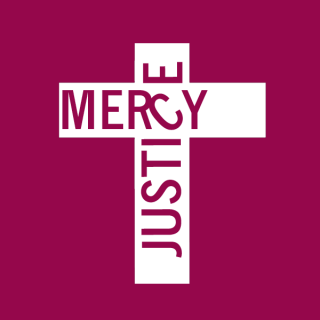
As the priest read the prayer of blessing over the elements on Easter morning, he used the memorable words from Prayer E in Common Worship. Lord … help us to work together for that day when your kingdom comes and justice and mercy will be seen in all the earth. As he read these words, I realised in a flash that the two words, mercy and justice, were precisely what survivors and victims long for, above all, in their dealing with the Church. At the same time, those of us who care passionately for them to receive these things, whether we are believing Christians or not, are able to make a small contribution towards the coming of God’s kingdom.
Let us look at each of these words in turn. Like most words in the Bible, ‘mercy’ has a variety of meanings. Anything that is said will not be complete but we can attempt to sketch out the range of meanings. At its heart the word has the meaning of responding to need. One side, the side showing mercy, is in the position to provide help. Mercy is offered in the form of material support, forgiveness or simply acceptance and love. If we were to describe the main need of an abuse survivor, it would be for another human being to reach out in understanding and care. Psychological wounds and hurts need soothing and binding up. In a Christian context, mercy might be what an entire community could be offering. It might involve offering a place of safety, a sanctuary beyond the hurts of the past abuses. Also, as any reader of Scripture will be aware, mercy is a quality of God himself. He reaches out to us and responds to our state of neediness, whatever form this might take.
The second word also sums up a crucial area of need for a survivor. Justice is not necessarily about punishment and revenge. Justice is needed so that a victim of wrong can see that the world has a moral centre. When things go badly wrong, we all need to know that there are people and institutions who really care that there are such things as rules, consequences and recompenses to be paid. If evil is never confronted and neutralised then it will be allowed to flourish and spread to the detriment of the well-being of all. The existence of justice and right in society really matter. The present betrayal of the values of honesty and fair-dealing in Trump’s America is a serious matter. When one person at the centre sits lightly to the rules of truth and civilised respectful behaviour to others, it affects the whole of society.
My previous blog post was hinting at the way that justice and mercy are not always found in Church structures in a way that would help survivors. After the Archbishop’s interview on Channel 4, it was suggested by ‘Graham’ that there were 14 ‘points of dispute’ in the interview in relation to the Smyth affair. The detail of Graham’s challenge is not here important. It is also not being suggested that the Archbishop was in any way deliberately lying. He was, however, as we suggested earlier, identifying with the narrative that is being put out by his advisers. He is far too busy to check out all these statements for himself, but hopes that the advice he is receiving is accurate and truthful. In a situation where the truths of the past are contested, we are left with a situation where survivors find very little to comfort or encourage them. Whatever else, the institution is providing with this kind of narrative of what happened in the past, mercy is notable by its total absence. Institutional defensiveness, whether justified by the facts or not, does not create a good ambiance for the experiencing of any kind of mercy by survivors. Survivors look for mercy and justice but what they are offered feels to be a long way from this ideal. The hard, defensive exterior shown by the Church in this situation has little in common with the hoped-for values of the kingdom articulated by Common Worship.
Working together for the coming of God’s kingdom is something that Christians everywhere pay lip-service to. It should also be possible for survivors to say to bishops, clergy and church lawyers who face them, that ‘above all we look to you for mercy and justice’. If you want to show that you share these kingdom values, help us first of all to find a place of safety and support. Then help us to know that the world and especially the Christian world is a place with a moral core, where rights are wronged and evil is named and dealt with. We do not recognise that being undermined, receiving threats, put-downs and humiliations are in any way appropriate to our needs as abuse survivors. Neither does this kind of treatment do justice to the meaning of the kingdom of God for which we all supposed to pray and work towards. Mercy and justice must be celebrated by Christians in every context. Above all, we expect to find it in the dealings between church leaders and survivors. When these values of mercy and justice are not respected, one has to ask whether the core values of Christianity are in operation.
We are left with two simple words that contain within them almost everything that needs to be said about the way the powerful should deal with the weak, the damaged and the exploited. Clearly what I have said about the needs of survivors could be applied to any group of needy people. The needs of the world are massive and what the church can do is finite. Somehow, I feel that the church loses its way when the needs of its own interests take precedence over these dictates of mercy and justice. In every relationship between the church and individuals and groups who come for help, the question must be asked. Are the dictates of mercy and justice being given their due place, so as to build the Kingdom of God for which we all long?
A postscript. Lambeth Palace is expected to be holding a meeting organised by the Archbishop’s staff to meet survivors today, the 25th April. The meeting is scheduled for 10 am to last for two hours and is entitled ‘Responding well to Victims of Abuse’. A problem is that one of the supporters of survivors originally invited has been uninvited. He will be turned away if he appears at the gate-house of Lambeth Palace. Whatever else is going on by withdrawing this invitation, this implies at the very least that the organisers appear to be trying to control the outcome of the meeting to suit their own agendas. Holding meetings with a potentially vulnerable group and then banning one of those who speaks for them shows that the two themes I have addressed in this post, mercy and justice, are not top of the Church’s agenda. Is Lambeth Palace showing itself to be a place that works ‘together for that day when your kingdom comes and justice and mercy will be seen in all the earth’?